David Nickerson, 24, rides a wave dressed as Mrs Doubtfire during the 7th annual ZJ Boarding House Haunted Heats Halloween surf contest. (Photo by Lucy Nicholson/Reuters)
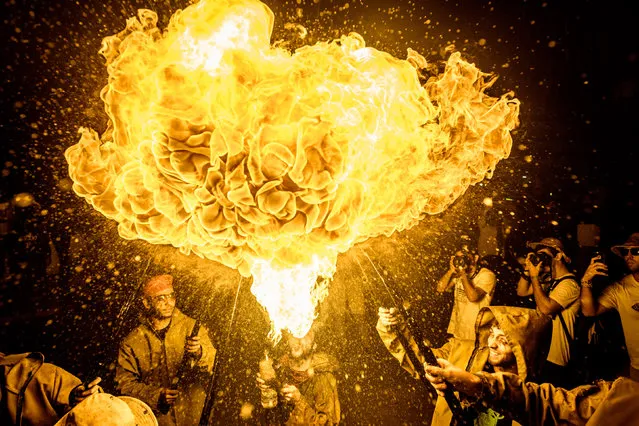
A fire-eater of the “Diables de Terrassa” performs during Sitges' little “Festa Major”, “Santa Tecla” in Sitges, Spain on September 19, 2016. This celebration brings together some of Catalonia’s most emblematic festive traditions. The central axis of the celebrations is the traditional parade, made up of “big-head” carnival figures and characters who dance to music played on different traditional instruments. One of the most popular events is the Correfoc or fire-running, which is also the closing event of the fiesta. The people run and jump over characters dressed up as devils and dragons, carrying fire. (Photo by Matthias Oesterle/ZUMA Press/Splash News)
Nikolai Vasilyev, 64, dressed as Father Frost, the Russian equivalent of Santa Claus, water-skis along the Yenisei River outside the Siberian city of Krasnoyarsk, Russia December 19, 2017. Vasilyev, former teacher of the Siberian State Aerospace University, constructed the water skis out of plastic foam and designed the sticks to propel him forward, while travelling on the water surface. (Photo by Ilya Naymushin/Reuters)
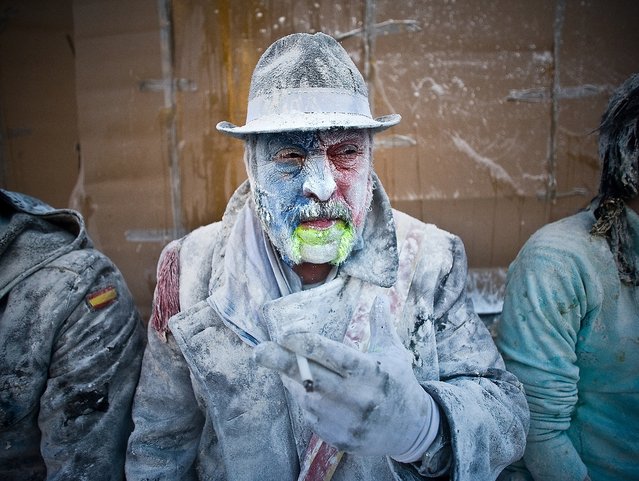
It’s a classic tale of dictatorship gone wrong and the fight for freedom. Like in any good battle, there’s fire, albeit from firecrackers, but the ammunition in this one is – flour. It takes place in a Hemingway-esque Spanish village. The battle of “Enfarinats” in celebration of the Els Enfarinats festival, rages on on December 28, 2012 in Ibi, Spain. Citizens of Ibi annually celebrate the festival with a fight using flour, eggs and firecrackers. The battle takes place between two groups, a group of married men called “Els Enfarinats” who take the control of the village for one day pronouncing a number of ridiculous laws and fining the citizens that infringe them and a group called “La Oposicio” who try to restore order. At the end of the day the money collected from the fines is donated to charitable causes in the village. The festival has been celebrated since 1981 after the town of Ibi recovered the tradition but the origins remain unknown.
Photo: A Reveller smokes during the battle of “Enfarinats”, a flour fight in celebration of the Els Enfarinats festival. (Photo by David Ramos)
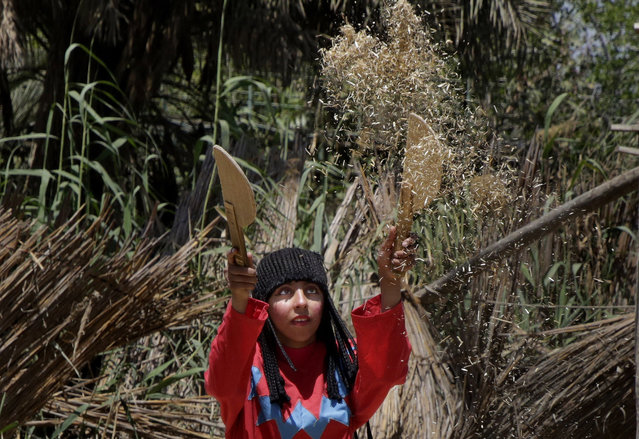
An Egyptian actress working at the Pharaonic Village simulates ancient agriculture scenes during a show marking Sham el-Nessim, or “smelling the breeze”, in Giza, Egypt, Monday, April 13, 2015. The holiday signifies the arrival of Spring, a uniquely Egyptian tradition practiced since the days of the Pharaohs. (Photo by Amr Nabil/AP Photo)
A Zimbabwean subsistence farmer holds a stunted maize cob in his field outside Harare, January 20, 2016. About 14 million people face hunger in Southern Africa because of a drought that has been exacerbated by an El Nino weather pattern, the United Nations World Food Programme (WFP) said on Monday. In Zimbabwe, 1.5 million people, more than 10 percent of the population, face hunger, WFP said. (Photo by Philimon Bulawayo/Reuters)
Pope Benedict XVI arrives at the Santa Sabina Basilica for the Ash Wednesday service on March 9, 2011 in Rome, Italy. Ash Wednesday opens the liturgical 40-day period of Lent, a period of prayer, fasting, penitence and alms giving leading up to Easter.
Students of the "Escola de Papai Noel do Brasil" (Brazil's school of Santa Claus) travel on a ferry through Guanabara bay, during their graduation ceremony in Rio de Janeiro, Brazil, November 10, 2015. The school holds 4 days' lessons in Santa-training, teaching Christmas carols, how to interact with children, and also how to wear the heavy red suit in Rio's typical 104-degree (40 degrees celsius) summer weather that is common around the holidays. (Photo by Pilar Olivares/Reuters)