Loading...
Done
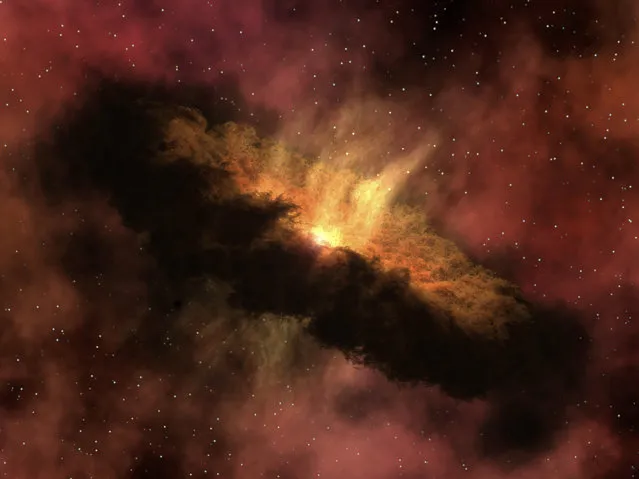
A fledgling solar system containing deep within it enough water vapor to fill all the oceans on Earth five times, located in our Milky Way galaxy about 1,000 light years from Earth in the constellation Perseus. (Photo by Reuters/NASA/JPL-Caltech)

A fledgling solar system containing deep within it enough water vapor to fill all the oceans on Earth five times, located in our Milky Way galaxy about 1,000 light years from Earth in the constellation Perseus. (Photo by Reuters/NASA/JPL-Caltech)
Details
28 Sep 2016 11:01:00
Children eat watermelons to meet the “beginning of autumn” at a kindergarten in Handan, China on August 7, 2015. Chinese tradition to eat watermelons or peaches before that day symbolises “biting away summer”. The solar term ‘beginning of autumn’ falls on 8 August this year. (Photo by Xinhua/REX Shutterstock)

Children eat watermelons to meet the “beginning of autumn” at a kindergarten in Handan, China on August 7, 2015. Chinese tradition to eat watermelons or peaches before that day symbolises “biting away summer”. The solar term ‘beginning of autumn’ falls on 8 August this year. (Photo by Xinhua/REX Shutterstock)
Details
11 Aug 2015 14:29:00
Refuge Gervasutti

New Refuge Gervasutti, the survival unit was designed by Italian architects LEAPfactory, who specialise in modular accommodation for extreme environments.’ This is a solar powered tubular mountain cabin installed on Mt.Blanc with the use of helicopters.
Details
28 Oct 2012 09:03:00
A disabled child is buried up to his neck in sand during the partial solar eclipse in belief its rays can heal, in Karachi, Pakistan, 25 October 202. A partial solar eclipse occurs when a portion of the Earth is engulfed by the shadow (penumbra) cast by the Moon as it passes between our planet and the Sun in imperfect alignment. During this eclipse - the first of the decade – the Moon appears to cover the Sun, leaving the Sun's halo as a visible rim forming an annulus, popularly known as the 'ring of fire. (Photo by Shahzaib Akber/EPA/EFE/Rex Features/Shutterstock)

A disabled child is buried up to his neck in sand during the partial solar eclipse in belief its rays can heal, in Karachi, Pakistan, 25 October 202. A partial solar eclipse occurs when a portion of the Earth is engulfed by the shadow (penumbra) cast by the Moon as it passes between our planet and the Sun in imperfect alignment. During this eclipse - the first of the decade – the Moon appears to cover the Sun, leaving the Sun's halo as a visible rim forming an annulus, popularly known as the 'ring of fire. (Photo by Shahzaib Akber/EPA/EFE/Rex Features/Shutterstock)
Details
09 Nov 2022 05:24:00
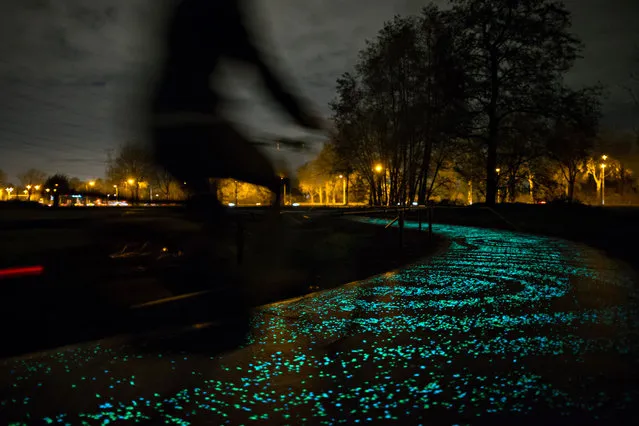
Dutch artist Daan Roosegaarde paid homage to Vincent Van Gogh's famous “Starry Night” painting by creating a glowing bike path relying on solar-powered LED lights. The 650-yard route  which opened November 12, 2014 extends between Eindhoven and Neunen, Netherlands, where Van Gogh spent part of his life. Its the first event marking the 125th anniversary of Van Gogh's death July 29, 2015. (Photo by Pim Hendriksen/Studio Roosegaarde)

Dutch artist Daan Roosegaarde paid homage to Vincent Van Gogh's famous “Starry Night” painting by creating a glowing bike path relying on solar-powered LED lights. The 650-yard route which opened November 12, 2014 extends between Eindhoven and Neunen, Netherlands, where Van Gogh spent part of his life. Its the first event marking the 125th anniversary of Van Gogh's death July 29, 2015. (Photo by Pim Hendriksen/Studio Roosegaarde)
Details
23 Nov 2014 13:31:00
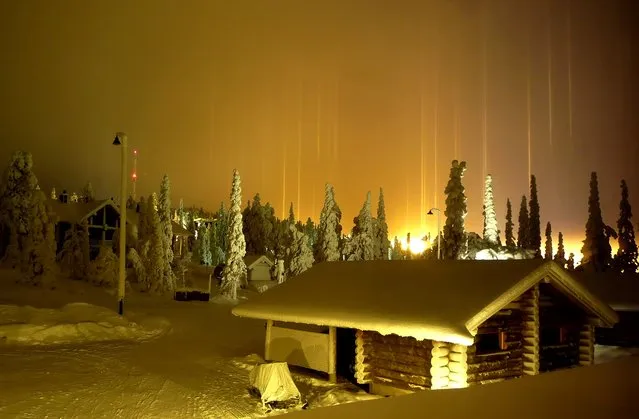
Mysterious Light Pillar

A light pillar is a visual phenomenon created by the reflection of light from ice crystals with near horizontal parallel planar surfaces. The light can come from the Sun (usually at or low to the horizon) in which case the phenomenon is called a sun pillar or solar pillar. It can also come from the Moon or from terrestrial sources such as streetlights.
Details
03 May 2014 15:17:00


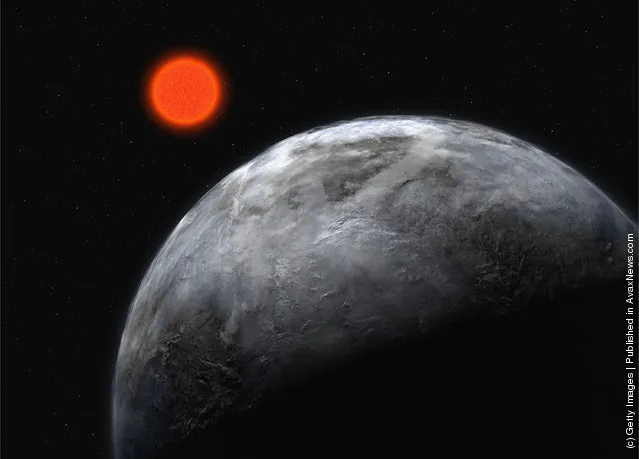
In this artist's impression supplied by the ESO (European Southern Observatory) on April 25, 2007, the planetary system around the red dwarf, Gliese 581, is pictured showing what astronomers believe is the most earth like planet found outside our solar system to date. Using the ESO 3.6-m telescope in Chile, astronomers have uncovered the planet which could have water running on its surface. The planet orbits the faint star Gliese 581, which is 20.5 light-years away in the constellation Libra. (Photo by ESO via Getty Images)
Details
12 Apr 2011 11:00:00
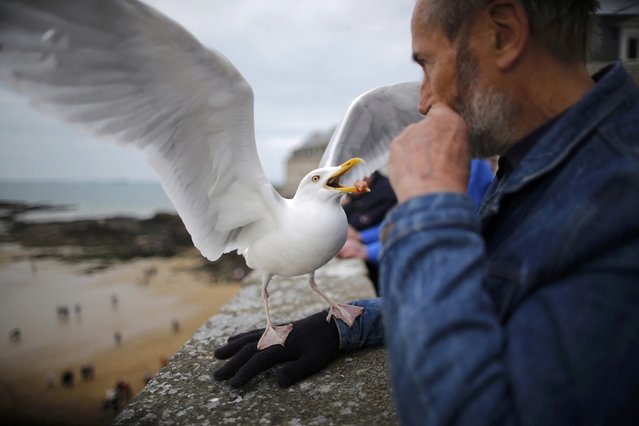
A man feeds a seagull during a record low tide in Saint Malo, western France, March 21, 2015. (Photo by Stephane Mahe/Reuters)

A man feeds a seagull during a record low tide in Saint Malo, western France, March 21, 2015. Towns on France's North Atlantic coast braced for their first giant tide of the millennium on Saturday as the full moon and this week's solar eclipse combined to create an ocean surge not seen since 1997. (Photo by Stephane Mahe/Reuters)
Details
22 Mar 2015 10:37:00