Loading...
Done
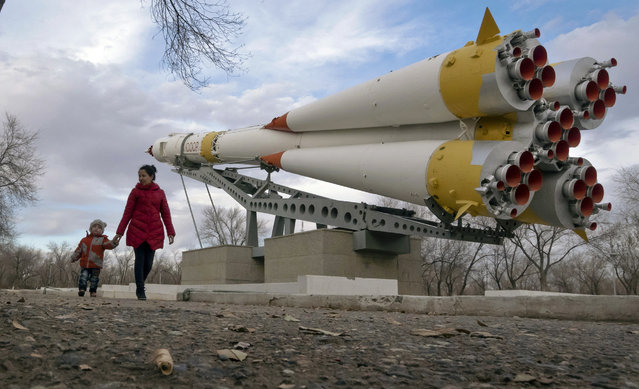
A woman walks with her child past a Soyuz rocket, installed as a monument at the Russian leased Baikonur cosmodrome, the world's first and largest operational space launch facility, in Baikonur, Kazakhstan, Saturday, November 12, 2016. The new Soyuz mission to the International Space Station (ISS) is scheduled for Friday, Nov. 18. (Photo by Dmitri Lovetsky/AP Photo)

A woman walks with her child past a Soyuz rocket, installed as a monument at the Russian leased Baikonur cosmodrome, the world's first and largest operational space launch facility, in Baikonur, Kazakhstan, Saturday, November 12, 2016. The new Soyuz mission to the International Space Station (ISS) is scheduled for Friday, Nov. 18. (Photo by Dmitri Lovetsky/AP Photo)
Details
08 Feb 2017 00:03:00
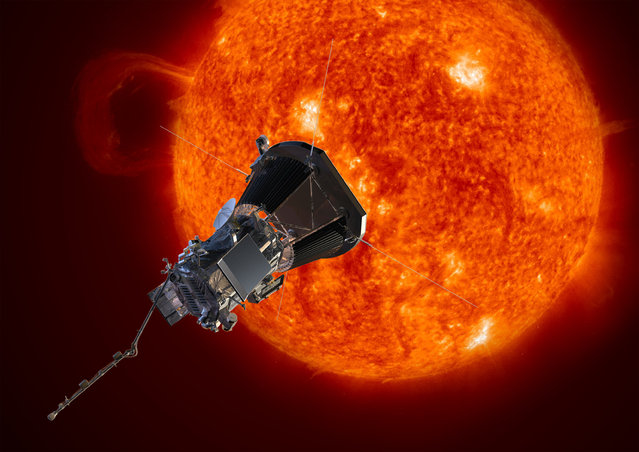
This image made available by the Johns Hopkins University Applied Physics Laboratory on Wednesday, May 31, 2017 depicts NASA's Solar Probe Plus spacecraft approaching the sun. On Wednesday, NASA announced it will launch the probe in summer 2018 to explore the solar atmosphere. It will be subjected to brutal heat and radiation like no other man-made structure before. (Photo by Johns Hopkins University Applied Physics Laboratory via AP Photo)

This image made available by the Johns Hopkins University Applied Physics Laboratory on Wednesday, May 31, 2017 depicts NASA's Solar Probe Plus spacecraft approaching the sun. On Wednesday, NASA announced it will launch the probe in summer 2018 to explore the solar atmosphere. It will be subjected to brutal heat and radiation like no other man-made structure before. (Photo by Johns Hopkins University Applied Physics Laboratory via AP Photo)
Details
08 Sep 2017 09:42:00
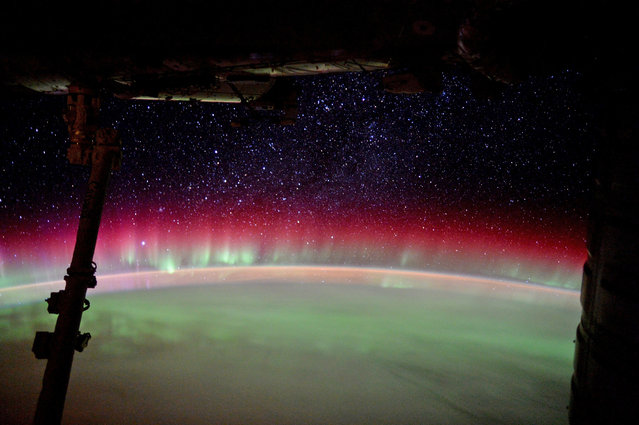
ESA astronaut Tim Peake posted this stunning image on his social media channels, commenting: “Station passed through magnificent aurora Australis last night”. Tim is set to return to Earth on 18 June 2016, bringing his six-month Principia mission to the ISS to an end. During his stay he performed more than 30 scientific experiments for ESA and taking part in numerous others from ESA's international partners. ESA and the UK Space Agency have partnered to develop many exciting educational activities around the Principia mission, aimed at sparking the interest of young children in science and space. (Photo by Tim Peake/ESA/NASA)

ESA astronaut Tim Peake posted this stunning image on his social media channels, commenting: “Station passed through magnificent aurora Australis last night”. Tim is set to return to Earth on 18 June 2016, bringing his six-month Principia mission to the ISS to an end. During his stay he performed more than 30 scientific experiments for ESA and taking part in numerous others from ESA's international partners. ESA and the UK Space Agency have partnered to develop many exciting educational activities around the Principia mission, aimed at sparking the interest of young children in science and space. (Photo by Tim Peake/ESA/NASA)
Details
31 Dec 2016 10:21:00
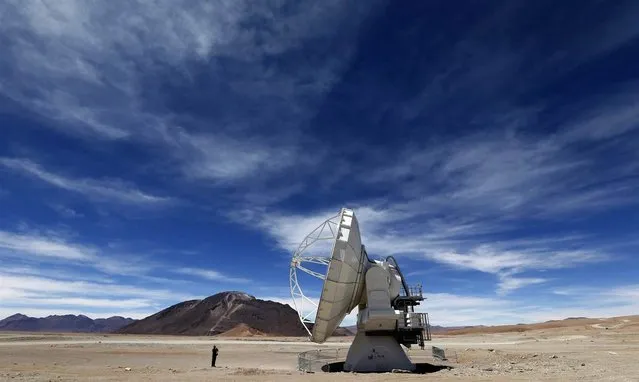
A man takes a photo of a radio antenna that's part of the Atacama Large Milimeter Array Observatory on March 12, 2013 at Llano de Chajnantor, about 43 miles (70 kilometers) from San Pedro de Atacama, Chile. The $1.5 billion ALMA facility, which had its official inauguration on March 13, is considered the world's most expensive ground-based observatory. (Photo by Felipe Trueba/EPA)

A man takes a photo of a radio antenna that's part of the Atacama Large Milimeter Array Observatory on March 12, 2013 at Llano de Chajnantor, about 43 miles (70 kilometers) from San Pedro de Atacama, Chile. The $1.5 billion ALMA facility, which had its official inauguration on March 13, is considered the world's most expensive ground-based observatory. (Photo by Felipe Trueba/EPA)
Details
03 Apr 2013 09:25:00
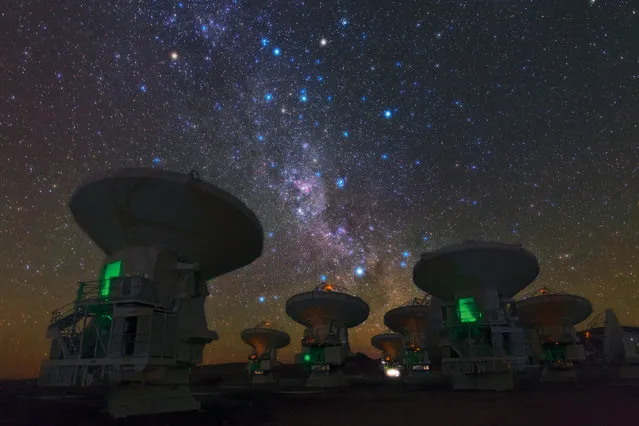
The antennas of the European Southern Observatory's Atacama Large Millimeter/Submillimeter Array, also known as ALMA, are set against the splendor of the Milky Way in this picture by Babak Tafreshi

The antennas of the European Southern Observatory's Atacama Large Millimeter/Submillimeter Array, also known as ALMA, are set against the splendor of the Milky Way in this picture by Babak Tafreshi. Construction of the full ALMA array is due to be completed in Chile's Atacama Desert in 2013, but the facility is already making scientific observations with a partial array of antennas. (Photo by ESO/B. Tafreshi/TWAN)
Details
03 Jun 2012 11:57:00
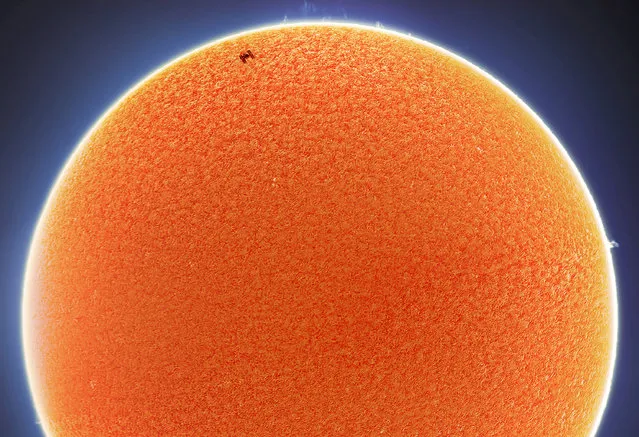
The International Space Station (ISS) moving in front of the sun in November 2020 by astrophotographer Andrew McCarthy. These incredible photos capture the clearest images ever taken of the International Space Station (ISS) moving in front of both the moon and the sun. The photos, taken within days of one another, were captured in the space of less than a second, as the space station could be clearly seen zooming across against the bright backdrops of both moon and sun. Photographer Andrew McCarthy, from California, USA, said the photo of the ISS in front of the sun, in broad daylight, was “one of my trickiest shots ever”. (Photo by Andrew McCarthy/South West News Service)

The International Space Station (ISS) moving in front of the sun in November 2020 by astrophotographer Andrew McCarthy. These incredible photos capture the clearest images ever taken of the International Space Station (ISS) moving in front of both the moon and the sun. The photos, taken within days of one another, were captured in the space of less than a second, as the space station could be clearly seen zooming across against the bright backdrops of both moon and sun. Photographer Andrew McCarthy, from California, USA, said the photo of the ISS in front of the sun, in broad daylight, was “one of my trickiest shots ever”. (Photo by Andrew McCarthy/South West News Service)
Details
28 Nov 2020 00:05:00
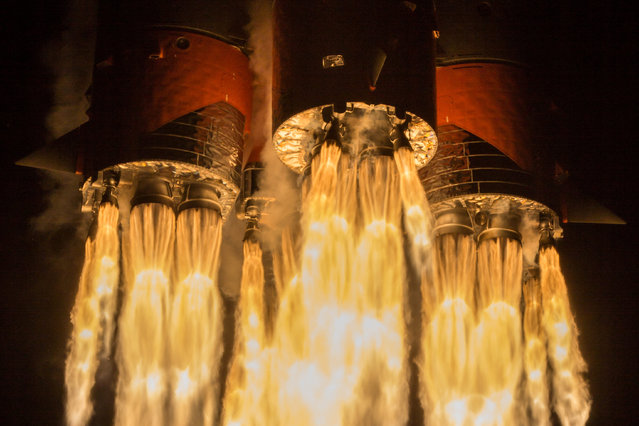
A handout photo made available by the Roscosmos State Corporation for Space Activities shows the Soyuz-2.1b launch vehicle with the OneWeb communication satellites launching from the Baikonur Cosmodrome, Kazakhstan, 07 February 2020. Thirty-four satellites from OneWeb were successfully put into orbit on a single Soyuz rocket from Baikonur. (Photo by Roscosmos/EPA/EFE)

A handout photo made available by the Roscosmos State Corporation for Space Activities shows the Soyuz-2.1b launch vehicle with the OneWeb communication satellites launching from the Baikonur Cosmodrome, Kazakhstan, 07 February 2020. Thirty-four satellites from OneWeb were successfully put into orbit on a single Soyuz rocket from Baikonur. (Photo by Roscosmos/EPA/EFE)
Details
13 Apr 2020 00:03:00
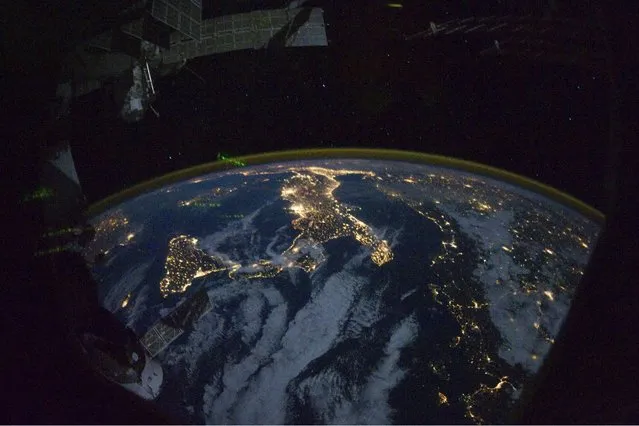
This image provided by NASA shows parts of Europe and Africa very easily recognizable in this night time image shot by one of the Expedition 25 crew members aboard the International Space Station flying 220 miles above Earth on Thursday Oct. 28, 2010. The view “looks” northward over Sicily and the “boot” of Italy, with the Mediterranean Sea representing most of the visible water in the view and the Adriatic Sea to the right of center. Tunisia is partially visible at left. Part of a docked Russian spacecraft and other components of the ISS are in the foreground. (Photo by AP photo/NASA)

This image provided by NASA shows parts of Europe and Africa very easily recognizable in this night time image shot by one of the Expedition 25 crew members aboard the International Space Station flying 220 miles above Earth on Thursday October 28, 2010. The view “looks” northward over Sicily and the “boot” of Italy, with the Mediterranean Sea representing most of the visible water in the view and the Adriatic Sea to the right of center. Tunisia is partially visible at left. Part of a docked Russian spacecraft and other components of the ISS are in the foreground. (Photo by AP Photo/NASA)
Details
11 May 2013 12:29:00