Loading...
Done
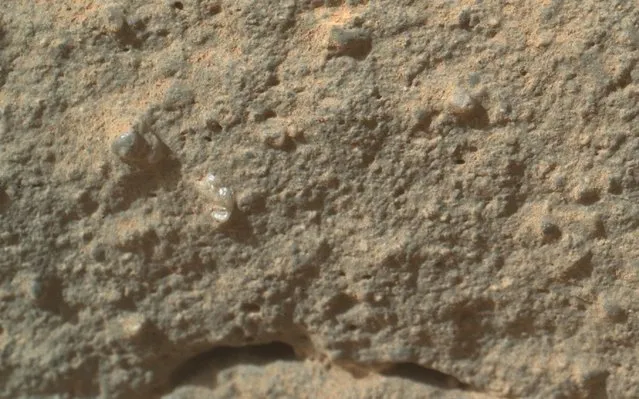
Scientists say that a “Martian flower”, seen here in an image from the Curiosity rover's Mars Hand Lens Imager, is a 2-millimeter-wide grain or pebble that's embedded in the surrounding rock. Another, darker-colored mineral grain can be seen above and to the left. (Photo by NASA)

“The scientists behind NASA's $2.5 billion Curiosity rover mission on Mars on Tuesday explained the nature of a tiny, gleaming "flower" embedded in Red Planet rock, and revealed where they'll be using the SUV-sized robot's drill for the first time”. – Alan Boyle via NBCNews.com

Photo: Scientists say that a “Martian flower”, seen here in an image from the Curiosity rover's Mars Hand Lens Imager, is a 2-millimeter-wide grain or pebble that's embedded in the surrounding rock. Another, darker-colored mineral grain can be seen above and to the left. (Photo by NASA)
Details
16 Jan 2013 11:12:00


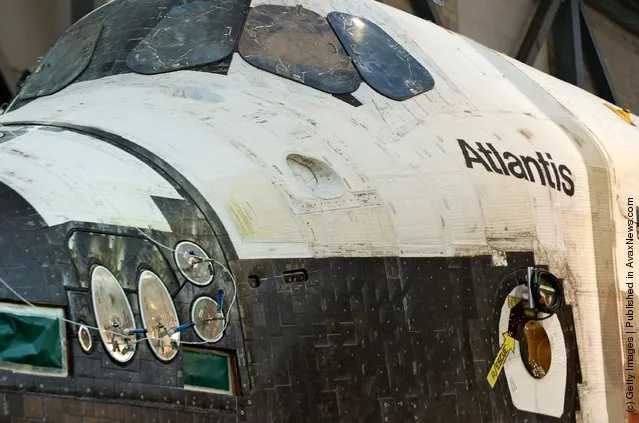
NASA space shuttle Atlantis is prepared on the Vehicle Assembly Building floor at the Kennedy Space Center May 18, 2011 in Cape Canaveral, Florida. The space shuttle program ends with Atlantis mission STS-135 scheduled for early July. Space shuttle Atlantis will carry the Raffaello multipurpose logistics module to deliver supplies, logistics and spare parts to the International Space Station. Atlantis also will fly a system to investigate the potential for robotically refueling existing spacecraft and return a failed ammonia pump module. (Photo by Roberto Gonzalez/Getty Images)
Details
19 May 2011 07:20:00
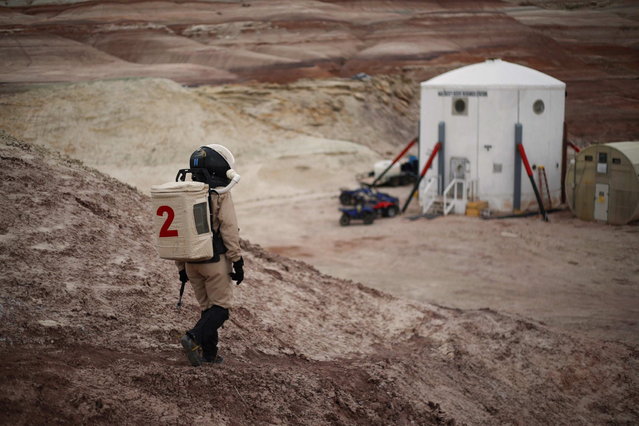
Csilla Orgel, a geologist of Crew 125 EuroMoonMars B mission, makes her way back to the Mars Desert Research Station (MDRS) in the Utah desert March 3, 2013. (Photo by Jim Urquhart/Reuters)

NASA says it could be another 20 years before humans touch down on Mars, but in a sense, the Mars Society has been exploring the red planet for more than a decade – in Utah. Photo: Csilla Orgel, a geologist of Crew 125 EuroMoonMars B mission, makes her way back to the Mars Desert Research Station (MDRS) in the Utah desert March 3, 2013. The MDRS aims to investigate the feasibility of a human exploration of Mars and uses the Utah desert's Mars-like terrain to simulate working conditions on the red planet. Scientists, students and enthusiasts work together developing field tactics and studying the terrain. All outdoor exploration is done wearing simulated spacesuits and carrying air supply packs and crews live together in a small communication base with limited amounts of electricity, food, oxygen and water. Everything needed to survive must be produced, fixed and replaced on site. (Photo by Jim Urquhart/Reuters)
Details
14 Mar 2013 12:11:00
An employe of Russian Space Training Center hangs out to dry space suits of Russian cosmonaut Anatoly Ivanishin, NASA's U.S. flight engineer Kathleen Rubins, and Japanese space agency's flight engineer Takuya Onishi, right, after their undergoing  training near in Noginsk, 60 km (38 miles) east of Moscow, Russia, Wednesday, July 2, 2014. (Photo by Alexander Zemlianichenko/AP Photo)

An employe of Russian Space Training Center hangs out to dry space suits of Russian cosmonaut Anatoly Ivanishin, NASA's U.S. flight engineer Kathleen Rubins, and Japanese space agency's flight engineer Takuya Onishi, right, after their undergoing training near in Noginsk, 60 km (38 miles) east of Moscow, Russia, Wednesday, July 2, 2014. The training was intended to simulate the capsule landing on water. Russian cosmonaut Anatoly Ivanishin, Japanese space agency's flight engineer Takuya Onishi, and NASA's U.S. flight engineer Kathleen Rubins are being trained for a future mission to the International Space Station. (Photo by Alexander Zemlianichenko/AP Photo)
Details
05 Jul 2014 11:47:00
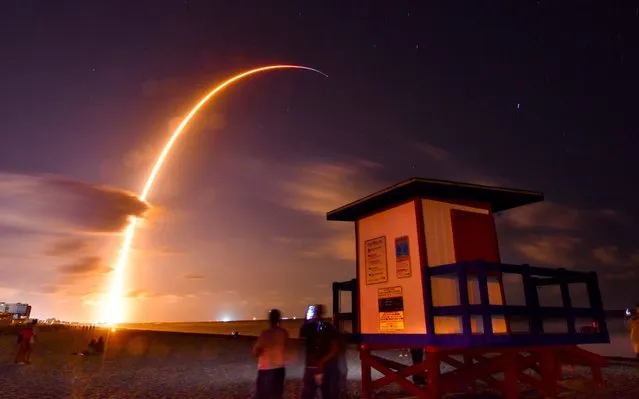
A Falcon 9 SpaceX rocket, with a payload of 60 satellites for SpaceX's Starlink broadband network, lifts off from Space Launch Complex 40 during a time exposure at the Cape Canaveral Air Force Station in Cape Canaveral, Fla., Thursday, May 23, 2019. (Photo by Malcolm Denemark/Florida Today via AP Photo)

A Falcon 9 SpaceX rocket, with a payload of 60 satellites for SpaceX's Starlink broadband network, lifts off from Space Launch Complex 40 during a time exposure at the Cape Canaveral Air Force Station in Cape Canaveral, Fla., Thursday, May 23, 2019. (Photo by Malcolm Denemark/Florida Today via AP Photo)
Details
26 May 2019 00:07:00
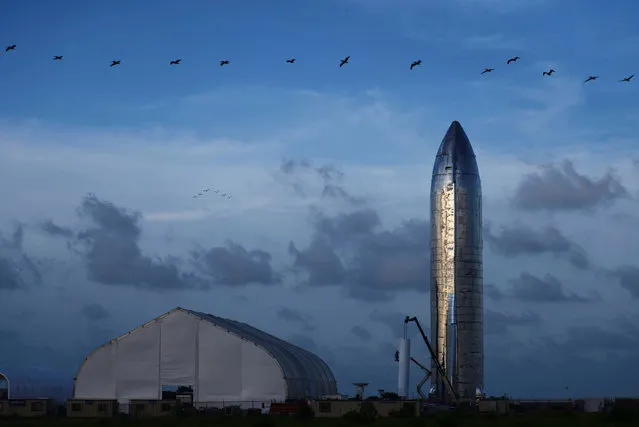
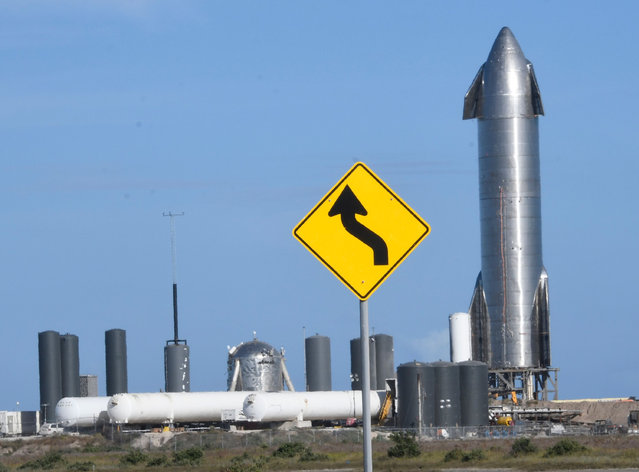
A prototype of SpaceX's Starship spacecraft is seen before SpaceX's Elon Musk gives an update on the company's Mars rocket Starship in Boca Chica, Texas U.S. September 28, 2019. (Photo by Callaghan O'Hare/Reuters)

A prototype of the Space Exploration Technologies Corp. (SpaceX) Starship launch vehicle stands during an event at the SpaceX launch facility in Cameron County, Texas, U.S., on Saturday, September 28, 2019. Elon Musk gave space fans an update Saturday evening on the status of “Starship”, the next-generation vehicle his SpaceX plans to use to eventually take humans to Mars. (Photo by Callaghan O'Hare/Reuters)
Details
30 Sep 2019 00:07:00
SpaceX crews prep the Starship SN8 for its second test engine firing in Boca Chica, TX. on Wednesday, November 11, 2020. SpaceX will try Thursday with 2 engines to be the first ever static fire test to use the LOX header tank. (Photo by Gene Blevins/ZUMA Wire/Rex Features/Shutterstock)

SpaceX crews prep the Starship SN8 for its second test engine firing in Boca Chica, TX. on Wednesday, November 11, 2020. SpaceX will try Thursday with 2 engines to be the first ever static fire test to use the LOX header tank. (Photo by Gene Blevins/ZUMA Wire/Rex Features/Shutterstock)
Details
16 Nov 2020 00:01:00
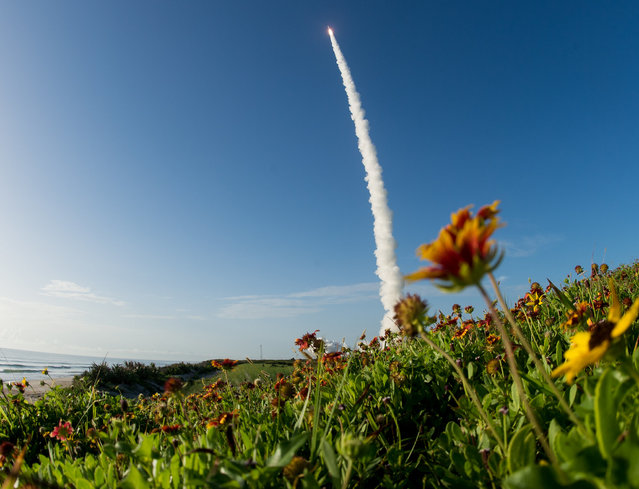
This NASA photo shows a United Launch Alliance Atlas V rocket with NASA’s Mars 2020 Perseverance rover onboard as it launches from Space Launch Complex 41 at Cape Canaveral Air Force Station, on July 30, 2020, from NASA’s Kennedy Space Center in Florida. The Perseverance rover is part of NASA’s Mars Exploration Program, a long-term effort of robotic exploration of the Red Planet. (Photo by Joel Kowsky/NASA)

This NASA photo shows a United Launch Alliance Atlas V rocket with NASA’s Mars 2020 Perseverance rover onboard as it launches from Space Launch Complex 41 at Cape Canaveral Air Force Station, on July 30, 2020, from NASA’s Kennedy Space Center in Florida. The Perseverance rover is part of NASA’s Mars Exploration Program, a long-term effort of robotic exploration of the Red Planet. (Photo by Joel Kowsky/NASA)
Details
05 Aug 2020 00:01:00