Loading...
Done
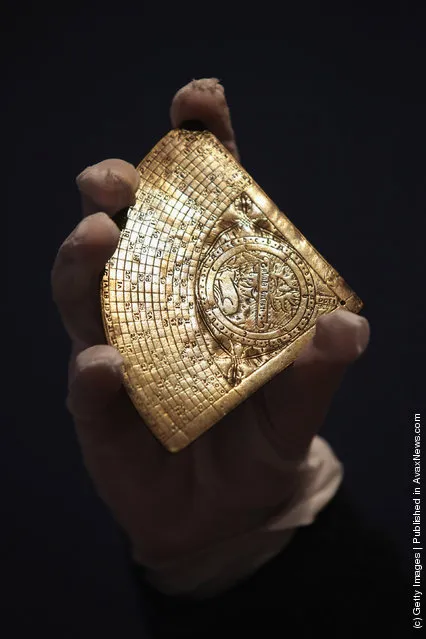
A rare 14th century time-telling device device in Bonhams auction house

A gallery assistant holds a rare 14th century time-telling device device in Bonhams auction house on December 9, 2011 in London, England. The instrument, which dates from 1396 and was discovered in a shed in Queensland, Australia, is due to be auctioned on December 13, 2011 and is expected to fetch 200,000 GBP. (Photo by Oli Scarff/Getty Images)
Details
10 Dec 2011 09:44:00
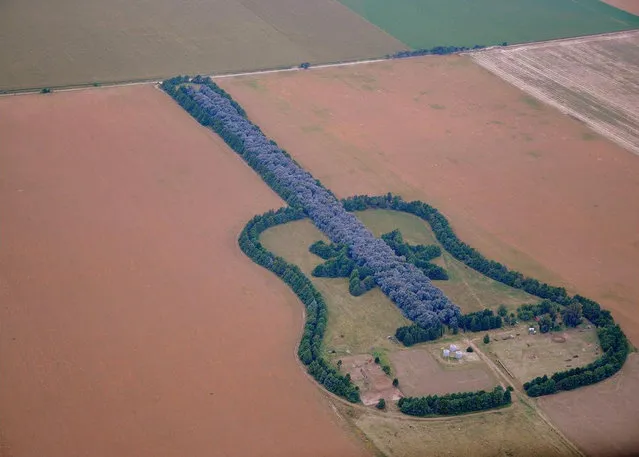
Guitar-Shaped Forest In Argentina By Pedro Martin Ureta

In the remote Argentine Pampas you can find an incredible forest formed in the shape of a guitar. More than 35 years ago, Pedro Ureta unexpectedly lost his wife to a brain aneurysm. Devastated by the loss of his love, he decided to create a shrine to her memory in their field that could only be seen above-head from an airplane. Ureta chose a guitar because it was his late wife’s most loved instrument.

Details
16 Oct 2014 20:32:00
A native Brazilian competes in a tora competition, which is a race while carrying a log, during the Indigenous Youth Games of Pataxos nation in Santa Cruz de Cabralia, Bahia state, Brazil, April 18, 2016. (Photo by Roosevelt Cassio/Reuters)

A native Brazilian competes in a tora competition, which is a race while carrying a log, during the Indigenous Youth Games of Pataxos nation in Santa Cruz de Cabralia, Bahia state, Brazil, April 18, 2016. (Photo by Roosevelt Cassio/Reuters)
Details
20 Apr 2016 12:24:00
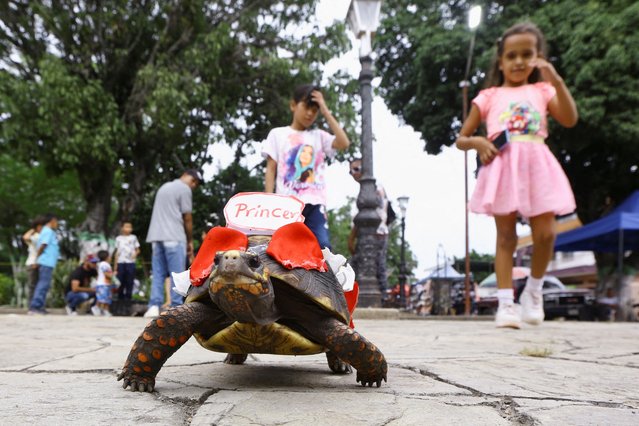
Children walk behind their Morrocoye, a terrestrial tortoise native to South America, before a tortoise race held to celebrate the upcoming feast day of Saint Francis of Assisi, the patron saint of animals, in the town of San Francisco de Asis, Venezuela, on October 3, 2025. (Photo by /Juan Carlos Hernandez/Reuters)

Children walk behind their Morrocoye, a terrestrial tortoise native to South America, before a tortoise race held to celebrate the upcoming feast day of Saint Francis of Assisi, the patron saint of animals, in the town of San Francisco de Asis, Venezuela, on October 3, 2025. (Photo by /Juan Carlos Hernandez/Reuters)
Details
18 Oct 2025 04:07:00
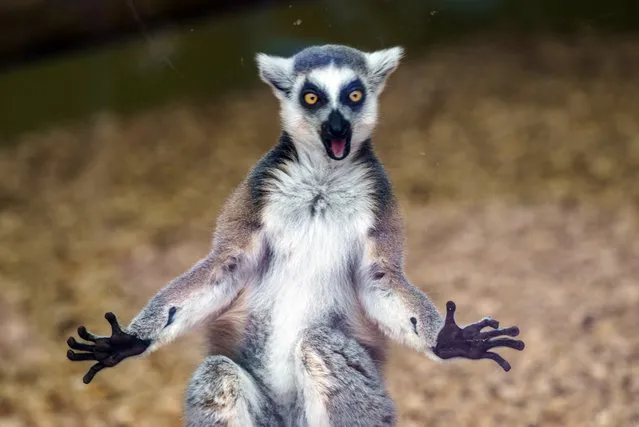
A calico sits in its enclosure and suns itself in Hessen, Germany on May 28, 2021. The Opel Zoo presents a walk-in Madagascar aviary for caltas and varis. The primate species is native to Madagascar and is threatened with extinction. (Photo by Andreas Arnold/dpa)

A calico sits in its enclosure and suns itself in Hessen, Germany on May 28, 2021. The Opel Zoo presents a walk-in Madagascar aviary for caltas and varis. The primate species is native to Madagascar and is threatened with extinction. (Photo by Andreas Arnold/dpa)
Details
30 May 2021 09:19:00
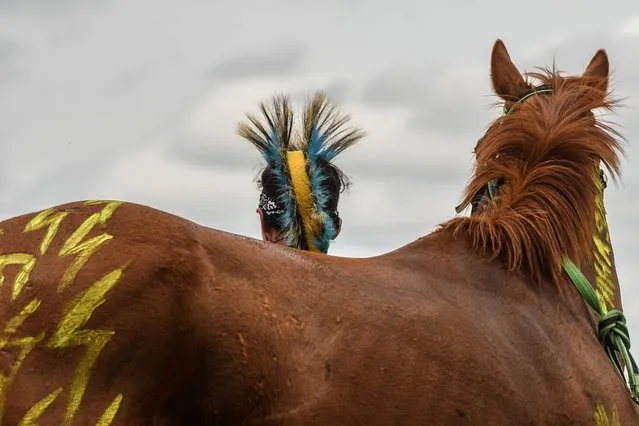
Kaden Bringsplenty brings his horse to the starting line as Native Americans from all over the United States participate in an Indian relay race over Memorial Day weekend at the Osage County Fairgrounds in Pawhuska, Oklahoma, U.S. May 30, 2021. (Photo by Stephanie Keith/Reuters)

Kaden Bringsplenty brings his horse to the starting line as Native Americans from all over the United States participate in an Indian relay race over Memorial Day weekend at the Osage County Fairgrounds in Pawhuska, Oklahoma, U.S. May 30, 2021. (Photo by Stephanie Keith/Reuters)
Details
08 Jun 2021 09:14:00
Giant's Causeway

Legend has it that the Irish warrior Fionn mac Cumhaill (Finn McCool) built the causeway to walk to Scotland to fight his Scottish counterpart Benandonner. One version of the legend tells that Fionn fell asleep before he got to Scotland. When he did not arrive, the much larger Benandonner crossed the bridge looking for him. To protect Fionn, his wife Oonagh laid a blanket over him so he could pretend that he was actually their baby son. In a variation, Fionn fled after seeing Benandonner's great bulk, and asked his wife to disguise him as the baby. In both versions, when Benandonner saw the size of the 'infant', he assumed the alleged father, Fionn, must be gigantic indeed. Therefore, Benandonner fled home in terror, ripping up the Causeway in case he was followed by Fionn.
Details
11 May 2015 10:45:00
A picture made available on 07 March 2016 shows visitors petting and holding a Fennec fox, native to the Sahara, in the petting room at the Little Zoo Cafe, a business built to capitalize on Thais' love for exotic animals, and food, on the outskirts of Bangkok, Thailand, 05 March 2016. (Photo by Barbara Walton/EPA)

A picture made available on 07 March 2016 shows visitors petting and holding a Fennec fox, native to the Sahara, in the petting room at the Little Zoo Cafe, a business built to capitalize on Thais' love for exotic animals, and food, on the outskirts of Bangkok, Thailand, 05 March 2016. The cafe boasts Fennec foxes, Meerkat, native to parts of Africa, Silver Fox, Raccoon and Chinchillas, along with a menu of Thai food and Cheesecake, among other sweet deserts. Nature is a faraway fantasy in the bustling exhaust-filled cement city of Bangkok, fuelling a demand to own and be close to exotic pets. The trend to be near to a species that was once wild, in a city environment, far from the natural setting, has drawn criticism but continues to grow. (Photo by Barbara Walton/EPA)
Details
13 Mar 2016 09:38:00