Loading...
Done
Participants perform parade in the street during Grebeg Sudiro festival on January 19, 2020 in Solo City, Central Java, Indonesia. Grebeg Sudiro festival is held as a prelude to the Chinese New Year, which falls on January 25th this year, welcoming the Year of the Rat. People bring offerings known as gunungan, including Chinese sweetcakes piled up into the shape of mountains, which are paraded in the streets followed by Chinese and Javanese performers. (Photo by Ulet Ifansasti/Getty Images)

Participants perform parade in the street during Grebeg Sudiro festival on January 19, 2020 in Solo City, Central Java, Indonesia. Grebeg Sudiro festival is held as a prelude to the Chinese New Year, which falls on January 25th this year, welcoming the Year of the Rat. People bring offerings known as gunungan, including Chinese sweetcakes piled up into the shape of mountains, which are paraded in the streets followed by Chinese and Javanese performers. (Photo by Ulet Ifansasti/Getty Images)
Details
23 Jan 2020 00:01:00
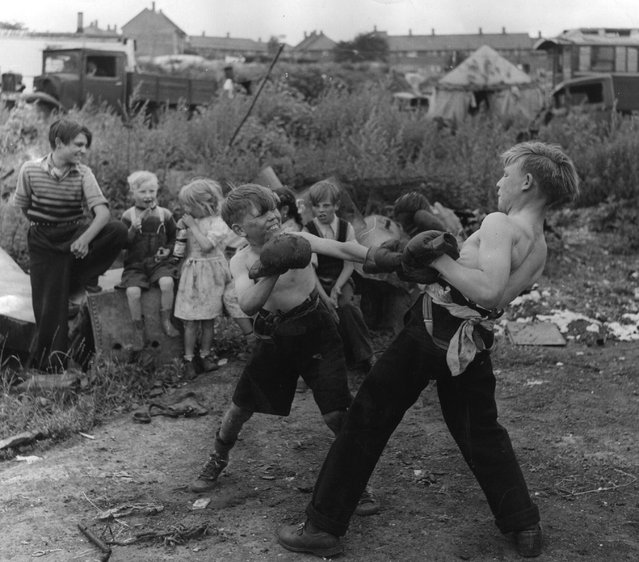
The unromantic gypsies. Children boxing in a gypsy camp in Kent, England on July 1, 1951. Like all boys these gypsy lads like to try their hand at boxing. Encouraged by their friends they fight it out on Corke's Meadow. Few Romanies now live a life of wandering romance. Most are like the three hundred squatters of Corke's Meadow, Kent, which is part of a “gypsy problem” that involves about 100,000 today. Of those about 25,000 can be rightly called gypsies, the rest are Mumpers and Posh-rats and Hobos. Corke's Meadow has both kinds. “Picture Post” cameraman Bert Hardy photographs the Corke's Meadow gypsies in their encampment. (Photo by Hulton-Deutsch Collection/Corbis via Getty Images)

The unromantic gypsies. Children boxing in a gypsy camp in Kent, England on July 1, 1951. Like all boys these gypsy lads like to try their hand at boxing. Encouraged by their friends they fight it out on Corke's Meadow. Few Romanies now live a life of wandering romance. Most are like the three hundred squatters of Corke's Meadow, Kent, which is part of a “gypsy problem” that involves about 100,000 today. Of those about 25,000 can be rightly called gypsies, the rest are Mumpers and Posh-rats and Hobos. Corke's Meadow has both kinds. “Picture Post” cameraman Bert Hardy photographs the Corke's Meadow gypsies in their encampment. (Photo by Hulton-Deutsch Collection/Corbis via Getty Images)
Details
12 Mar 2017 00:01:00
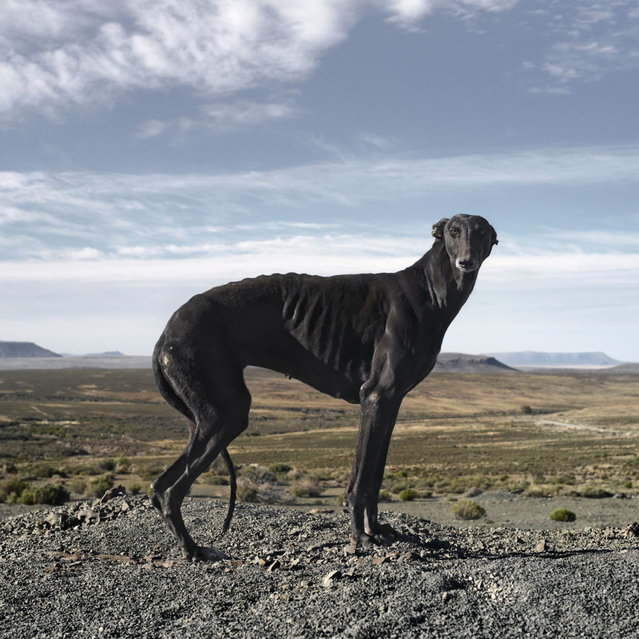
Africanis 18. Murraysburg, Western Cape, May 10, 2010. (Photo by Daniel Naudé)

“The Africanis is a landrace of South African dogs. It is believed to be of ancient origin, directly descended from hounds and pariah dogs of ancient Africa, introduced into the Nile Valley from the Levant. The Swahili name for the breed is umbwa wa ki-shenzi meaning common or mongrel or “traditional dog”. Africanis is also an umbrella name for all the aboriginal dogs in southern Africa”. – Wikipedia. Photo: Africanis 18. Murraysburg, Western Cape, May 10, 2010. (Photo by Daniel Naudé)
Details
19 May 2013 11:51:00


A man cries in a graveyard during the funeral of Nasser Ali Afglio, a young Libyan rebel killed during battle with government troops loyal to Libyan ruler Moammar Gaddafi April 19, 2011 in Misrata, Libya. The graveyard where Nasser was buried has hundreds of simple concrete graves; many dozens are those that have been killed during the last two months of fighting in the besieged town. Thousands of civilians are trapped in Misrata as fighting continues between Libyan government forces that have surrounded the city and anti-government rebels there. (Photo by Chris Hondros/Getty Images)
Details
22 Apr 2011 08:22:00


A vehicle is trapped in a flooded street during a rainstorm in Beijing city on June 23, 2011 in Beijing, China. Heavy rain that hit Beijing on Thursday afternoon has disrupted traffic and caused flooding low-lying areas. (Photo by ChinaFotoPress/Getty Images)
Details
24 Jun 2011 09:25:00
Paperworks By Jennifer Collier

Jennifer Collier is an innovative textiles and crafts artist who uses a combination of natural and found materials. Through methods of weaving, waxing, bonding, fusing, trapping, embedding and stitching she creates unusual materials, which are then developed into garments and accessories.
Details
26 Jun 2013 14:06:00
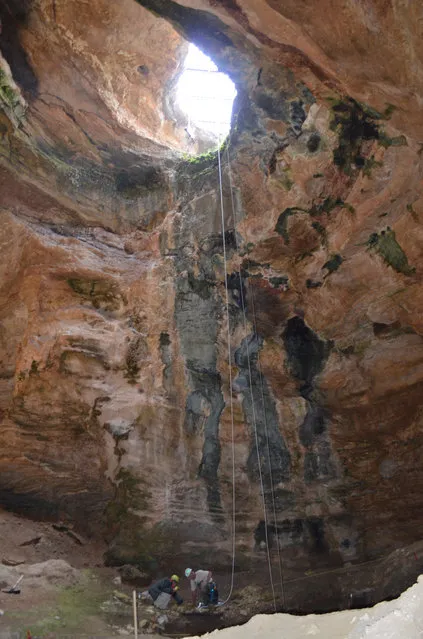
This July 2014 image provided by the Bureau of Land Management shows the interior of the Natural Trap Cave in north-central Wyoming. The cave holds the remains of tens of thousands of animals, including many now-extinct species, from the late Pleistocene period tens of thousands of years ago. Scientists have resumed digging for the first time in more than 30 years. (Photo by AP Photo/Bureau of Land Management)

This July 2014 image provided by the Bureau of Land Management shows the interior of the Natural Trap Cave in north-central Wyoming. The cave holds the remains of tens of thousands of animals, including many now-extinct species, from the late Pleistocene period tens of thousands of years ago. Scientists have resumed digging for the first time in more than 30 years. (Photo by AP Photo/Bureau of Land Management)
Details
10 Aug 2014 10:35:00
Mud-covered tourists pretend to be trapped inside a mud prison at the Daecheon Beach Mud Plaza in the city of Boryeong on South Korea's west coast, July 17, as they take part in the Boryeong Mud Festival, which opened that day and runs through July 26. Boryeong mud is rich in natural mineral component and is considered to prevent skin aging. (Photo by EPA/Yonhap)

Mud-covered tourists pretend to be trapped inside a mud prison at the Daecheon Beach Mud Plaza in the city of Boryeong on South Korea's west coast, July 17, as they take part in the Boryeong Mud Festival, which opened that day and runs through July 26. Boryeong mud is rich in natural mineral component and is considered to prevent skin aging. (Photo by EPA/Yonhap)
Details
18 Jul 2015 13:33:00