Loading...
Done
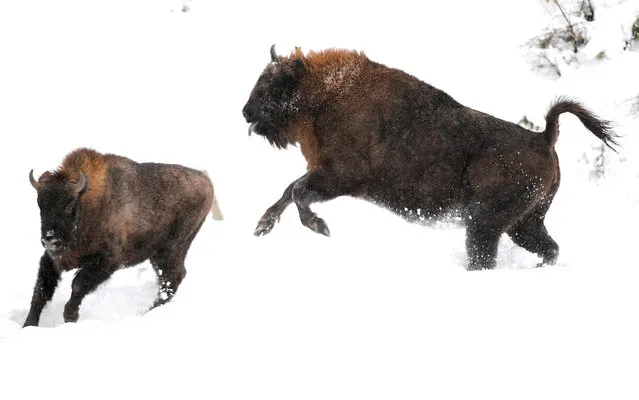
European bisons (also known as Wisent) at the Bison farm in Muczne, southeastern Poland, 30 December 2018. The Bison farm is a continuation of bison breeding in Bieszczady, which was started in 1963. Here visitors can admire the bison of Bialowieza-Caucasian line, also called the mountain race. The European Bison is the national animal of Poland. (Photo by Darek Delmanowicz/EPA/EFE)

European bisons (also known as Wisent) at the Bison farm in Muczne, southeastern Poland, 30 December 2018. The Bison farm is a continuation of bison breeding in Bieszczady, which was started in 1963. Here visitors can admire the bison of Bialowieza-Caucasian line, also called the mountain race. The European Bison is the national animal of Poland. (Photo by Darek Delmanowicz/EPA/EFE)
Details
06 Jan 2019 00:03:00
A handout picture provided by Solar Impulse on 18 March 2015 shows the Swiss solar-powered plane Solar Impulse 2, HB-SIB, taking off with Swiss explorer Andre Borshberg on board for the third leg Ahmedabad to Varanasi, of the Round-The-World, in Ahmedabad, India, 18 March 2015. Swiss explorers Bertrand Piccard and Andre Borschberg attempt to circumnavigate the world flying with an aircraft, with a 72 metres wingspan, powered only by solar energy without a drop of fuel. (Photo by EPA/Solar Impulse)

A handout picture provided by Solar Impulse on 18 March 2015 shows the Swiss solar-powered plane Solar Impulse 2, HB-SIB, taking off with Swiss explorer Andre Borshberg on board for the third leg Ahmedabad to Varanasi, of the Round-The-World, in Ahmedabad, India, 18 March 2015. Swiss explorers Bertrand Piccard and Andre Borschberg attempt to circumnavigate the world flying with an aircraft, with a 72 metres wingspan, powered only by solar energy without a drop of fuel. (Photo by EPA/Solar Impulse)
Details
21 Mar 2015 12:56:00
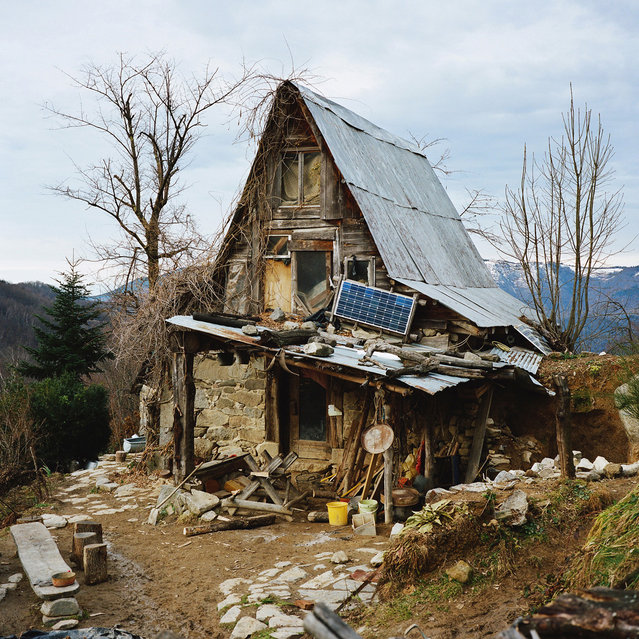
This property in the French Pyrenees is owned by a German man, who moved with his family here 25 years ago. He has since renovated the shack to be a completely self-sufficient house. There are no electrical appliances, but the solar panel powers small lights in the house. (Photo by Antoine Bruy)

Back in 2010, French photographer Antoine Bruy began hitchhiking around Europe without any fixed route. Along his travels, he met people who had entirely abandoned city life in favour of an isolated country existence they found more fulfilling. Bruy began seeking out people who lived off-the-grid. After three years on the road, staying in makeshift houses and on community farms, he has released Scrublands, a documentation of the lifestyle. While each living situation is different, Bruy found that all the people he met shared a common desire to escape the rat race and achieve a quieter life in harmony with nature. (Photo by Antoine Bruy)
Details
13 Aug 2014 09:45:00


Beyonce Knowles performs at the Glastonbury Festival at Worthy Farm, Pilton on June 26, 2011 in Glastonbury, England. The festival, which started in 1970 when several hundred hippies paid 1 GBP to watch Marc Bolan, has grown into Europe's largest music festival attracting more than 175,000 people over five days. (Photo by Dave Hogan/Getty Images)
Details
28 Jun 2011 11:02:00
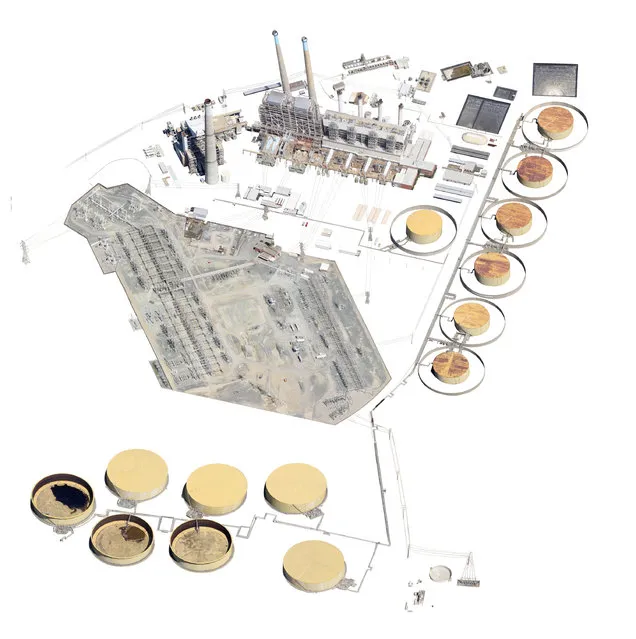
Natural gas plant in Pittsburg, CA (detail of Power Landscape), 2013. (Photo by Jenny Odell)

Jenny Odell repurposes online imagery mostly from Google Maps, but also from YouTube, Craigslist, and other sites. In her “Satellite Collections”, for example, she incorporated aerial views of swimming pools, basketball courts, parking lots, and other recognizable structures, seen from space. Her more recent series, “Satellite Landscapes”, includes painstakingly isolated Google Maps imagery of oil refineries, wastewater treatment plants, solar farms, etc. This work is meant as a reminder of our physically determined and vulnerable existence, since we depend on many of these things for survival and maintenance of our way of life. Photo: Natural gas plant in Pittsburg, CA (detail of Power Landscape), 2013. (Photo by Jenny Odell)
Details
19 Mar 2014 07:28:00
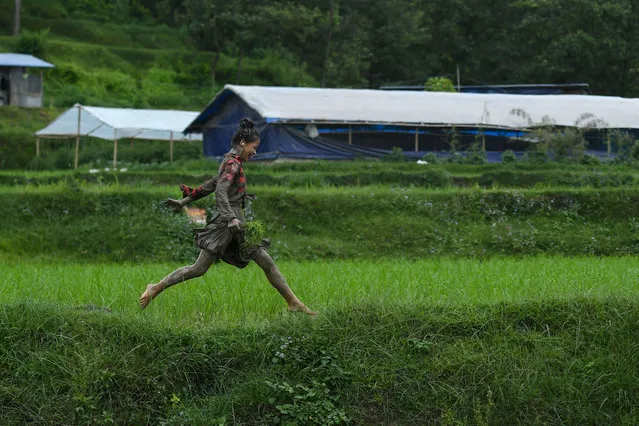
A girl walks along rice paddy fields during “National Paddy Day”, which marks the start of the annual rice planting season, in Tokha village on the outskirts of Kathmandu on June 29, 2020. Splashing mud and drinking local rice beer, Nepali farmers this week celebrated National Paddy Day to mark the beginning of the rice-planting season, despite some coronavirus lockdown measures still in place. Traditional farming songs and laughter echoed in the air as farmers waded into waterlogged fields to sow green paddy. (Photo by Prakash Mathema/AFP Photo)

A girl walks along rice paddy fields during “National Paddy Day”, which marks the start of the annual rice planting season, in Tokha village on the outskirts of Kathmandu on June 29, 2020. Splashing mud and drinking local rice beer, Nepali farmers this week celebrated National Paddy Day to mark the beginning of the rice-planting season, despite some coronavirus lockdown measures still in place. Traditional farming songs and laughter echoed in the air as farmers waded into waterlogged fields to sow green paddy. (Photo by Prakash Mathema/AFP Photo)
Details
02 Aug 2020 00:01:00
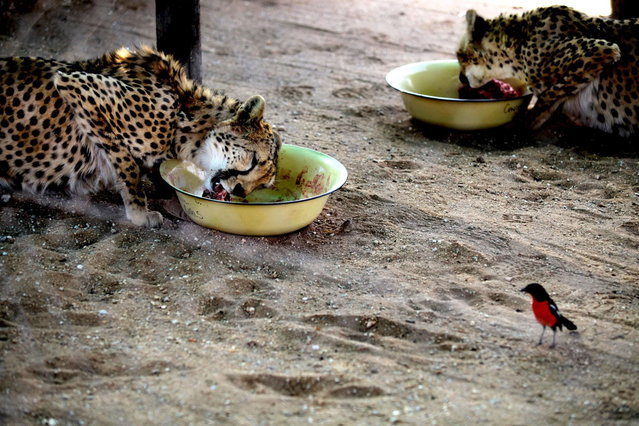
Young cheetahs eat meat at The Cheetah Conservation Fund (CCF) center in Otjiwarongo, Namibia, on August 13, 2013. The CCF started breeding Anatolian livestock dogs to promote cheetah-friendly farming after some 10,000 big cats – the current total worldwide population – were killed or moved off farms in the 1980s.  Up to 1,000 cheetahs were being killed a year, mostly by farmers who saw them as livestock killers. But the use of dogs has slashed losses for sheep and goat farmers and led to less retaliation against the vulnerable cheetah. (Photo by Jennifer Bruce/AFP Photo)

Young cheetahs eat meat at The Cheetah Conservation Fund (CCF) center in Otjiwarongo, Namibia, on August 13, 2013. The CCF started breeding Anatolian livestock dogs to promote cheetah-friendly farming after some 10,000 big cats – the current total worldwide population – were killed or moved off farms in the 1980s. Up to 1,000 cheetahs were being killed a year, mostly by farmers who saw them as livestock killers. But the use of dogs has slashed losses for sheep and goat farmers and led to less retaliation against the vulnerable cheetah. (Photo by Jennifer Bruce/AFP Photo)
Details
29 Aug 2013 10:56:00


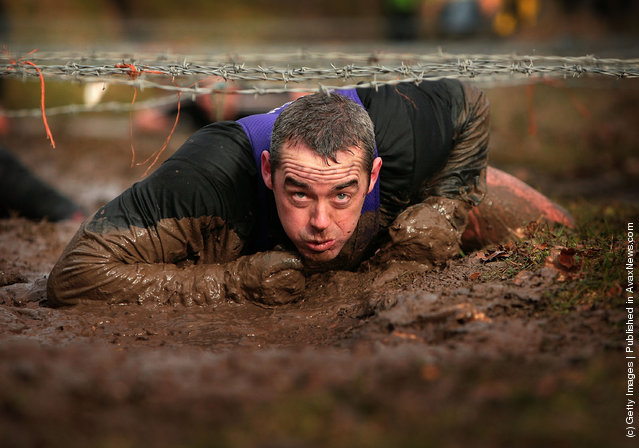
A competitor scrambles in the mud under barbed wire during the Tough Guy Challenge 2009 at South Perton Farm on February 1, 2009 in Wolverhampton, England. The biannual event to raise cash for charity challenges thousands of international competitors to run through a gruelling set of 21 obstacles including water, fire and tunnels after a lengthy run at the start. (Photo by Christopher Furlong/Getty Images)
Details
18 Nov 2011 14:02:00