Loading...
Done
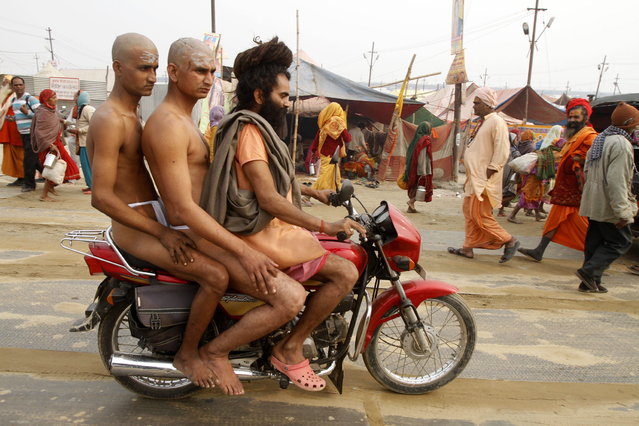
Two Hindu holy men of the Juna Akhara sect  are being take on a motorcycle by their teacher as they got delayed for a rituals that are believed to rid them of all ties in this life and dedicate themselves to serving God as a “Naga” or naked holy men, at Sangam, the confluence of the Ganges and Yamuna River during the Maha Kumbh festival in Allahabad, India, Wednesday, February 6, 2013. (Photo by Rajesh Kumar Singh/AP Photo)

Two Hindu holy men of the Juna Akhara sect are being take on a motorcycle by their teacher as they got delayed for a rituals that are believed to rid them of all ties in this life and dedicate themselves to serving God as a “Naga” or naked holy men, at Sangam, the confluence of the Ganges and Yamuna River during the Maha Kumbh festival in Allahabad, India, Wednesday, February 6, 2013. The significance of nakedness is that they will not have any worldly ties to material belongings, even something as simple as clothes. This ritual that transforms selected holy men to Naga can only be done at the Kumbh festival. (Photo by Rajesh Kumar Singh/AP Photo)
Details
07 Feb 2013 10:11:00
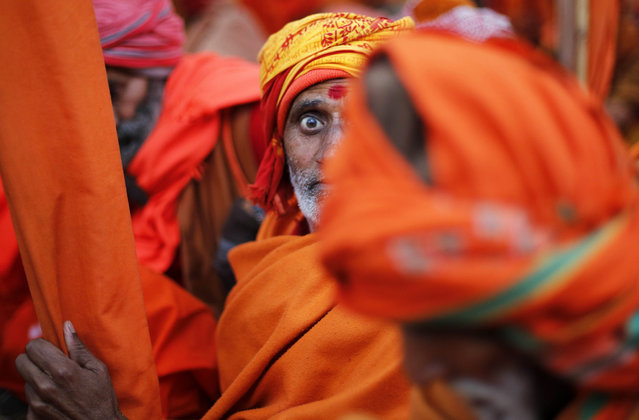
An Indian Sadhu, or Hindu holy man, sits for a community feast at the Sangam, the confluence of the Rivers Ganges, Yamuna and mythical Saraswati, during the annual month-long Magh Mela religious fair in Allahabad, India, Friday, January 16, 2015. (Photo by Rajesh Kumar Singh/AP Photo)

An Indian Sadhu, or Hindu holy man, sits for a community feast at the Sangam, the confluence of the Rivers Ganges, Yamuna and mythical Saraswati, during the annual month-long Magh Mela religious fair in Allahabad, India, Friday, January 16, 2015. Hundreds of thousands of devout Hindus are expected to take holy dips at the confluence during the astronomically auspicious period of over 45 days celebrated as Magh Mela. (Photo by Rajesh Kumar Singh/AP Photo)
Details
17 Jan 2015 11:54:00
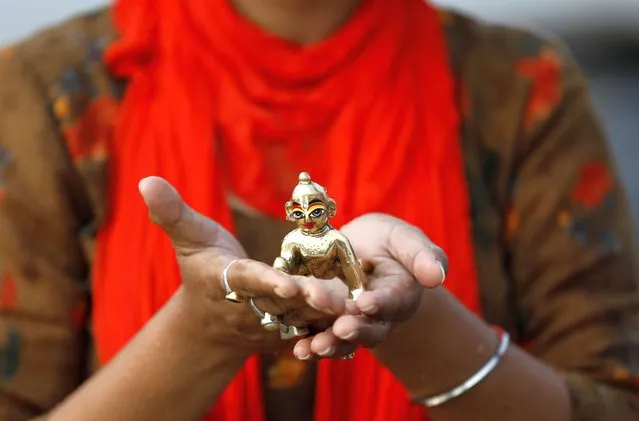
A Hindu devotee offers prayers at the Sangam, the confluence of three rivers – the Ganges, the Yamuna and the mythical Saraswati, to take a ritualistic bath during Makar Sankranti festival that falls during the annual traditional fair of Magh Mela festival, one of the most sacred pilgrimages in Hinduism, in Prayagraj, India. Friday, January 14, 2022. (Photo by Rajesh Kumar Singh/AP Photo)

A Hindu devotee offers prayers at the Sangam, the confluence of three rivers – the Ganges, the Yamuna and the mythical Saraswati, to take a ritualistic bath during Makar Sankranti festival that falls during the annual traditional fair of Magh Mela festival, one of the most sacred pilgrimages in Hinduism, in Prayagraj, India. Friday, January 14, 2022. (Photo by Rajesh Kumar Singh/AP Photo)
Details
26 Jan 2022 07:40:00
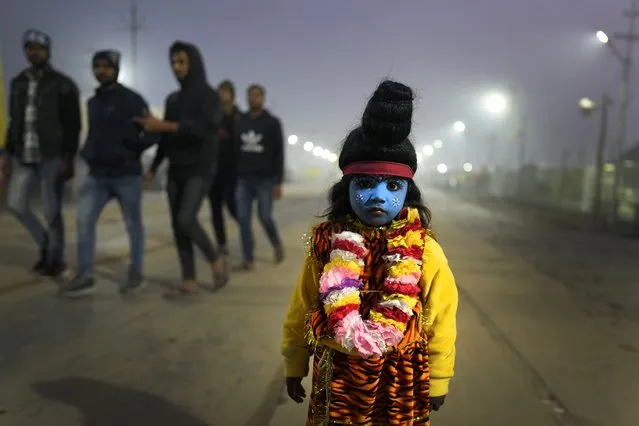
A child dressed as Hindu God Shiva begs for alms from devotees at the Sangam, the confluence of three rivers – the Ganges, the Yamuna and the mythical Saraswati, on the Makar Sankranti festival during the annual traditional fair of Magh Mela in Prayagraj, in the northern Indian state of Uttar Pradesh, Sunday, January 14, 2024. Hundreds of thousands of Hindu pilgrims are expected to take dips in the confluence, hoping to wash away sins during the month-long festival. (Photo by Rajesh Kumar Singh/AP Photo)

A child dressed as Hindu God Shiva begs for alms from devotees at the Sangam, the confluence of three rivers – the Ganges, the Yamuna and the mythical Saraswati, on the Makar Sankranti festival during the annual traditional fair of Magh Mela in Prayagraj, in the northern Indian state of Uttar Pradesh, Sunday, January 14, 2024. Hundreds of thousands of Hindu pilgrims are expected to take dips in the confluence, hoping to wash away sins during the month-long festival. (Photo by Rajesh Kumar Singh/AP Photo)
Details
05 Feb 2024 11:34:00
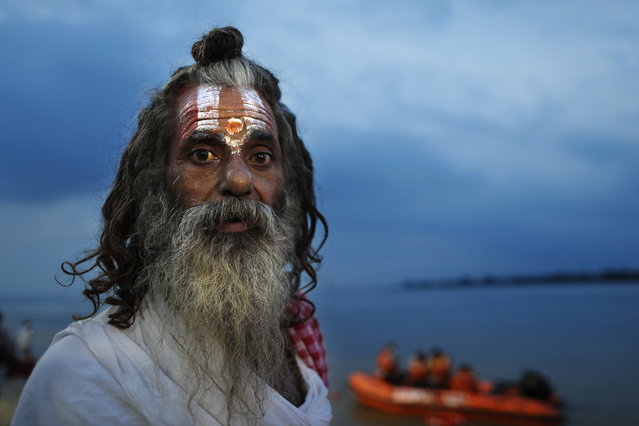
A Hindu holy man looks at a decoration on the ghats of the river Saryu as part of preparations for the groundbreaking ceremony of a temple to the Hindu god Ram in Ayodhya, in the Indian state of Uttar Pradesh, Monday, August 3, 2020. As Hindus prepare to celebrate the groundbreaking of a long-awaited temple at a disputed ground in northern India, Muslims say they have no firm plans yet to build a new mosque at an alternative site they were granted to replace the one torn down by Hindu hard-liners decades ago. (Photo by Rajesh Kumar Singh/AP Photo)

A Hindu holy man looks at a decoration on the ghats of the river Saryu as part of preparations for the groundbreaking ceremony of a temple to the Hindu god Ram in Ayodhya, in the Indian state of Uttar Pradesh, Monday, August 3, 2020. As Hindus prepare to celebrate the groundbreaking of a long-awaited temple at a disputed ground in northern India, Muslims say they have no firm plans yet to build a new mosque at an alternative site they were granted to replace the one torn down by Hindu hard-liners decades ago. (Photo by Rajesh Kumar Singh/AP Photo)
Details
13 Aug 2020 00:01:00
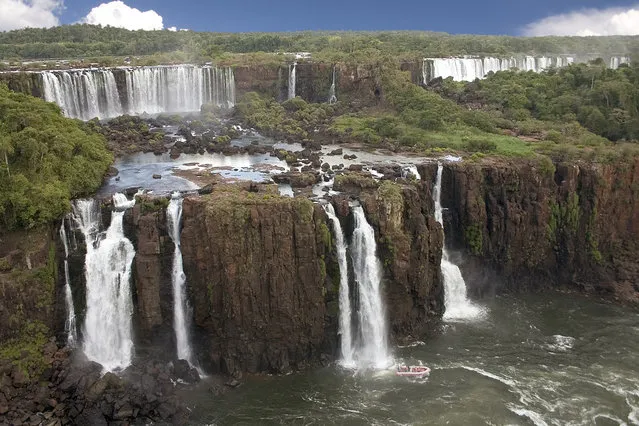
 Iguazu Falls

Iguazu Falls are waterfalls of the Iguazu River on the border of the Brazilian state of Paraná and the Argentinian province of Misiones. The falls divide the river into the upper and lower Iguazu. The Iguazu River rises near the city of Curitiba. It flows through Brazil for most of its course. Below its confluence with the San Antonio River, the Iguazu River forms the boundary between Argentina and Brazil.
Details
15 Jul 2013 11:54:00
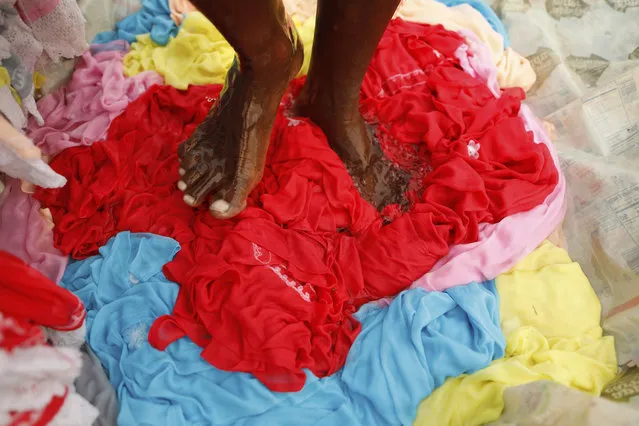
A dhobi, or a washerman washes cloths on the banks of the River Gomti in Lucknow, India, Saturday, September 12, 2020. Dhobis are traditional laundry workers who wash clothes by hand and dry them in the sun, an occupation which has been in existence for generations. Most cities in India have a Dhobi Ghat, or washermen's area, where the city's pile of clothes is laundered. This practice is still popular in India, despite of modern technology. Around 1,000 families work in Lucknow's Dhobi Ghat. However, in light of the novel coronavirus, their wages have decreased drastically. With each family earning around US$100-200 per month. (Photo by Rajesh Kumar Singh/AP Photo)

A dhobi, or a washerman washes cloths on the banks of the River Gomti in Lucknow, India, Saturday, September 12, 2020. Dhobis are traditional laundry workers who wash clothes by hand and dry them in the sun, an occupation which has been in existence for generations. Most cities in India have a Dhobi Ghat, or washermen's area, where the city's pile of clothes is laundered. This practice is still popular in India, despite of modern technology. Around 1,000 families work in Lucknow's Dhobi Ghat. However, in light of the novel coronavirus, their wages have decreased drastically. With each family earning around US$100-200 per month. (Photo by Rajesh Kumar Singh/AP Photo)
Details
25 Sep 2020 00:03:00
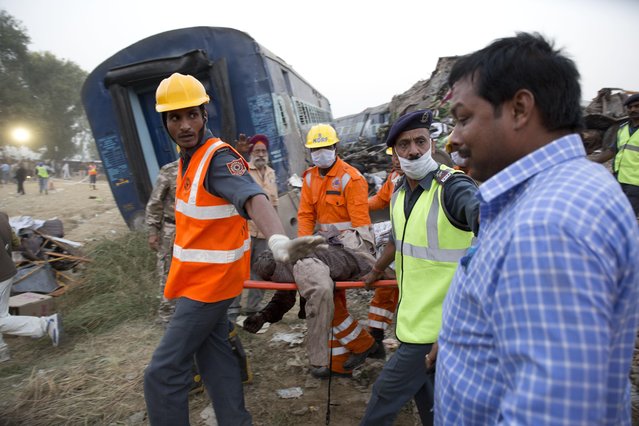
A relative, right, breaks down as rescuers carry the body of a victim after 14 coaches of an overnight passenger train rolled off the track near Pukhrayan village Kanpur Dehat district, Uttar Pradesh state, India, Sunday, November 20, 2016. Dozens were killed and dozens more were injured in the accident. (Photo by Rajesh Kumar Singh/AP Photo)

A relative, right, breaks down as rescuers carry the body of a victim after 14 coaches of an overnight passenger train rolled off the track near Pukhrayan village Kanpur Dehat district, Uttar Pradesh state, India, Sunday, November 20, 2016. Dozens were killed and dozens more were injured in the accident. (Photo by Rajesh Kumar Singh/AP Photo)
Details
21 Nov 2016 10:16:00