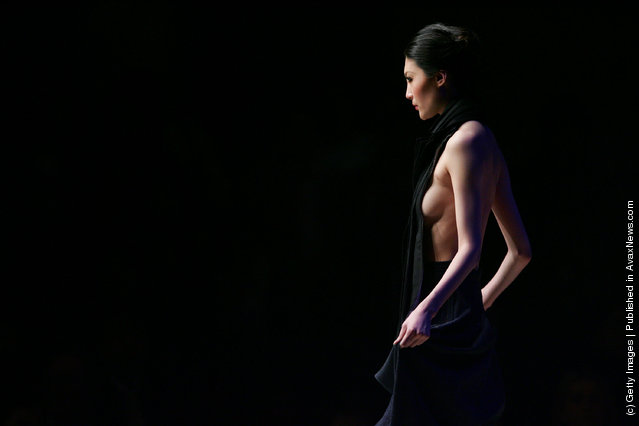
A model walks down the runway at the 13th China International Young Fashion Designers Contest during China Fashion Week on March 25, 2005 in Beijing, China. (Photo by China Photos/Getty Images)
Chinese special policemen rank in a line of battle during an anti-terror drill at a training base of Chengdu Armed Police Headquarters on September 28, 2005 in Chengdu of Sichuan Province, China. (Photo by China Photos/Getty Images)
Vladimir Putin looks at a model of the Tupolev TU-160 bomber, or Blackjack, that was presented to him on his arrival in Olenegorsk, Russia, August 16, 2005. Putin flew in the Tupolev TU-160 bomber and took part in the launch of cruise missiles in the Arctic north. (Photo by Reuters/ITAR-TASS/Presidential Press Service)
Employee Victoria Livesey walks past Banksy's “Kate Moss 2005” on display at Bonhams on March 23, 2012 in London, England. The painting, estimated at GBP 30,000 – 50,000, USD 48,000 – 79,000 and 35,000 – 59,000 euros forms part of the Urban Art Sale, which takes place at Bonhams on March 29, 2012. (Photo by Peter Macdiarmid/Getty Images)
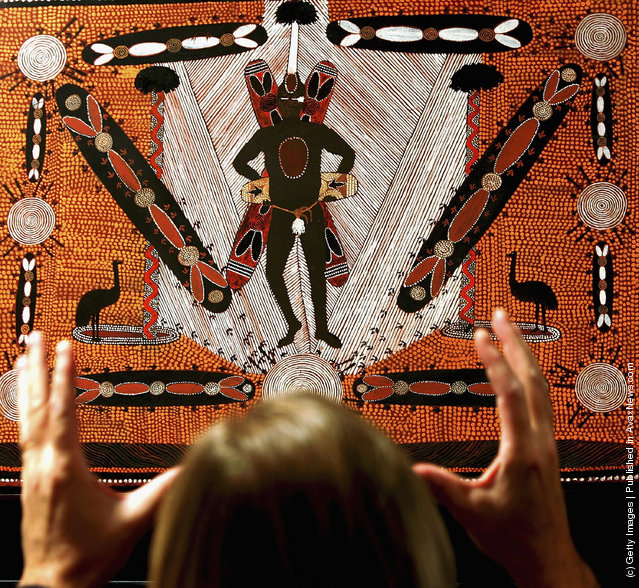
Tim Klingender, Director of Aboriginal Art at Sotheby's hangs the painting “Emu Corroboree Man” by Clifford Possum Tjapaltjarri before a record auction of Aboriginal Art July 14, 2005 in Sydney, Australia. The painting is expected to fetch AUD 150,000 – 250,000 (USD 120,000 – 200,000). Sotheby's unveiled a selection of Aboriginal art and artifacts after a tour of New York and London, which will go to auction in Melbourne July 25 2005. The total pre-sales estimate of the collection is AUD 6 million – 8.5 million (USD 5 million – 7 million). (Photo by Ian Waldie/Getty Images)
“The fennec fox is a small nocturnal fox found in the Sahara of North Africa. Its most distinctive feature is unusually large ears. The name “fennec” comes from the Arabic word for fox, and the species name zerda has a Greek origin that refers to its habitat. The fennec is the smallest species of canid in the world; coat, ears and kidney functions have adapted to a high-temperature, low-water, desert environment. In addition, its hearing is sensitive enough to hear prey moving underground”. – Wikipedia
Photo: A Baby Fennec is seen at Sunshine International Aquarium on June 24, 2009 in Tokyo, Japan. The small nocturnal fox babies were born on May 17 2009. (Photo by Junko Kimura/Getty Images)
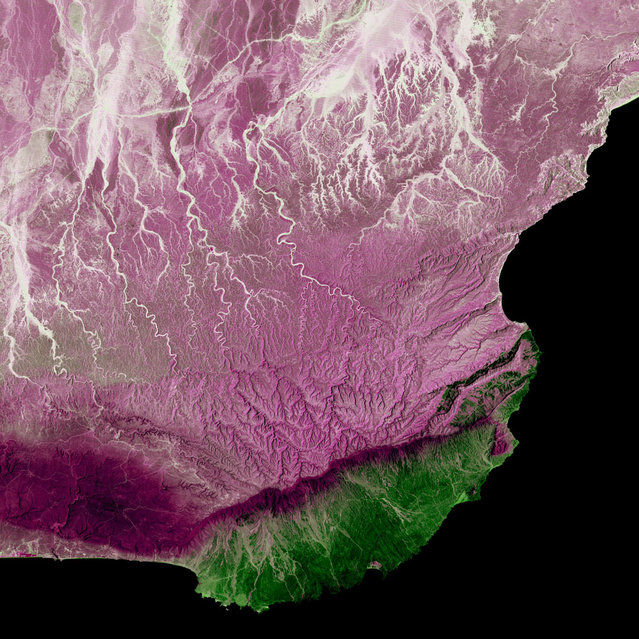
Dhofar Region, Oman. Much of Oman is desert, but the Arabian Sea coast in the Dhofar region represents a startling difference in climate. This coastal region catches the monsoon rains, or khareef, during the summer months. Drenching rains fall primarily on the mountainous ridge that separates the lush, fertile areas along the coast from the arid interior, recharging streams, waterfalls and springs that provide plentiful water supplies in the fertile lowlands for the remainder of the year. Image taken by Landsat 5 on April 2, 2005. (Photo by USGS/NASA)
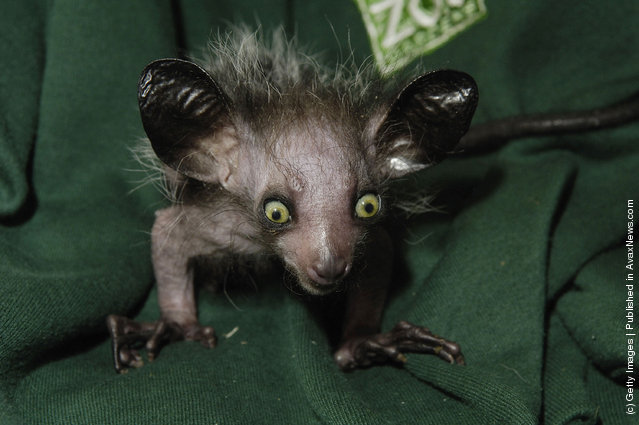
“The aye-aye (Daubentonia madagascariensis) is a lemur, a strepsirrhine primate native to Madagascar that combines rodent-like teeth and a special thin middle finger to fill the same ecological niche as a woodpecker. It is the world's largest nocturnal primate, and is characterized by its unusual method of finding food; it taps on trees to find grubs, then gnaws holes in the wood and inserts its narrow middle finger to pull the grubs out. The only other animal species known to find food in this way is the striped possum. From an ecological point of view the aye-aye fills the niche of a woodpecker as it is capable of penetrating wood to extract the invertebrates within”. – Wikipedia
Photo: In this handout image from Bristol Zoo is seen the first captive bred aye-aye in the UK named “Kintana” (meaning star in Malagasy) April 15, 2005 at Bristol Zoo Gardens, England. The zoo announced today only the second baby aye-aye to be hand-reared in the world (the first was in Jersey Zoo) and has now made his first public appearance since his birth on 11 February 2005. (Photo by Rob Cousins/Bristol Zoo via Getty Images)