Loading...
Done


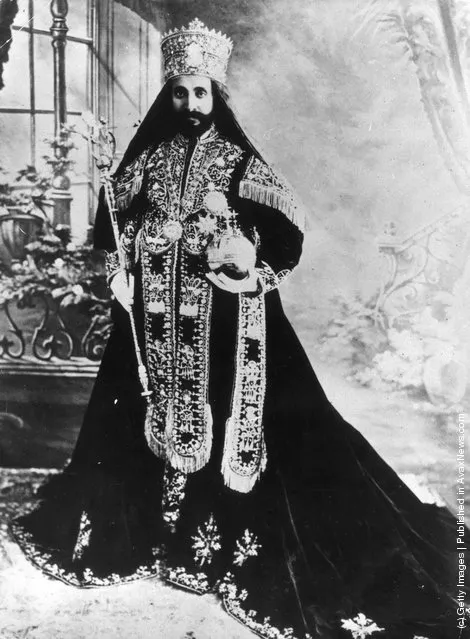
“Haile Selassie I (23 July 1892 – 27 August 1975), born Tafari Makonnen, was Ethiopia's regent from 1916 to 1930 and Emperor of Ethiopia from 1930 to 1974. The heir to a dynasty that traced its origins to the 13th century, and from there by tradition back to King Solomon and Queen Makeda, Empress of Axum, known in the Abrahamic tradition as the Queen of Sheba. Haile Selassie is a defining figure in both Ethiopian and African history.

Haile Selassie is revered as the returned Messiah of the Bible, God incarnate, among the Rastafari movement, the number of followers of which is estimated between 200,000 and 800,000. Begun in Jamaica in the 1930s, the Rastafari movement perceives Haile Selassie as a messianic figure who will lead a future golden age of eternal peace, righteousness, and prosperity. He himself remained an Ethiopian Orthodox Christian throughout his life”. – Wikipedia

Photo: Negusa Negasti, Emperor of Ethiopia Haile Selassie I, known as “Lord of Lords”, “The Conquering Lion of the tribe of Judah”, “Light of the world”, “Elect of God”, in full ceremonial regalia following his coronation. (Photo by Hulton Archive/Getty Images)
Details
21 Jun 2011 11:04:00
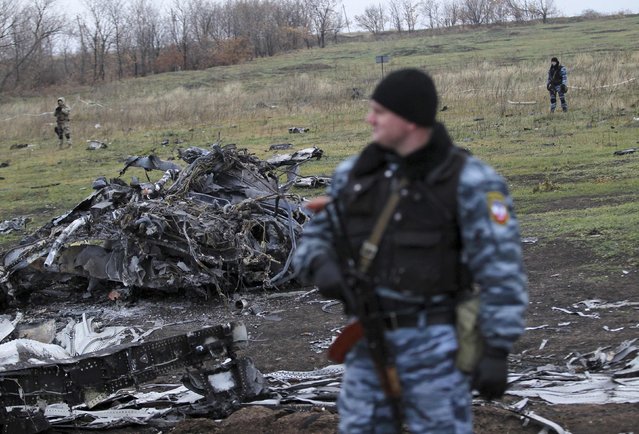
A pro-Russian armed man secures crash site wreckage of the Malaysia Airlines Boeing 777 plane (flight MH17) at the site of the plane crash near the settlement of Grabovo in the Donetsk region November 16, 2014. Local emergency services have begun collecting parts of the wreckage from its crash site in the middle of the conflict zone, Dutch air accident investigators said on Sunday. (Photo by Antonio Bronic/Reuters)

A pro-Russian armed man secures crash site wreckage of the Malaysia Airlines Boeing 777 plane (flight MH17) at the site of the plane crash near the settlement of Grabovo in the Donetsk region November 16, 2014. Local emergency services have begun collecting parts of the wreckage from its crash site in the middle of the conflict zone, Dutch air accident investigators said on Sunday. Dutch inspectors had hoped to collect the parts themselves, following the downing of the flight on July 17 that killed 298 people, two thirds of them Dutch citizens. But they remain concerned about the safety of their staff in the rebel-held conflict zone, and so have decided to work with local services following an initial focus on finding human remains and belongings. (Photo by Antonio Bronic/Reuters)
Details
17 Nov 2014 12:47:00


“Sektor gaza” (Russian: Сектор газа) was a Russian rock band formed on 5 December 1987 in the city of Voronezh, Russia. Despite only semi-officially existing (due to obscene lyrics), the group remains popular in Russia today. The group name was taken from an eponymous industrial district of Voronezh (itself named for high levels of environmental contamination). Their music style could be defined as Russian punk, integrated with elements of different musical genres such as rock, rap, and Russian folk. On 4 July 2000, group leader Yuri “Hoy” Klinskih complained of strong pains in his stomach and the left side of his chest. He suffered heart failure shortly thereafter. Klinskikh died in Voronezh (Russia)at the age of 35. He is buried in the Levoberezhniy Cemetery. The group ceased to exist.

About the music video: The First Chechen War, also known as the War in Chechnya, was a conflict between the Russian Federation and the Chechen Republic of Ichkeria, fought from December 1994 to August 1996. After the initial campaign of 1994 – 1995, culminating in the devastating Battle of Grozny, Russian federal forces attempted to seize control of the mountainous area of Chechnya but were set back by Chechen guerrilla warfare and raids on the flatlands in spite of Russia's overwhelming manpower, weaponry, and air support...
Details
24 May 2012 14:38:00
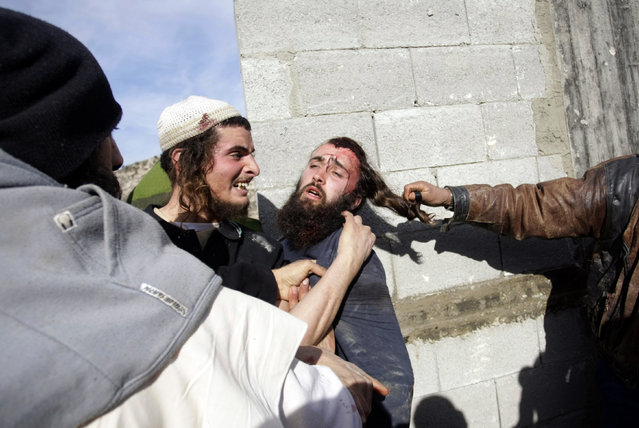
Palestinians hit injured Israeli settlers, center, detained by Palestinian villagers in a building under construction near the West Bank village of Qusra, southeast of the city of Nablus, Tuesday, January 7, 2014. (Photo by Nasser Ishtayeh/AP Photo)

Palestinians hit injured Israeli settlers, center, detained by Palestinian villagers in a building under construction near the West Bank village of Qusra, southeast of the city of Nablus, Tuesday, January 7, 2014. Palestinians held more than a dozen Israeli settlers for about two hours Tuesday in retaliation for the latest in a string of settler attacks on villages in the area, witnesses said. The military said the chain of events apparently began after Israeli authorities removed an illegally built structure in Esh Kodesh, a rogue Israeli settlement in the area. In recent years, militant settlers have often responded to any attempts by the Israeli military to remove parts of dozens of rogue settlements, or outposts, by attacking Palestinians and their property. The tactic, begun in 2008, is known as “price tag”. (Photo by Nasser Ishtayeh/AP Photo)
Details
10 Jan 2014 11:32:00
March 28, 1967 Egg Roll; A large bunny attracted the attention of children and their parents during the annual Easter egg roll Monday on the south lawn of the White House. The bunny was made by Fred Johansen, Silver Spring, Md. (Photo by Minneapolis Star Tribune)

March 28, 1967. Egg Roll; A large bunny attracted the attention of children and their parents during the annual Easter egg roll Monday on the south lawn of the White House. The bunny was made by Fred Johansen, Silver Spring, Md. Nearly 17,000 youngsters and adults took part in the egg rolling. The President and Mrs. John-son were not at the festivities because they were in Camp David, Md. The tradition of egg rolling was begun in 1878 during the administration of Rutherford B. Hayes. (Photo by Minneapolis Star Tribune)
Details
05 Apr 2015 10:51:00
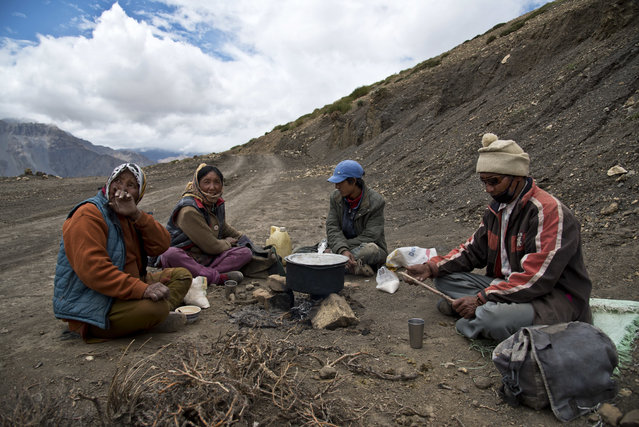
In this August 17, 2016, photo, from left to right, Chhering Chodom, 60, Tashi Yangzom, 50, Lobsang Chhering, 27, and Dorje Tandup, 58, drink milk tea on the side of the road. For centuries, the sleepy valley nestled in the Indian Himalayas remained a hidden Buddhist enclave forbidden to outsiders. Enduring the harsh year-round conditions of the high mountain desert, the people of Spiti Valley lived by a simple communal code – share the Earth's bounty, be hospitable to neighbors, and eschew greed and temptation at all turns. That's all starting to change, for better or worse. Since India began allowing its own citizens as well as outsiders to visit the valley in the early 1990s, tourism and trade have boomed. And the marks of modernization, such as solar panels, asphalt roads and concrete buildings, have begun to appear around some of the villages that dot the remote landscape at altitudes above 4,000 meters (13,000 feet). (Photo by Thomas Cytrynowicz/AP Photo)

In this August 17, 2016, photo, from left to right, Chhering Chodom, 60, Tashi Yangzom, 50, Lobsang Chhering, 27, and Dorje Tandup, 58, drink milk tea on the side of the road. For centuries, the sleepy valley nestled in the Indian Himalayas remained a hidden Buddhist enclave forbidden to outsiders. Enduring the harsh year-round conditions of the high mountain desert, the people of Spiti Valley lived by a simple communal code – share the Earth's bounty, be hospitable to neighbors, and eschew greed and temptation at all turns. That's all starting to change, for better or worse. (Photo by Thomas Cytrynowicz/AP Photo)
Details
15 Sep 2016 09:22:00
Chinese Teenager With Unusually Long Neck

This teenager from Anhui Province has Marfan syndrome, which has caused his neck to become very long. His father says that he has three extra vertebrae, according to Anhui News.
Details
01 Sep 2014 10:34:00
The Rio dry cargo ship that has ran aground during a storm in December 2018 in Kabardinka, Krasnodar Territory, Russia on August 11, 2020. The vessel has become a tourist attraction of the region. (Photo by Alexander Ryumin/TASS)

The Rio dry cargo ship that has ran aground during a storm in December 2018 in Kabardinka, Krasnodar Territory, Russia on August 11, 2020. The vessel has become a tourist attraction of the region. (Photo by Alexander Ryumin/TASS)
Details
21 Aug 2020 00:05:00