Loading...
Done
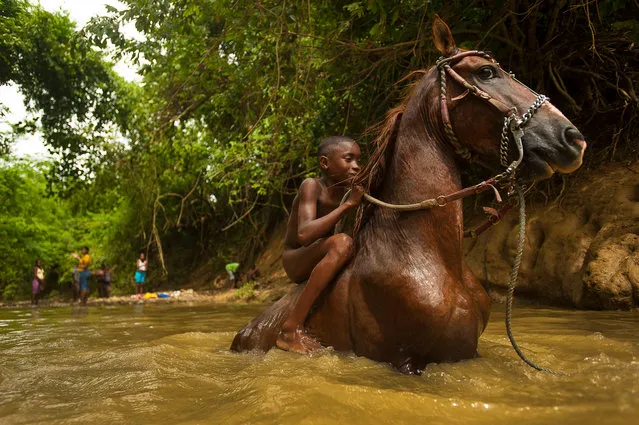
This image of a young bareback rider was taken in the village of Palenque de San Basilio, in Colombia’s Bolívar department. Founded by freed slaves in the 17th century, it became the first free town in the Americas, following a decree by the Spanish crown. Most of today’s inhabitants are direct descendants of those slaves and have preserved many of their customs, including their own language, Palenquero. (Photo by Sebastián Suki Beláustegui/The Guardian)

This image of a young bareback rider was taken in the village of Palenque de San Basilio, in Colombia’s Bolívar department. Founded by freed slaves in the 17th century, it became the first free town in the Americas, following a decree by the Spanish crown. Most of today’s inhabitants are direct descendants of those slaves and have preserved many of their customs, including their own language, Palenquero. (Photo by Sebastián Suki Beláustegui/The Guardian)
Details
07 Sep 2017 09:13:00
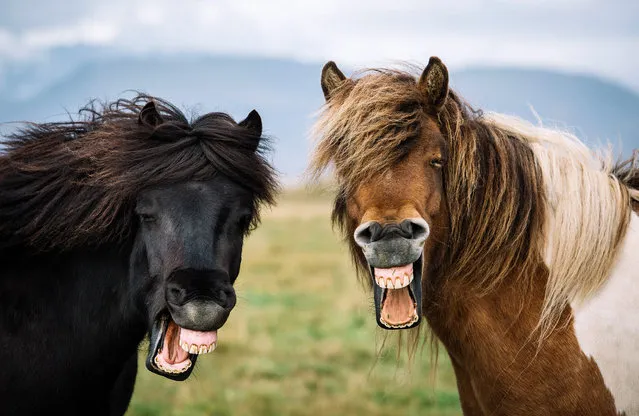
Two horses appear to burst into laughter before a sweet embrace. The horses both turn their head to look at the camera and flash their teeth, treating the lucky photographer to a rare shot. Moments later the pair show their affectionate side by coming together and “hugging”. Photographer Nir Amos, 34, said he was “amazed” to capture the horses “laughing” in a field near Skógar, in the south east of Iceland on July 31, 2018. (Photo by Nir Amos/Solent News & Photo Agency)

Two horses appear to burst into laughter before a sweet embrace. The horses both turn their head to look at the camera and flash their teeth, treating the lucky photographer to a rare shot. Moments later the pair show their affectionate side by coming together and “hugging”. Photographer Nir Amos, 34, said he was “amazed” to capture the horses “laughing” in a field near Skógar, in the south east of Iceland on July 31, 2018. (Photo by Nir Amos/Solent News & Photo Agency)
Details
05 Aug 2018 00:03:00
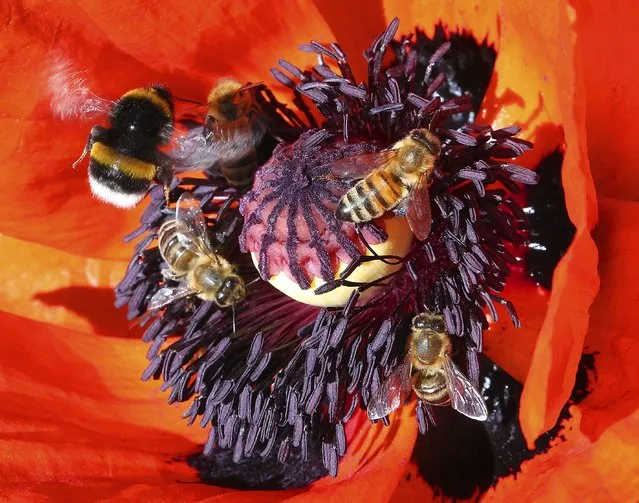
Honey bees and ground bumblebees fly with thick purple pollen pouches to the flower of a corn poppy, also called poppy or corn rose, to obtain nectar in Berlin, Germany, Tuesday, June 7, 2022. Bumblebees, which like bees belong to the stinging bee family, form so-called summer colonies that exist for only a few months. (Photo by Wolfgang Kumm/dpa via AP Photo)

Honey bees and ground bumblebees fly with thick purple pollen pouches to the flower of a corn poppy, also called poppy or corn rose, to obtain nectar in Berlin, Germany, Tuesday, June 7, 2022. Bumblebees, which like bees belong to the stinging bee family, form so-called summer colonies that exist for only a few months. (Photo by Wolfgang Kumm/dpa via AP Photo)
Details
08 Jun 2022 05:27:00
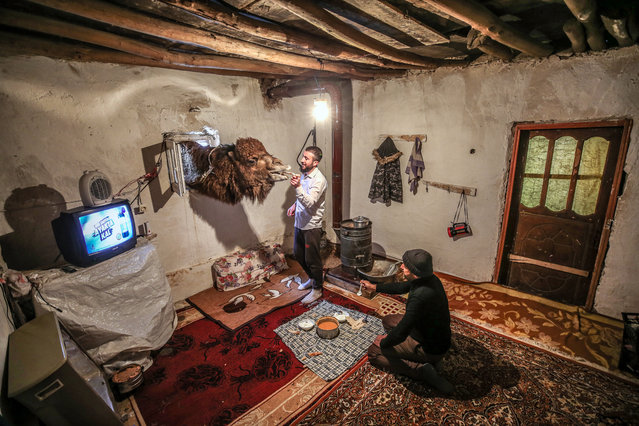
Shepherd brothers Mustafa Erbay and Baran Erbay train their camels on snowy grounds, enabling them to become champions in competitions held in the Aegean and Mediterranean regions in Baskale district of Van, Turkey on February 1, 2020. (Photo by Ozkan Bilgin/Anadolu Agency via Getty Images)

Shepherd brothers Mustafa Erbay and Baran Erbay train their camels on snowy grounds, enabling them to become champions in competitions held in the Aegean and Mediterranean regions in Baskale district of Van, Turkey on February 1, 2020. (Photo by Ozkan Bilgin/Anadolu Agency via Getty Images)
Details
07 Feb 2020 00:01:00
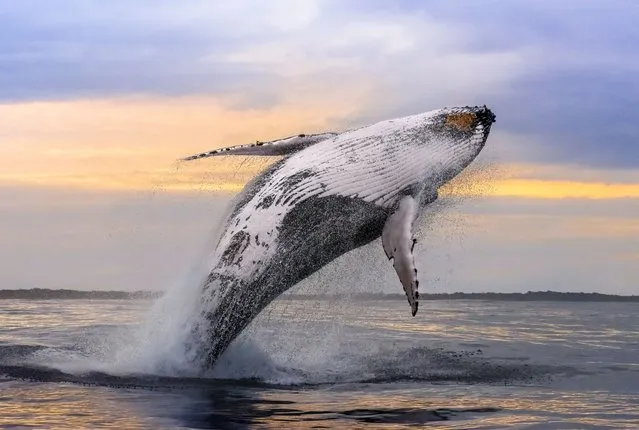
A 40-tonne humpback launching out of the water in an incredible breach in New South Wales, Australia on October 2022 in front of a sunset. The humpback whale can grow up to 56 feet long and typically covers 9,900 miles a year as it travels through the oceans of the world. Humpback whales are a species of Baleen whale, meaning they don't have teeth. Instead, they have baleen which helps them to filter feed. Their main source of food is krill or tiny bait fish. (Photo by Jodie Lowe/Media Drum Images)

A 40-tonne humpback launching out of the water in an incredible breach in New South Wales, Australia on October 2022 in front of a sunset. The humpback whale can grow up to 56 feet long and typically covers 9,900 miles a year as it travels through the oceans of the world. Humpback whales are a species of Baleen whale, meaning they don't have teeth. Instead, they have baleen which helps them to filter feed. Their main source of food is krill or tiny bait fish. (Photo by Jodie Lowe/Media Drum Images)
Details
30 Oct 2022 04:28:00
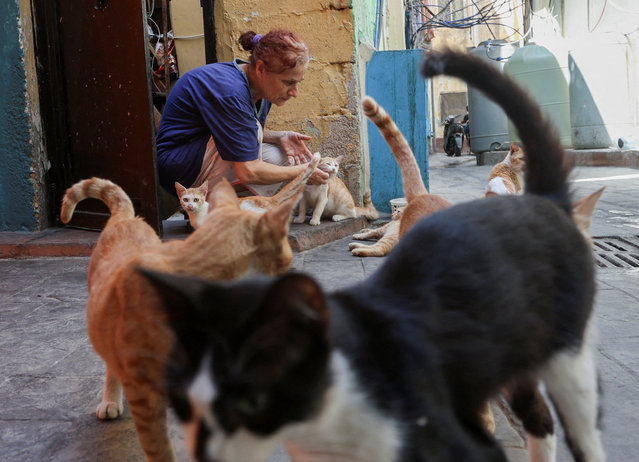
A woman feeds cats at Mar Elias Palestinian refugee camp in Beirut, Lebanon, on August 28, 2024. (Photo by Ahmed Saad/Reuters)

A woman feeds cats at Mar Elias Palestinian refugee camp in Beirut, Lebanon, on August 28, 2024. (Photo by Ahmed Saad/Reuters)
Details
03 Sep 2024 03:34:00
Russian soldiers rehearse ahead of a forthcoming parade on Red Square in Moscow on November 5, 2017 The event will take place on November 7, marking the 76 th anniversary of a 1941 parade, when Red Army soldiers marched past the Kremlin walls towards the front line to fight Nazi Germany troops during World War Two. (Photo by Mladen Antonov/AFP Photo)

Russian soldiers rehearse ahead of a forthcoming parade on Red Square in Moscow on November 5, 2017 The event will take place on November 7, marking the 76 th anniversary of a 1941 parade, when Red Army soldiers marched past the Kremlin walls towards the front line to fight Nazi Germany troops during World War Two. (Photo by Mladen Antonov/AFP Photo)
Details
06 Nov 2017 09:15:00
Cuban-American artist Jorge Rodriguez-Gerada's six-acre sand and soil “facescape” stretches across the JFK Hockey Field on the north side of the Reflecting Pool along the National Mall October 1, 2014 in Washington, DC. Titled “Out of Many, One” and composed of 2,500 tons of sand, 800 tons of top soil and eight miles of string, the piece is the artist's interpreative blending of 30 different men's faces. (Photo by Chip Somodevilla/Getty Images)

Cuban-American artist Jorge Rodriguez-Gerada's six-acre sand and soil “facescape” stretches across the JFK Hockey Field on the north side of the Reflecting Pool along the National Mall October 1, 2014 in Washington, DC. Titled “Out of Many, One” and composed of 2,500 tons of sand, 800 tons of top soil and eight miles of string, the piece is the artist's interpreative blending of 30 different men's faces. Rodriguez-Gereda used high-precision global positioning satellites to place 10,000 wood pegs as waypoints for the giant face. The piece will be open to the public beginning October 4 and will eventually be tilled back into the earth. (Photo by Chip Somodevilla/Getty Images)
Details
04 Oct 2014 11:39:00