Loading...
Done
In this October 6, 2018, photo, a craftsman makes daggers or “Jambiyya” in Yemeni Arabic, made out of remains of missiles, at his workshop, in Hajjah, Yemen. (Photo by Hammadi Issa/AP Photo)

In this October 6, 2018, photo, a craftsman makes daggers or “Jambiyya” in Yemeni Arabic, made out of remains of missiles, at his workshop, in Hajjah, Yemen. Missiles raining on Yemen from the jets of the Saudi-led coalition fighting Houthi rebels are killing thousands of civilians and militiamen alike, but amid crashing economy, some Yemenis see the bright side of it: they make daggers out of the fragments of the missiles for ordinary men traditionally wear for prestige and a show of courage. (Photo by Hammadi Issa/AP Photo)
Details
10 Oct 2018 00:01:00
In this July 12, 2007 file photo, a two-day-old piping plover runs along a beach in the Quonochontaug Conservation Area in Westerly, R.I. A court fight to protect the piping plover, a bird listed as “threatened” under the federal Endangered Species Act, is holding up a $207 million plan to replenish sand along a 19-mile stretch of shoreline on New York's Fire Island. The sand was eroded during Superstorm Sandy. (Photo by Steven Senne/AP Photo)

In this July 12, 2007 file photo, a two-day-old piping plover runs along a beach in the Quonochontaug Conservation Area in Westerly, R.I. (Photo by Steven Senne/AP Photo)
Details
25 Nov 2014 11:28:00
A woman promotes a go-go dance bar in Pattaya, Thailand March 25, 2017. With mascots dressed as smiling fish and a police rock band, Thai authorities launched a “Happy Zone” at the weekend to improve the image of a city notorious for sеx tourism. Stung by foreign headlines portraying the seaside resort of Pattaya as “Sin City” and “The World’s Sеx Capital”, Thailand’s junta has begun a new effort to re-brand it. Businesses in the Happy Zone are asked to make the area feel safer, there are increased security patrols, police launched a mobile phone app for visitors to summon them if an emergency occurs. (Photo by Jorge Silva/Reuters)

A woman promotes a go-go dance bar in Pattaya, Thailand March 25, 2017. With mascots dressed as smiling fish and a police rock band, Thai authorities launched a “Happy Zone” at the weekend to improve the image of a city notorious for sеx tourism. Stung by foreign headlines portraying the seaside resort of Pattaya as “Sin City” and “The World’s Sеx Capital”, Thailand’s junta has begun a new effort to re-brand it. Businesses in the Happy Zone are asked to make the area feel safer, there are increased security patrols, police launched a mobile phone app for visitors to summon them if an emergency occurs. (Photo by Jorge Silva/Reuters)
Details
28 Mar 2017 09:20:00
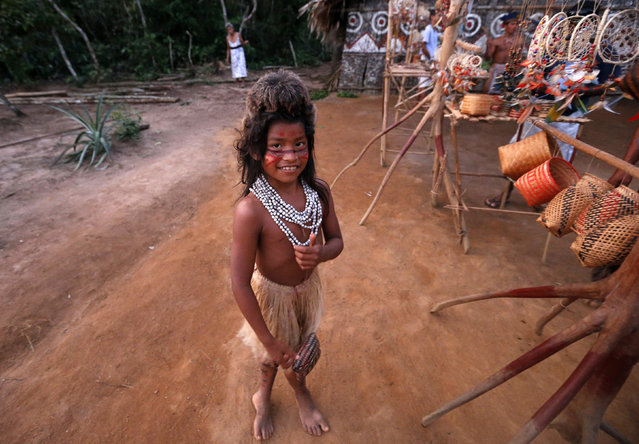
A girl of the Amazonian Tatuyo tribe poses while waiting to sell crafts to tourists in her village in the Rio Negro (Black River) near Manaus city, a World Cup host city, June 23, 2014. Because of their proximity to host city Manaus and their warm welcome, the Tatuyo have enjoyed three weeks of brisk business thanks to the World Cup. Usually, they host between 10 and 30 tourists a day. During the World Cup, this number has rocketed to 250 a day, They have become richer and other communities now come to them to sell them juices and fishes. (Photo by Andres Stapff/Reuters)

A girl of the Amazonian Tatuyo tribe poses while waiting to sell crafts to tourists in her village in the Rio Negro (Black River) near Manaus city, a World Cup host city, June 23, 2014. Because of their proximity to host city Manaus and their warm welcome, the Tatuyo have enjoyed three weeks of brisk business thanks to the World Cup. Usually, they host between 10 and 30 tourists a day. During the World Cup, this number has rocketed to 250 a day, They have become richer and other communities now come to them to sell them juices and fishes. (Photo by Andres Stapff/Reuters)
Details
27 Jun 2014 10:30:00
Russia's President Vladimir Putin (L) reacts as he talks to Belarus' President Alexander Lukashenko before a meeting on resolving the Ukrainian crisis in Minsk, February 11, 2015. (Photo by Mykola Lazarenko/Reuters)

Russia's President Vladimir Putin (L) reacts as he talks to Belarus' President Alexander Lukashenko before a meeting on resolving the Ukrainian crisis in Minsk, February 11, 2015. A document seen by Reuters at talks on the Ukraine crisis suggested the sides may agree to end fighting in eastern Ukraine with a ceasefire starting on February 14, the withdrawal of heavy weapons and the creation of a security zone. (Photo by Mykola Lazarenko/Reuters)
Details
12 Feb 2015 12:23:00
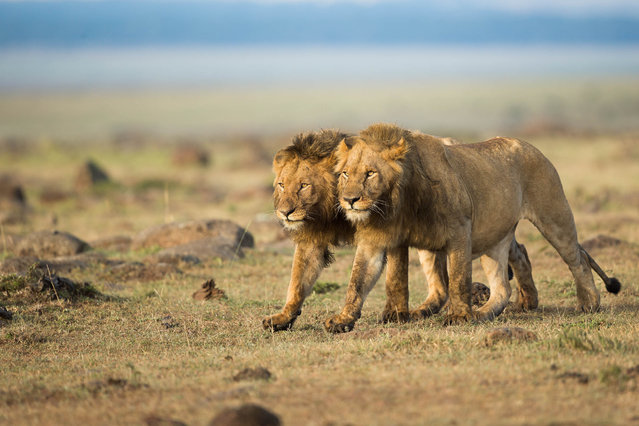
“Two Brothers”. We found about 20 lions eating a buffalo. When the male leaved the group we anticipated him to take photos. It is 8AM, light is perfect and the position too. The lion stops and looks down from the hill, another lion is coming up, it stiffens, I think that will be a fight, i'm tense, the camera is OK, the shots previously made perfect. Photo location: Masai Mara, Kenya. (Photo and caption by Massimo Mei/National Geographic Photo Contest)

“Two Brothers”. We found about 20 lions eating a buffalo. When the male leaved the group we anticipated him to take photos. It is 8AM, light is perfect and the position too. The lion stops and looks down from the hill, another lion is coming up, it stiffens, I think that will be a fight, i'm tense, the camera is OK, the shots previously made perfect. The two meet, looking directly into their eyes, they sniff, rub against their heads, the tension drops, they start walking with the same step as when they were puppies, they are two brothers. Photo location: Masai Mara, Kenya. (Photo and caption by Massimo Mei/National Geographic Photo Contest)
Details
02 Jul 2014 09:45:00
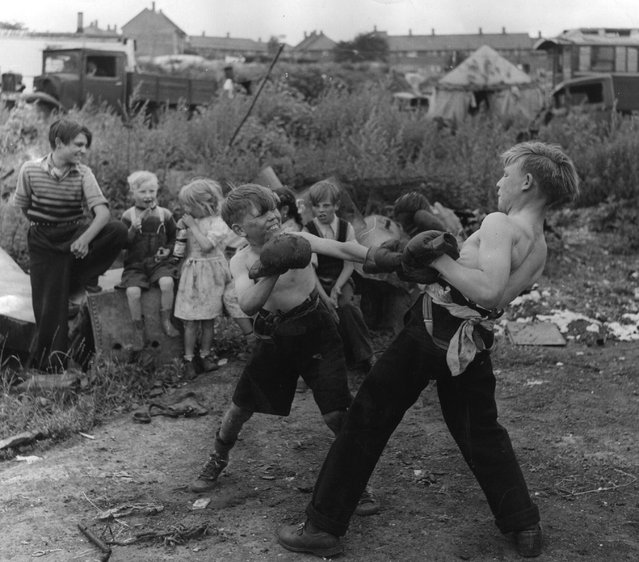
The unromantic gypsies. Children boxing in a gypsy camp in Kent, England on July 1, 1951. Like all boys these gypsy lads like to try their hand at boxing. Encouraged by their friends they fight it out on Corke's Meadow. Few Romanies now live a life of wandering romance. Most are like the three hundred squatters of Corke's Meadow, Kent, which is part of a “gypsy problem” that involves about 100,000 today. Of those about 25,000 can be rightly called gypsies, the rest are Mumpers and Posh-rats and Hobos. Corke's Meadow has both kinds. “Picture Post” cameraman Bert Hardy photographs the Corke's Meadow gypsies in their encampment. (Photo by Hulton-Deutsch Collection/Corbis via Getty Images)

The unromantic gypsies. Children boxing in a gypsy camp in Kent, England on July 1, 1951. Like all boys these gypsy lads like to try their hand at boxing. Encouraged by their friends they fight it out on Corke's Meadow. Few Romanies now live a life of wandering romance. Most are like the three hundred squatters of Corke's Meadow, Kent, which is part of a “gypsy problem” that involves about 100,000 today. Of those about 25,000 can be rightly called gypsies, the rest are Mumpers and Posh-rats and Hobos. Corke's Meadow has both kinds. “Picture Post” cameraman Bert Hardy photographs the Corke's Meadow gypsies in their encampment. (Photo by Hulton-Deutsch Collection/Corbis via Getty Images)
Details
12 Mar 2017 00:01:00
In this March 7, 1991 file photo, a U.S. Marine patrol walks across the charred oil landscape near a burning well during perimeter security patrol near Kuwait City. Twenty five years after the first U.S. Marines swept across the border into Kuwait in the 1991 Gulf War, American forces find themselves battling the extremist Islamic State group, born out of al-Qaida, in the splintered territories of Iraq and Syria. The Arab allies that joined the 1991 coalition are fighting their own conflicts both at home and abroad, as Iran vies for greater regional power following a nuclear deal with world powers. (Photo by John Gaps III/AP Photo)

In this March 7, 1991 file photo, a U.S. Marine patrol walks across the charred oil landscape near a burning well during perimeter security patrol near Kuwait City. Twenty five years after the first U.S. Marines swept across the border into Kuwait in the 1991 Gulf War, American forces find themselves battling the extremist Islamic State group, born out of al-Qaida, in the splintered territories of Iraq and Syria. The Arab allies that joined the 1991 coalition are fighting their own conflicts both at home and abroad, as Iran vies for greater regional power following a nuclear deal with world powers. (Photo by John Gaps III/AP Photo)
Details
23 Feb 2016 11:43:00