Loading...
Done
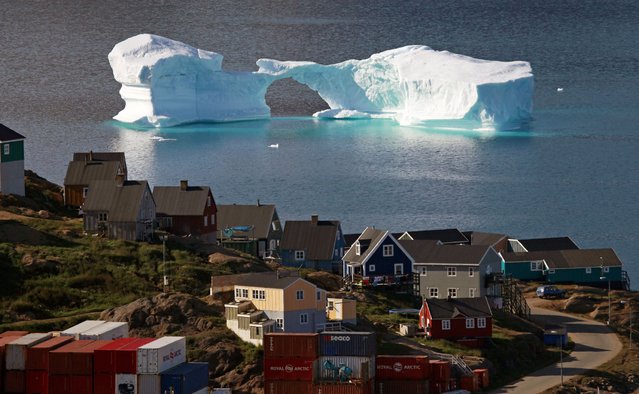
File photo of an iceberg floating near a harbour in the town of Kulusuk, east Greenland August 1, 2009. The United Nations 19th Climate Change Conference (COP19) will take place November 11-22, 2013 in Warsaw. The main goal of the talks with almost almost 200 nations assembled, is to lay the foundation for the new global climate agreement, aiming at further emission reduction, which is to be signed in 2015 in Paris and be launched in 2020. (Photo by Bob Strong/Reuters)

It's taken roughly five months, but a massive iceberg has separated from Antarctica's Pine Island Glacier. According to NASA's Earth Observatory, the estimated size of this iceberg, named B-31, is around 660 square kilometres (33 km long by 20 km wide) – a city-sized block of ice that has slowly migrated away from the continent, and is now floating out to sea. Take a look at some massive icebergs afloat in the oceans. Photo: File photo of an iceberg floating near a harbour in the town of Kulusuk, east Greenland August 1, 2009. (Photo by Bob Strong/Reuters)
Details
27 Apr 2014 07:47:00
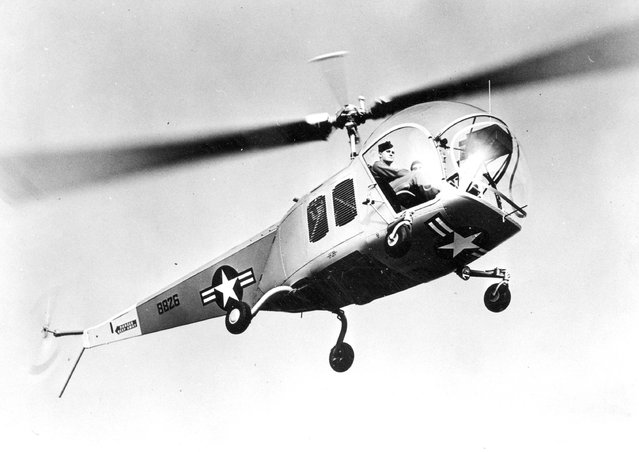
Number 10. BELL H-13 SIOUX was a two-bladed, single engine, light helicopter built by Bell Helicopter. Westland Aircraft manufactured the Sioux under license for the British military as the Sioux AH.1 and HT. (Photo by AP Photo)

Number 10. BELL H-13 SIOUX was a two-bladed, single engine, light helicopter built by Bell Helicopter. Westland Aircraft manufactured the Sioux under license for the British military as the Sioux AH.1 and HT. In 1947, the United States Air Force ordered the improved Bell Model 47A. Most were designated YR-13 and three winterized versions were designated YR-13A. The United States Army first ordered Bell 47s in 1948 under the designation H-13. These would later receive the name Sioux. The Bell-built H-13 B is seen airborne in this April 29, 1951 photo. The helicopter is equipped with a 173 horsepower engine, cruises at 85 miles per hour, climbs 900 feet in a minute and has a service ceiling of 11,500 feet. (Photo by AP Photo)
Details
08 Aug 2014 11:59:00
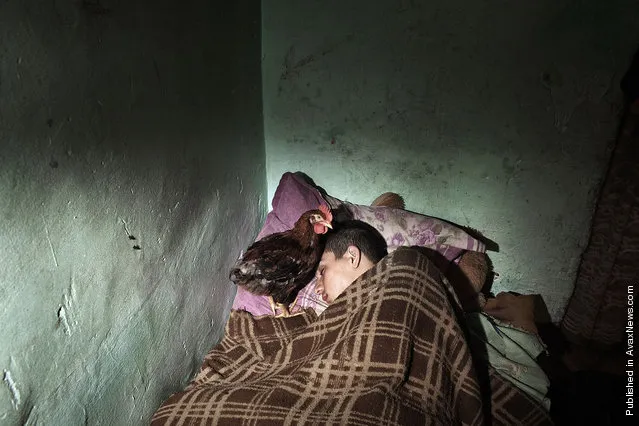
Roma Community In Romania

“Inspired by the French authorities' solution to move Romas from point A to point B, Romanian authorities planned and started forced evictions of Roma informal settlements in cities like Cluj-Napoca and Baia Mare. Some of these settlements date back to the early 1990’s. These communities were tolerated by the authorities who verbally encouraged Romas to build in the area, meanwhile, reassuring them nothing bad would ever happen to them. However, the the reality today is that during political campaigns, authorities are planning forced evictions without reasons other than ethnic cleansing of the cities. My home documents the every day life of Roma communities in Romania, 2011”. – Mugur Varzariu. (Photo by Mugur Varzariu, 2011 FotoVisura Grant Finalist)
Details
20 Apr 2012 13:22:00
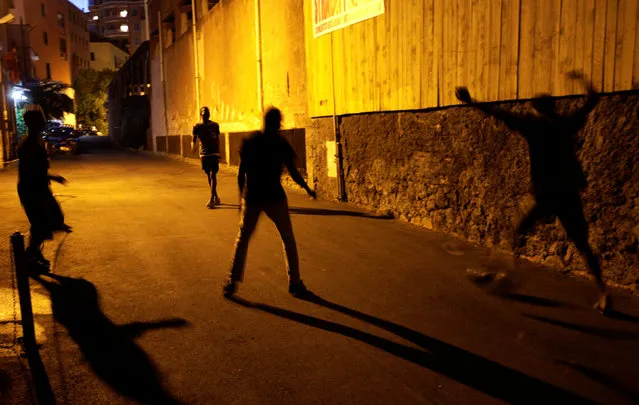
Migrants play soccer at makeshift camp in Via Cupa (Gloomy Street) in downtown Rome, Italy, August 2, 2016. Italy is taking in thousands of boat migrants every week for a third year in a row, and friction is common between them and those who live along the path many take on their journey towards northern Europe. Set up by volunteers, the Baobab centre, by Rome's Tiburtina train station, was shut down by police in December in the wake of the Paris attacks and because the European Union wants Italy to stop migrants from moving on, not help them to do so. B(Photo by Max Rossi/Reuters)

Migrants play soccer at makeshift camp in Via Cupa (Gloomy Street) in downtown Rome, Italy, August 2, 2016. Italy is taking in thousands of boat migrants every week for a third year in a row, and friction is common between them and those who live along the path many take on their journey towards northern Europe. (Photo by Max Rossi/Reuters)
Details
11 Aug 2016 14:31:00
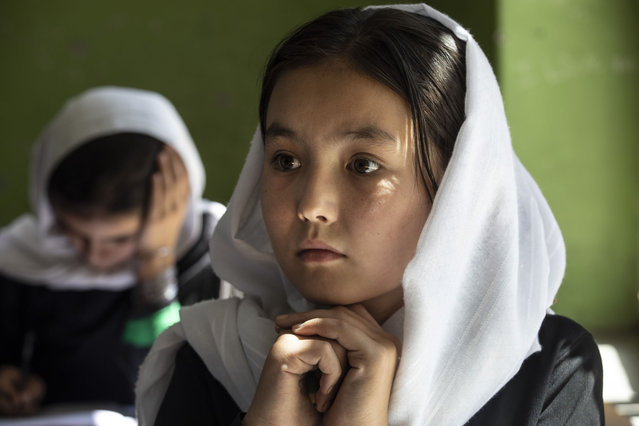
Behishta,11, listens during 4th grade class at the Zarghoona high school on July 25 2021 in Kabul, Afghanistan. The Zarghoona girls high school is the largest in Kabul with 8,500 female students attending classes. The school opened after a nearly two-month break due to the coronavirus (COVID-19) pandemic. Currently there is widespread fear that the Taliban who already control around half the country will reintroduce its notorious system barring girls and women from almost all work, and access to education. The Ministry of Education has announced the opening of schools, but there are  mixed reports in many areas where the Taliban have taken control or where fighting is ongoing. (Photo by Paula Bronstein/Getty Images)

Behishta,11, listens during 4th grade class at the Zarghoona high school on July 25 2021 in Kabul, Afghanistan. The Zarghoona girls high school is the largest in Kabul with 8,500 female students attending classes. The school opened after a nearly two-month break due to the coronavirus (COVID-19) pandemic. (Photo by Paula Bronstein/Getty Images)
Details
12 Aug 2021 08:41:00
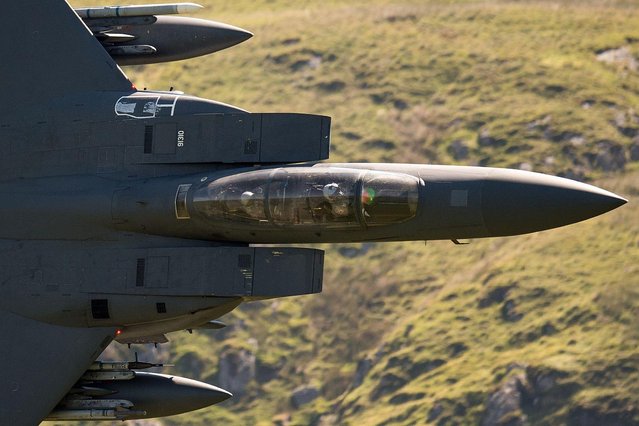
A United States Air Force (USAF) F-15 fighter jet travels at low altitude through the “Mach Loop” series of valleys near Dolgellau, north Wales on June 26, 2018. (Photo by Oli Scarff/AFP Photo)

A United States Air Force (USAF) F-15 fighter jet travels at low altitude through the “Mach Loop” series of valleys near Dolgellau, north Wales on June 26, 2018. The Mach Loop valleys, situated between Dolgellau and Machynlleth, are regularly used by the military for operational low flying training which can take place as low as 76 metres from the nearest terrain. The USAF regularly use the loop to practice low-altitude flight, which confuses radar systems. (Photo by Oli Scarff/AFP Photo)
Details
29 Jun 2018 00:05:00


“Echus Chasma is a chasma in the Lunae Planum high plateau north of the Valles Marineris canyon system of Mars. Clay has been found in Echus Chasma that means that water once sat there for a time. Echus Chasma is approximately 100 km long and 10 km wide, with valleys ranging in depth from around 1 km to 4 km”. – Wikipedia

Photo: In this handout image supplied by the European Space Agency (ESA) on July 16, 2008, The Echus Chasma, one of the largest water source regions on Mars, is pictured from ESA's Mars Express. The data was acquired on September 25, 2005. The dark material shows a network of light-coloured, incised valleys that look similar to drainage networks known on Earth. It is still debated whether the valleys originate from precipitation, groundwater springs or liquid or magma flows on the surface. (Photo by ESA via Getty Images)
Details
18 Jul 2011 11:47:00
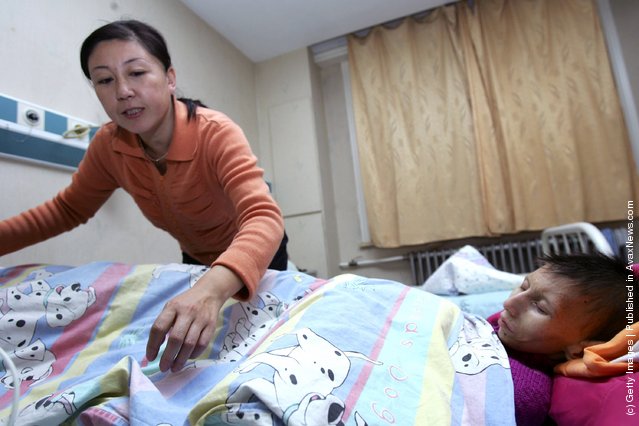
12-year-old Chinese girl Sun Yangyang suffering from Cockayne syndrome

“Cockayne syndrome (also called Weber-Cockayne syndrome, or Neill-Dingwall Syndrome) is a rare autosomal recessive congenital disorder characterized by growth failure, impaired development of the nervous system, abnormal sensitivity to sunlight (photosensitivity), and premature aging. Hearing loss and eye abnormalities (pigmentary retinopathy) are other common features, but problems with any or all of the internal organs are possible. It is associated with a group of disorders called leukodystrophies. The underlying disorder is a defect in a DNA repair mechanism. It is named after English physician Edward Alfred Cockayne (1880–1956)”. – Wikipedia

Photo: Mother of 12-year-old Chinese girl Sun Yangyang suffering from Cockayne syndrome, tends her at the First Affiliated Hospital of Jilin University on November 11, 2006 in Changchun of Jilin Province, China. The disease results in the senile appearance of Yangyang and also causes eyesight, hearing weakness and other problems. Doctors failed to cure the girl... (Photo by China Photos/Getty Images)
Details
08 Aug 2011 11:17:00