Loading...
Done
Revellers at the Chin Chin music festival in Amsterdam, Netherlands on July 3, 2021. The festival season has started with a QR code, one can enter, corona proof or vaccination proof in the corona check app. (Photo by Robin Utrecht/Rex Features/Shutterstock)

Revellers at the Chin Chin music festival in Amsterdam, Netherlands on July 3, 2021. The festival season has started with a QR code, one can enter, corona proof or vaccination proof in the corona check app. (Photo by Robin Utrecht/Rex Features/Shutterstock)

Details
14 Mar 2022 04:55:00
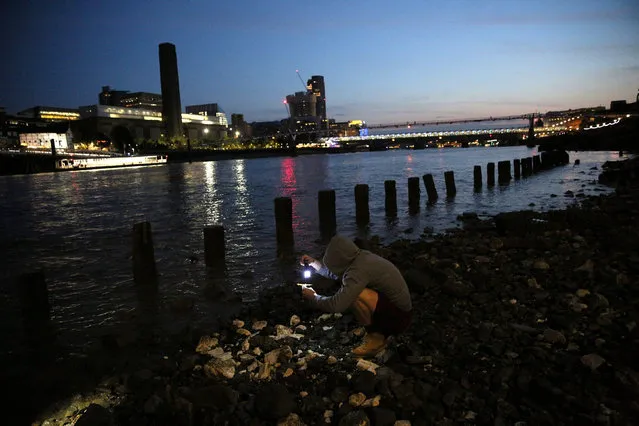
A mudlark uses a torch to look for items on the bank of the River Thames in London, Britain June 06, 2016. Mudlarking is believed to trace its origins to the 18th and 19th century, when scavengers searched the Thames' shores for items to sell. These days, history and archaeology fans are the ones hoping to find old relics such as coins, ceramics, artifacts or everyday items from across centuries. They wait for the low tide and then scour specific areas of exposed shores. "If you're in a field you could be out all day long, with the river you're restricted to about two or three hours," mudlark Nick Stevens said. While many just use the naked eye for their searches, others rely on metal detectors for which a permit from the Port of London Authority is needed. Digging also requires consent. (Photo by Neil Hall/Reuters)

A mudlark uses a torch to look for items on the bank of the River Thames in London, Britain June 06, 2016. Mudlarking is believed to trace its origins to the 18th and 19th century, when scavengers searched the Thames' shores for items to sell. These days, history and archaeology fans are the ones hoping to find old relics such as coins, ceramics, artifacts or everyday items from across centuries. their finds with the Portable Antiquities Scheme. Any item over 300 years old must be recorded. (Photo by Neil Hall/Reuters)
Details
27 Aug 2016 10:43:00
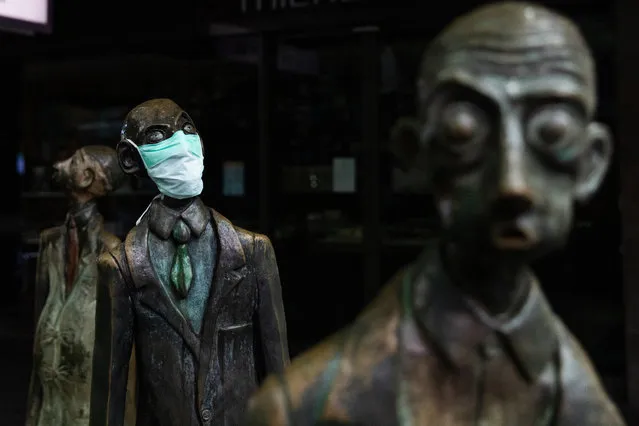
A face mask is placed on one of the 'Three business men who brought lunch' statues on Swanston street on March 29, 2020 in Melbourne, Australia. All international arrivals into Australia from midnight on Saturday will be placed into mandatory quarantine in hotels for 14 days as the Federal Government increases restrictions to stop the spread of COVID-19. All libraries, museums, galleries, beauty salons, tattoo parlours, shopping centre food courts, auctions, open houses, amusement parks, arcades, indoor and outdoor play centres, swimming pools are closed and indoor exercise activities are now banned. This is in addition to the closure of bars, pubs and nightclubs which came into effect on Monday. Restaurants and cafes are restricted to providing takeaway only. Weddings will now be restricted to five people including the couple while funerals are limited to 10 mourners. All Australians are now expected to stay at home except for essential outings such as work, grocery shopping and medical appointments. Exercising outdoors alone is still permitted. Australia now has more than 3,600 confirmed cases of COVID-19 while the death toll now stands at 16. (Photo by Asanka Ratnayake/Getty Images)

A face mask is placed on one of the 'Three business men who brought lunch' statues on Swanston street on March 29, 2020 in Melbourne, Australia. All international arrivals into Australia from midnight on Saturday will be placed into mandatory quarantine in hotels for 14 days as the Federal Government increases restrictions to stop the spread of COVID-19. (Photo by Asanka Ratnayake/Getty Images)
Details
31 Mar 2020 00:07:00
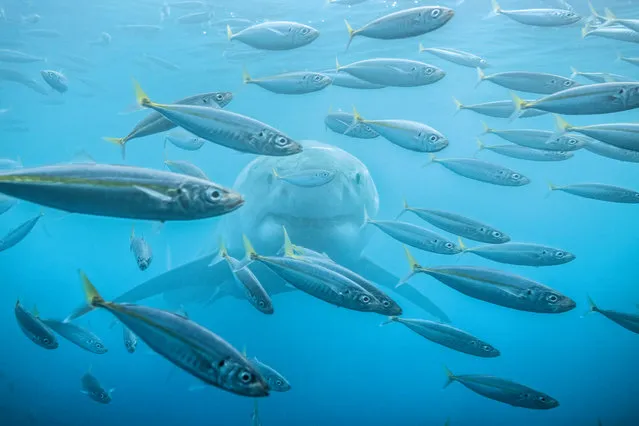
Under Exposed: Pekka Tuuri (Finland) – Great white shark, Isla Guadalupe, Mexico. Isla Guadalupe is the world capital when it comes to observing great white sharks, but cage diving seriously limits the possibilities to take ‘fresh’ pictures. When I took this, the water close to the surface was quite milky, making photography very challenging. From out of the ‘mist’, I saw this great white shark lurking behind a school of fusiliers. I quickly focused on the shark and set a wide aperture to get focus blur on the fish, along with a fast shutter to avoid excessive motion blur. (Photo by Pekka Tuuri/The Outdoor Photographer of the Year/The Guardian)

Under Exposed: Pekka Tuuri (Finland) – Great white shark, Isla Guadalupe, Mexico. “Isla Guadalupe is the world capital when it comes to observing great white sharks, but cage diving seriously limits the possibilities to take ‘fresh’ pictures. When I took this, the water close to the surface was quite milky, making photography very challenging. From out of the “mist”, I saw this great white shark lurking behind a school of fusiliers. I quickly focused on the shark and set a wide aperture to get focus blur on the fish, along with a fast shutter to avoid excessive motion blur”. (Photo by Pekka Tuuri/The Outdoor Photographer of the Year/The Guardian)

Details
25 Jan 2018 07:37:00
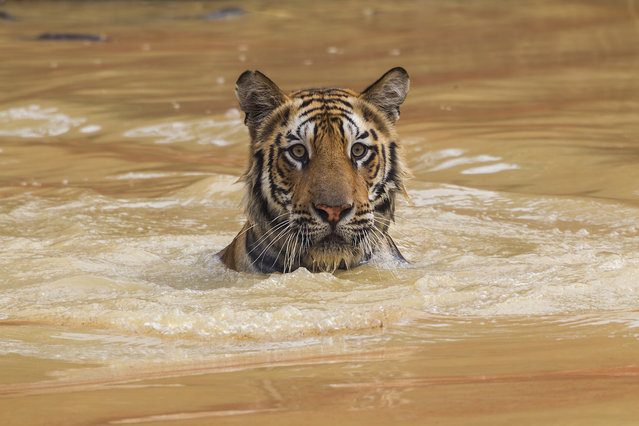
A 14-month-old cub, cooling off in a pond, is riveted by a deer that appeared near the shore. Tigers are powerful swimmers; they can easily cross rivers four to five miles wide and have been known to swim distances of up to 18 miles. (Photo by Steve Winter/National Geographic)

National Geographic photographer Steve Winter has spent most of his adult life shooting wild cats. Photo: A 14-month-old cub, cooling off in a pond, is riveted by a deer that appeared near the shore. Tigers are powerful swimmers; they can easily cross rivers four to five miles wide and have been known to swim distances of up to 18 miles. (Photo by Steve Winter/National Geographic)
Details
08 Apr 2014 11:52:00
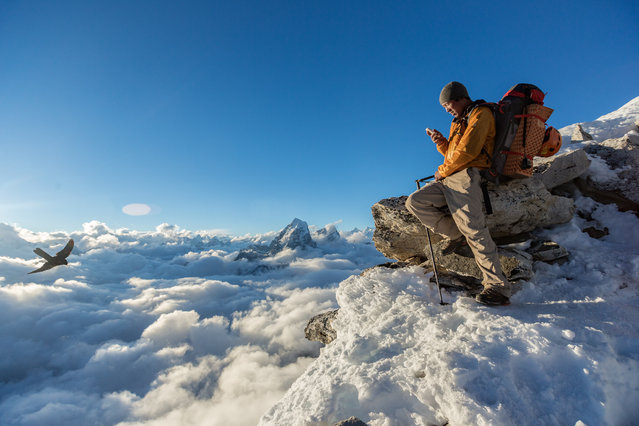
Finding just the right spot above the clouds at Camp 1 on Ama Dablam, Danuru Sherpa uses his iPhone to catch up with friends and family. Even at 18,500 feet (5,654 meters), climbers here can check their email and other dispatches from the world below. (Photo by Aaron Huey/National Geographic)

Finding just the right spot above the clouds at Camp 1 on Ama Dablam, Danuru Sherpa uses his iPhone to catch up with friends and family. Even at 18,500 feet (5,654 meters), climbers here can check their email and other dispatches from the world below. (Photo by Aaron Huey/National Geographic)
Details
28 Apr 2014 09:14:00
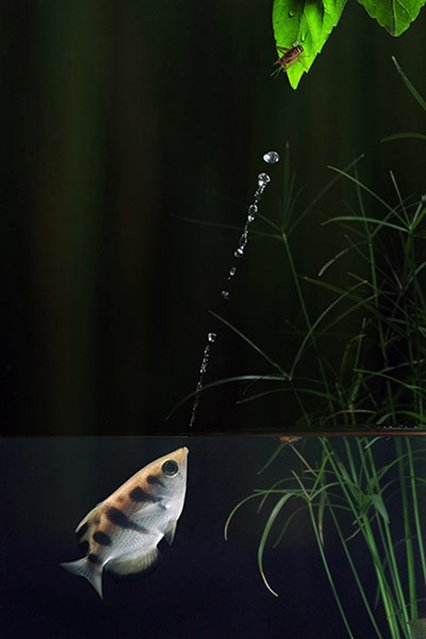
The Archerfish

The archerfish (spinner fish or archer fish) are a family (Toxotidae) of fish known for their habit of preying on land based insects and other small animals by literally shooting them down with water droplets from their specialized mouths. The family is small, consisting of seven species in the genus Toxotes; which typically inhabit brackish waters of estuaries and mangroves, but can also be found in the open ocean as well as far upstream in fresh water They can be found from India to the Philippines, Australia, and Polynesia.
Details
21 Nov 2012 12:54:00
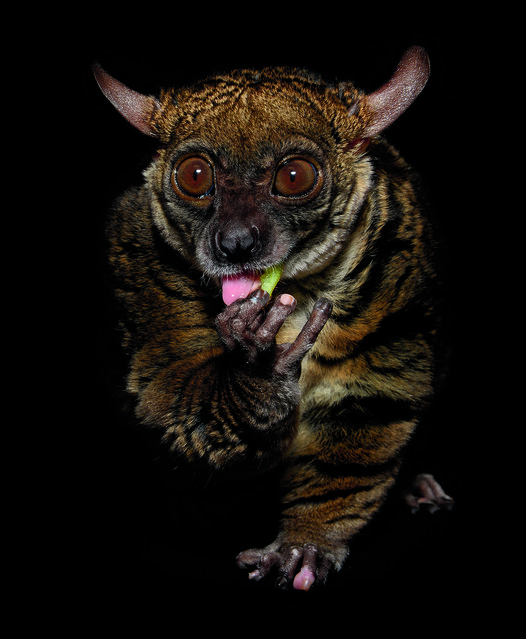
Galagos, more commonly known as bush babies, are tiny African primates with remarkable jumping abilities. Thanks to the elastic energy stored in the tendons of their lower legs, small-eared galagos can jump 6 feet straight up in the air. (Photo by Traer Scott/Chronicle Books)

Galagos, more commonly known as bush babies, are tiny African primates with remarkable jumping abilities. Thanks to the elastic energy stored in the tendons of their lower legs, small-eared galagos can jump 6 feet straight up in the air. (Photo by Traer Scott/Chronicle Books)
Details
07 Sep 2014 12:38:00