Loading...
Done
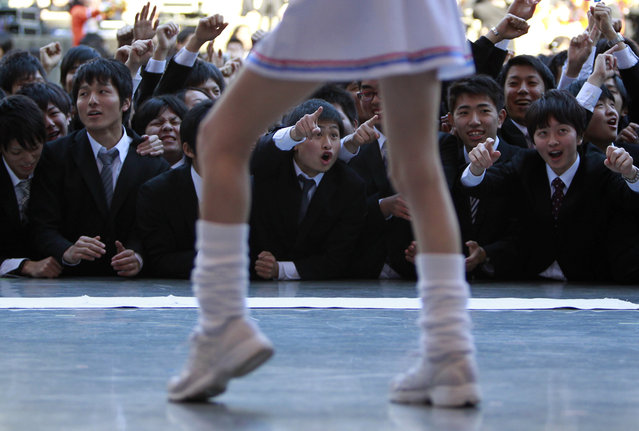
Japanese college students look at cheerleaders during a job-hunting rally in Tokyo January 29, 2014. According to the rally organizers, about 1,500 students from vocational schools attend the rally to boost their morale ahead of their job hunt. (Photo by Yuya Shino/Reuters)

Japanese college students look at cheerleaders during a job-hunting rally in Tokyo January 29, 2014. According to the rally organizers, about 1,500 students from vocational schools attend the rally to boost their morale ahead of their job hunt. (Photo by Yuya Shino/Reuters)
Details
01 Feb 2014 13:10:00
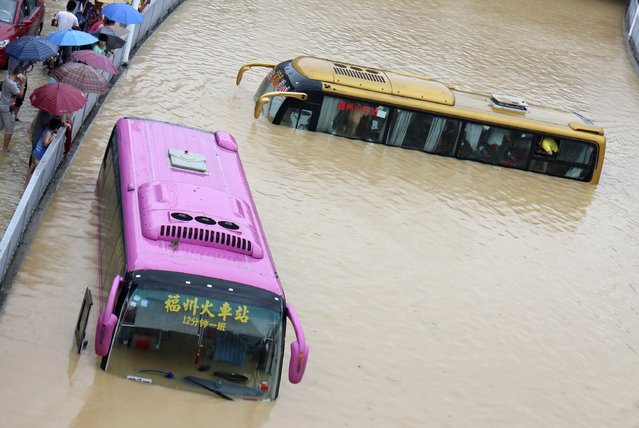
Buses are stranded in a flooded street in Fuzhou, Fujian province, July 24, 2014. Typhoon Matmo hit Taiwan on Wednesday, bringing heavy rain and strong winds, shutting financial markets and schools. It passed the island and headed into China, downgraded from typhoon to tropical storm. (Photo by Reuters/Stringer)

Buses are stranded in a flooded street in Fuzhou, Fujian province, July 24, 2014. Typhoon Matmo hit Taiwan on Wednesday, bringing heavy rain and strong winds, shutting financial markets and schools. It passed the island and headed into China, downgraded from typhoon to tropical storm. (Photo by Reuters/Stringer)
Details
25 Jul 2014 11:45:00
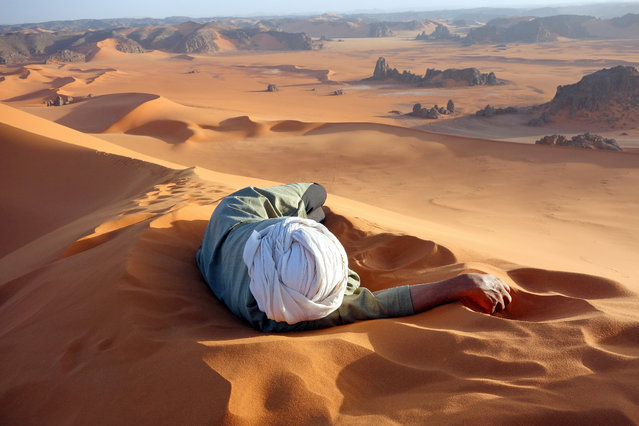
“A Well Earned Rest in the Sahara”. This photo of Moussa Macher, our Tuareg guide, was taken at the summit of Tin-Merzouga, the largest dune (or erg) in the Tadrat region of the Sahara desert in southern Algeria. Moussa rested while waiting for us to finish our 45-minute struggle to the top. Photo location: Summit of Tin-Merzouga, Tadrat, Tassili N'Ajjer National Park, Algeria. (Photo and caption by Evan Cole/National Geographic Photo Contest)

Merit Prize Winner: “A Well Earned Rest in the Sahara”. This photo of Moussa Macher, our Tuareg guide, was taken at the summit of Tin-Merzouga, the largest dune (or erg) in the Tadrat region of the Sahara desert in southern Algeria. Moussa rested while waiting for us to finish our 45-minute struggle to the top. It only took ten minutes of rolling, running, and jumping to get back down. The Tadrat is part of the Tassili N'Ajjer National Park World Heritage area, famous for its red sand and engravings and rock paintings of cattle, elephants, giraffes, and rhinos that lived there when the climate was milder. Photo location: Summit of Tin-Merzouga, Tadrat, Tassili N'Ajjer National Park, Algeria. (Photo and caption by Evan Cole/National Geographic Photo Contest)
Details
01 Aug 2014 11:38:00
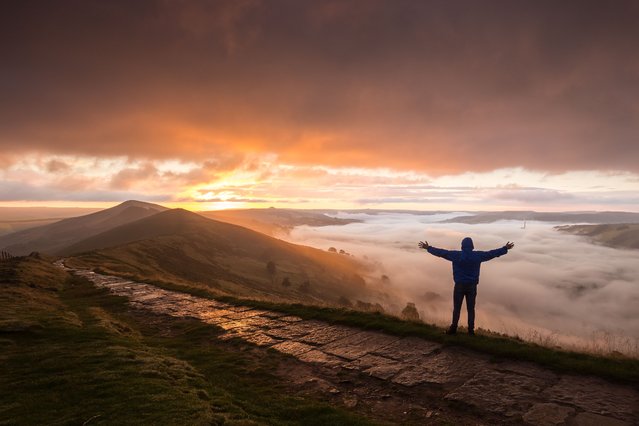
Cloud inversion taken at Sunrise in Mam Tor, Derbyshire, UK on August 30, 2016. (Photo by David Zdanowicz/REX Shutterstock)

Cloud inversion taken at Sunrise in Mam Tor, Derbyshire, UK on August 30, 2016. (Photo by David Zdanowicz/REX Shutterstock)
Details
03 Sep 2016 10:07:00
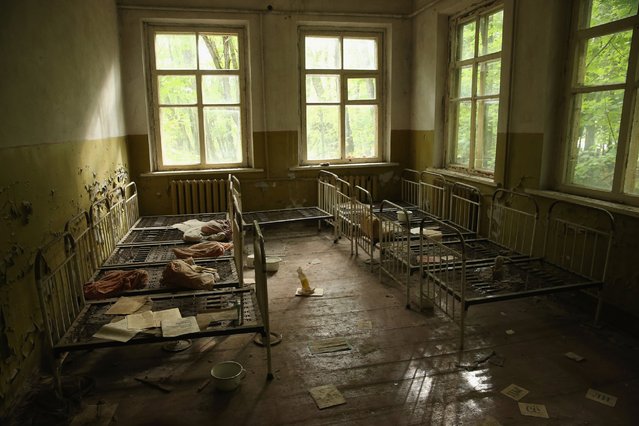
The 30th anniversary of the meltdown at the Chernobyl nuclear plant that caused large amounts of radioactive particles to be released into the air will be commemorated on April 26, 2016. Photojournalist Sean Gallup returned to the area to document the lasting effects of the world's worst nuclear power plant accident. Pictured, children's beds are seen in an abandoned kindergarten in Kopachi village located inside the Chernobyl exclusion zone, Sept. 29, 2015, near Chernobyl, Ukraine. (Photo by Sean Gallup/Getty Images)

The 30th anniversary of the meltdown at the Chernobyl nuclear plant that caused large amounts of radioactive particles to be released into the air will be commemorated on April 26, 2016. Photojournalist Sean Gallup returned to the area to document the lasting effects of the world's worst nuclear power plant accident. Pictured, children's beds are seen in an abandoned kindergarten in Kopachi village located inside the Chernobyl exclusion zone, September 29, 2015, near Chernobyl, Ukraine. (Photo by Sean Gallup/Getty Images)
Details
14 Apr 2016 12:01:00
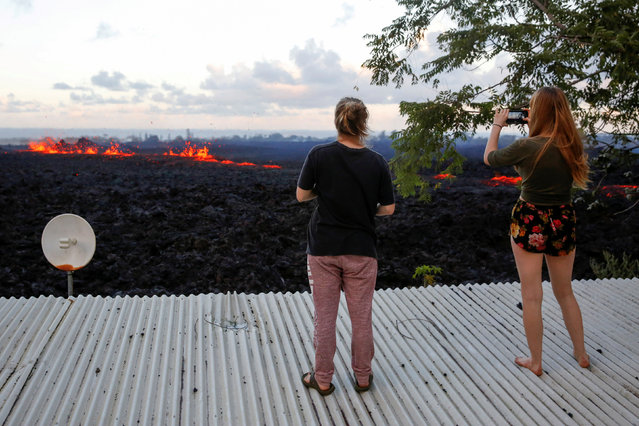
Jolon Clinton, 15, (L), and her sister, Halcy, 17, take photos of a fissure near their home on the outskirts of Pahoa during ongoing eruptions of the Kilauea Volcano in Hawaii, U.S., May 14, 2018. (Photo by Terray Sylvester/Reuters)

Jolon Clinton, 15, (L), and her sister, Halcy, 17, take photos of a fissure near their home on the outskirts of Pahoa during ongoing eruptions of the Kilauea Volcano in Hawaii, U.S., May 14, 2018. (Photo by Terray Sylvester/Reuters)
Details
16 May 2018 08:11:00
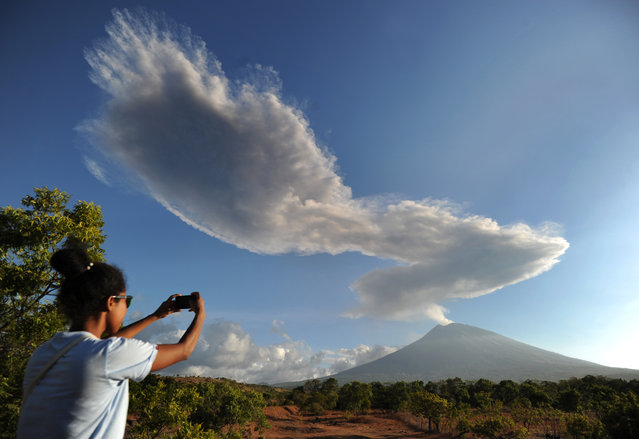
A woman takes photos as Mount Agung volcano sends up another plume of smoke, seen from the Kubu subdistrict in Karangasem Regency on Indonesia's resort island of Bali on July 5, 2018. Mount Agung roared to life again on July 2, belching a plume of ash 2,000 metres (6,500 feet) high, as well as temporarily shuttering the airport and grounding hundreds of flights after erupting the week before. (Photo by Sonny Tumbelaka/AFP Photo)

A woman takes photos as Mount Agung volcano sends up another plume of smoke, seen from the Kubu subdistrict in Karangasem Regency on Indonesia's resort island of Bali on July 5, 2018. Mount Agung roared to life again on July 2, belching a plume of ash 2,000 metres (6,500 feet) high, as well as temporarily shuttering the airport and grounding hundreds of flights after erupting the week before. (Photo by Sonny Tumbelaka/AFP Photo)
Details
07 Jul 2018 00:01:00
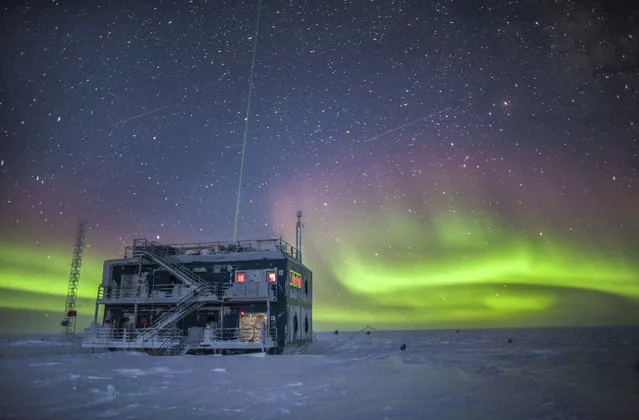
This undated photo provided by NOAA in May 2018 shows aurora australis near the South Pole Atmospheric Research Observatory in Antarctica. When a hole in the ozone formed over Antarctica, countries around the world in 1987 agreed to phase out several types of ozone-depleting chemicals called chlorofluorocarbons (CFCs). Production was banned, emissions fell and the hole shriveled. But according to a study released on Wednesday, May 16, 2018, scientists say since 2013, there’s more of a banned CFC going into the atmosphere. (Photo by Patrick Cullis/NOAA via AP Photo)

This undated photo provided by NOAA in May 2018 shows aurora australis near the South Pole Atmospheric Research Observatory in Antarctica. When a hole in the ozone formed over Antarctica, countries around the world in 1987 agreed to phase out several types of ozone-depleting chemicals called chlorofluorocarbons (CFCs). Production was banned, emissions fell and the hole shriveled. But according to a study released on Wednesday, May 16, 2018, scientists say since 2013, there’s more of a banned CFC going into the atmosphere. (Photo by Patrick Cullis/NOAA via AP Photo)
Details
15 Aug 2018 00:05:00