Loading...
Done
Afghan children play on the remains of a Soviet-era armored personnel carrier on the outskirts of Jalalabad on February 15, 2016. Soviet troops withdrew from Afghanistan on February 15, 1989, after ten years of fighting against Mujahidin militiamen. (Photo by Noorullah Shirzada/AFP Photo)

Afghan children play on the remains of a Soviet-era armored personnel carrier on the outskirts of Jalalabad on February 15, 2016. Soviet troops withdrew from Afghanistan on February 15, 1989, after ten years of fighting against Mujahidin militiamen. (Photo by Noorullah Shirzada/AFP Photo)
Details
11 Jul 2018 00:01:00
Aerial view of a boat working in the green water of Taihu Lake covered by blue-green algae, Wuxi city, Jiangsu province, China on May 23, 2018. (Photo by Imaginechina/Rex Features/Shutterstock)

Aerial view of a boat working in the green water of Taihu Lake covered by blue-green algae, Wuxi city, Jiangsu province, China on May 23, 2018. (Photo by Imaginechina/Rex Features/Shutterstock)
Details
13 Aug 2018 00:03:00
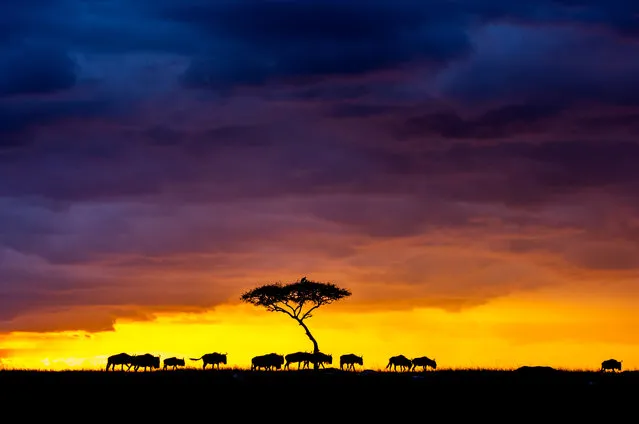
A herd of wildebeest cross the skyline against the fading light in Masai Mara, Kenya, 25 August 2017. Stunning sunset photos silhouette Africa’s wildlife against streaks of orange and red sky. In August, German photographer Ingo Gerlach was on safari in the Masai Mara when he convinced his safari guide to stop and take in the sunset. The wildlife photographer was rewarded with his patience by an eye-catching sunset, which cast Africa’s wildlife into dark shadows against the vibrant skies. (Photo by Ingo Gerlach/Barcroft Images)

A herd of wildebeest cross the skyline against the fading light in Masai Mara, Kenya, 25 August 2017. Stunning sunset photos silhouette Africa’s wildlife against streaks of orange and red sky. In August, German photographer Ingo Gerlach was on safari in the Masai Mara when he convinced his safari guide to stop and take in the sunset. The wildlife photographer was rewarded with his patience by an eye-catching sunset, which cast Africa’s wildlife into dark shadows against the vibrant skies. (Photo by Ingo Gerlach/Barcroft Images)
Details
14 Sep 2017 08:17:00
Construction workers walk past a mural in Phnom Penh on September 6, 2022. (Photo by Tang Chhin Sothy/AFP Photo)

Construction workers walk past a mural in Phnom Penh on September 6, 2022. (Photo by Tang Chhin Sothy/AFP Photo)
Details
09 Oct 2022 04:05:00
Waves break against the pier at Tynemouth, on the North East coast, England on March 30, 2020. (Photo by Owen Humphreys/PA Images via Getty Images)

Waves break against the pier at Tynemouth, on the North East coast, England on March 30, 2020. (Photo by Owen Humphreys/PA Images via Getty Images)
Details
07 May 2021 08:34:00
An Afghan hawker selling balloons walks along a path in a ground in Chaman-e-Hozori area in Kabul on December 10, 2021. (Photo by Ahmad Sahel Arman/AFP Photo)

An Afghan hawker selling balloons walks along a path in a ground in Chaman-e-Hozori area in Kabul on December 10, 2021. (Photo by Ahmad Sahel Arman/AFP Photo)
Details
25 Dec 2021 08:29:00
Riot police detain a woman during a protest near Mong Kok police station in Hong Kong, China on September 7, 2019. (Photo by Tyrone Siu/Reuters)

Riot police detain a woman during a protest near Mong Kok police station in Hong Kong, China on September 7, 2019. (Photo by Tyrone Siu/Reuters)
Details
18 Jan 2020 00:05:00
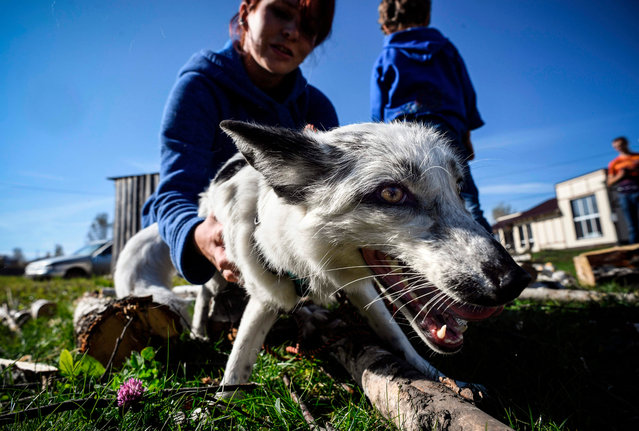
Tatyana Abramova, 33, plays with her home fox Plombir at her countryside house outside Siberian city of Novosibirsk on September 12, 2020. The official start of the Soviet experiment to better understand the domestication of animals by humans began in 1959, and was initiated by geneticists Dmitri Beliaiev and Lioudmila Trout on a farm in Akademgorodok, the scientific center of excellence in Siberia. Their primary objective was to domesticate foxes, to understand how the ancestor of wolves, another canine, evolved into a loyal and loving dog. And understand what this domestication tells us about the genetic evolution of species. (Photo by Alexander Nemenov/AFP Photo)


Tatyana Abramova, 33, plays with her home fox Plombir at her countryside house outside Siberian city of Novosibirsk on September 12, 2020. The official start of the Soviet experiment to better understand the domestication of animals by humans began in 1959, and was initiated by geneticists Dmitri Beliaiev and Lioudmila Trout on a farm in Akademgorodok, the scientific center of excellence in Siberia. Their primary objective was to domesticate foxes, to understand how the ancestor of wolves, another canine, evolved into a loyal and loving dog. And understand what this domestication tells us about the genetic evolution of species. (Photo by Alexander Nemenov/AFP Photo)

Details
25 Oct 2020 00:05:00