Loading...
Done
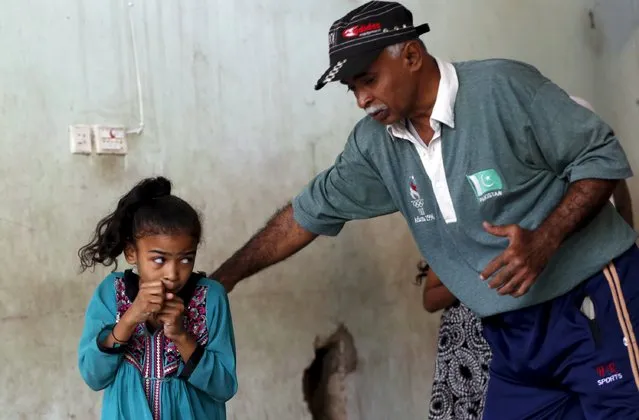
Arisha, 9, takes instructions from coach Younus Qambrani during an exercise session at the first women's boxing coaching camp in Karachi, Pakistan February 19, 2016. (Photo by Akhtar Soomro/Reuters)

Arisha, 9, takes instructions from coach Younus Qambrani during an exercise session at the first women's boxing coaching camp in Karachi, Pakistan February 19, 2016. For the past six months about a dozen girls, aged 8 to 17, have gone to the Pak Shine Boxing Club after school to practice their jabs, hooks and upper cuts. (Photo by Akhtar Soomro/Reuters)
Details
01 Mar 2016 09:46:00
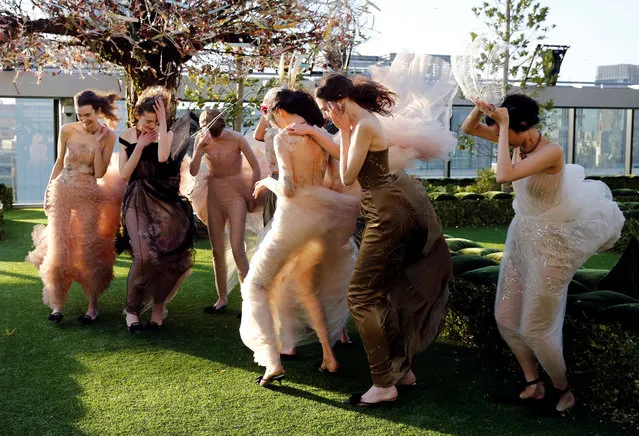
Models struggle against strong wind before the rehearsal of Christian Dior's Haute Couture Spring-Summer 2017 live show to celebrate Dior's new flagship store at the rooftop of Ginza Six mall in Tokyo, Japan, April 19, 2017. (Photo by Toru Hanai/Reuters)

Models struggle against strong wind before the rehearsal of Christian Dior's Haute Couture Spring-Summer 2017 live show to celebrate Dior's new flagship store at the rooftop of Ginza Six mall in Tokyo, Japan, April 19, 2017. (Photo by Toru Hanai/Reuters)
Details
20 Apr 2017 09:12:00
Arrow sports his new elastic booties at a PetSmart in Tempe, Ariz. on Tuesday, June 20, 2017. (Photo by Angie Wang/AP Photo)

Arrow sports his new elastic booties at a PetSmart in Tempe, Ariz. on Tuesday, June 20, 2017. Phoenix radio station KSLX handed out the protective coverings to protect dogs' paws from the hot pavement, as temperatures in Phoenix are forecasted to hit 120 degrees (48°C). (Photo by Angie Wang/AP Photo)
Details
21 Jun 2017 08:18:00
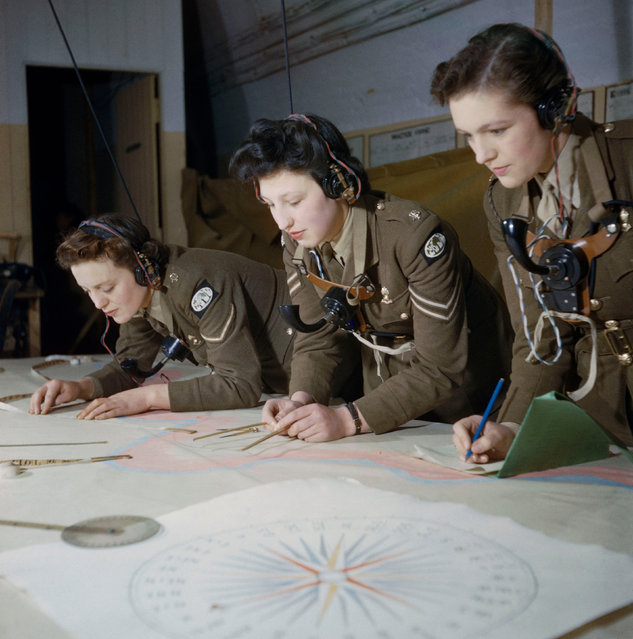
Auxiliary Territorial Service (ATS) plotters at work at Coastal Artillery Headquarters in Dover, December 1942. (Photo by Ted Dearberg/IWM/PA Wire)

Auxiliary Territorial Service (ATS) plotters at work at Coastal Artillery Headquarters in Dover, December 1942. The Auxiliary Territorial Service was the women's branch of the British Army during the Second World War. It was formed on 9 September 1938, initially as a women's voluntary service, and existed until 1 February 1949, when it was merged into the Women's Royal Army Corps. The ATS had its roots in the Women's Auxiliary Army Corps (WAAC), which was formed in 1917 as a voluntary service. During the First World War its members served in a number of jobs including clerks, cooks, telephonists and waitresses. The WAAC was disbanded after four years in 1921. (Photo by Ted Dearberg/IWM/PA Wire)
Details
13 Jul 2017 07:52:00
A participant takes part in the annual Jack In The Green parade involving hundreds of costumed revellers joining a four hour procession culminating in the traditional “slaying” of a Jack character to “unleash the spirit of summer” on the May Day week end, in Hastings, southern Britain, May 2, 2016. (Photo by Toby Melville/Reuters)

A participant takes part in the annual Jack In The Green parade involving hundreds of costumed revellers joining a four hour procession culminating in the traditional “slaying” of a Jack character to “unleash the spirit of summer” on the May Day week end, in Hastings, southern Britain, May 2, 2016. (Photo by Toby Melville/Reuters)
Details
03 May 2016 13:07:00
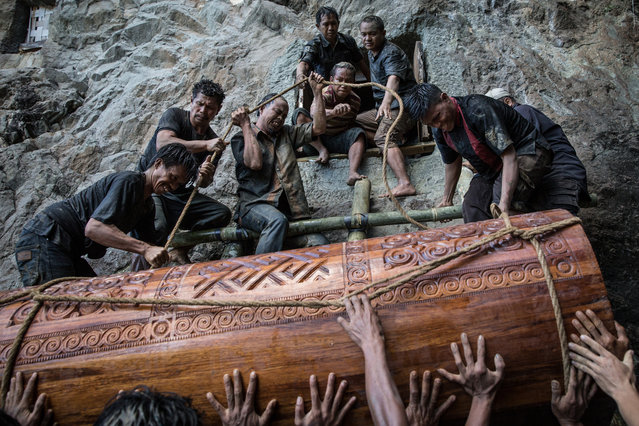
It is said that Torajans are people who “live to die”. For this Indonesian ethnic group, funerals are such extravagant events that they sometimes attract tourists. Families can postpone burials years (and the deceased are considered sick and hosted at home until the funeral) until the family can raise enough money and gather as many relatives as possible. And then it’s a jubilant multiday social event with a parade, dances and animal sacrifices. Agung Parameswara photographed these funerary practices when he traveled to South Sulawesi province, where the Torajans live. But often, their funeral isn’t the last time the dead are seen. In August, crypts are opened, coffins are slid back out and bodies delicately unsheathed. This tender ritual is known as Ma’Nene, which is customarily performed every few years. (Photo by Agung Parameswara/The Washington Post)

It is said that Torajans are people who “live to die”. For this Indonesian ethnic group, funerals are such extravagant events that they sometimes attract tourists. Families can postpone burials years (and the deceased are considered sick and hosted at home until the funeral) until the family can raise enough money and gather as many relatives as possible. And then it’s a jubilant multiday social event with a parade, dances and animal sacrifices. Agung Parameswara photographed these funerary practices when he traveled to South Sulawesi province, where the Torajans live. (Photo by Agung Parameswara/The Washington Post)
Details
06 Oct 2016 09:15:00
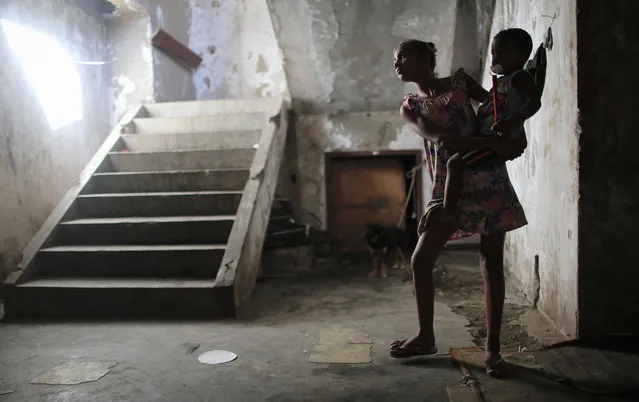
Resident Taina holds her brother Ysaque in the hallway outside their apartment in an occupied building in the Mangueira “favela” community on August 13, 2016 in Rio de Janeiro, Brazil. (Photo by Mario Tama/Getty Images,)

Resident Taina holds her brother Ysaque in the hallway outside their apartment in an occupied building in the Mangueira “favela” community on August 13, 2016 in Rio de Janeiro, Brazil. (Photo by Mario Tama/Getty Images)
Details
22 Aug 2016 12:18:00
A woman loyal to the Houthi movement holds a rifle as she takes part in a parade to show support to the movement in Sanaa, Yemen September 6, 2016. Dressed in the head to toe garments which obscured their faces, the female fighters brandished machine guns, rocket launchers and grenades. The women also wore hats as they showed support for the Shiite Houthi rebels. The Saudi-led Arab coalition launched a military campaign against the Houthis and their allies in March 2015. It was after the rebels closed in on Gulf-backed President Abedrabbo Mansour Hadi in his southern refuge of Aden, forcing him into exile. The female protesters have pledged to remain supportive and do whatever they can to back the ongoing resistance against the kingdom. Yemen is in the grip of its most severe crisis in years, and is on the brink of civil war. (Photo by Khaled Abdullah/Reuters)

A woman loyal to the Houthi movement holds a rifle as she takes part in a parade to show support to the movement in Sanaa, Yemen September 6, 2016. The Saudi-led Arab coalition launched a military campaign against the Huthis and their allies in March 2015, after the rebels closed in on Gulf-backed President Abedrabbo Mansour Hadi in his southern refuge of Aden, forcing him into exile. (Photo by Khaled Abdullah/Reuters)
Details
07 Sep 2016 10:24:00