Loading...
Done
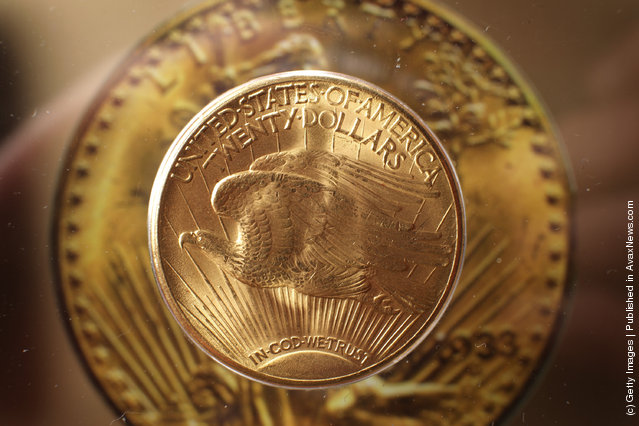
A 'Double Eagle' gold twenty dollar coin

“A Double Eagle is a gold coin of the United States with a denomination of $20. (Its gold content of 0.9675 troy oz was worth $20 at the then official price of $20.67/oz). The coins are made from a 90% gold (0.900 fine = 21.6 kt) and 10% copper alloy”. – Wikipedia

Photo: A “Double Eagle” gold twenty dollar coin is displayed above a catalogue picture showing the reverse side of the coin at Goldsmith's Hall on March 2, 2012 in London, England. Nearly half a million of these coins were originally minted in the midst of the Great Depression in the US. Only 13 are known today after the rest were melted down before they ever left the US Mint, sacrificed as part of a strategy to stabalise the American economy. In 2002 a Double Eagle sold at auction for $7.6 million. (Photo by Peter Macdiarmid/Getty Images)
Details
03 Mar 2012 10:37:00
“Hard for Life”. (Photo by Theo Vu Xuan/Sony World Photography Awards/WENN.com)

“Hard for Life”. (Photo by Theo Vu Xuan/Sony World Photography Awards/WENN.com)
Details
19 Mar 2015 13:49:00
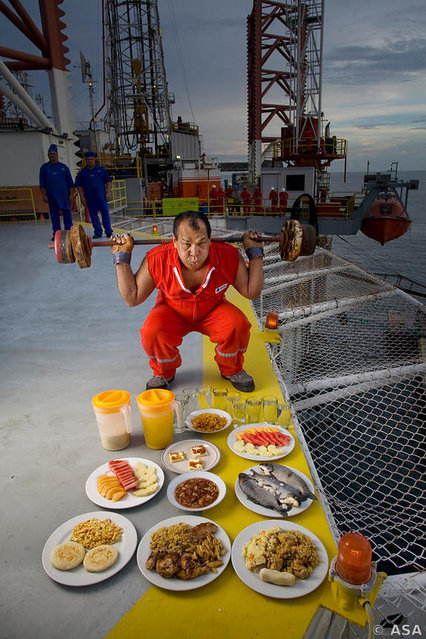
What the World Eats By Peter Menzel And Faith D'Aluisio Part 1

A stunning photographic collection featuring portraits of people from 30 countries and the food they eat in one day. In this fascinating study of people and their diets, 80 profiles are organized by the total number of calories each person puts away in a day. Featuring a Japanese sumo wrestler, a Massai herdswoman, world-renowned Spanish chef Ferran Adria, an American competitive eater, and more, these compulsively readable personal stories also include demographic particulars, including age, activity level, height, and weight. Essays from Harvard primatologist Richard Wrangham, journalist Michael Pollan, and others discuss the implications of our modern diets for our health and for the planet. This compelling blend of photography and investigative reportage expands our understanding of the complex relationships among individuals, culture, and food.
Details
23 Apr 2014 14:34:00
“One in Eight Hundred” by Mario Wezel, from Germany, is the winner of the “People” category. The title refers to the odds given to Martin and Karina at their prenatal screening before their daughter, Emmy, was born. The five-year-old from Denmark has Down's Syndrome. (Photo by Mario Wezel/Sony World Photography Awards)

“One in Eight Hundred” by Mario Wezel, from Germany, is the winner of the “People” category. The title refers to the odds given to Martin and Karina at their prenatal screening before their daughter, Emmy, was born. The five-year-old from Denmark has Down's Syndrome. (Photo by Mario Wezel/Sony World Photography Awards)
Details
02 May 2014 10:53:00
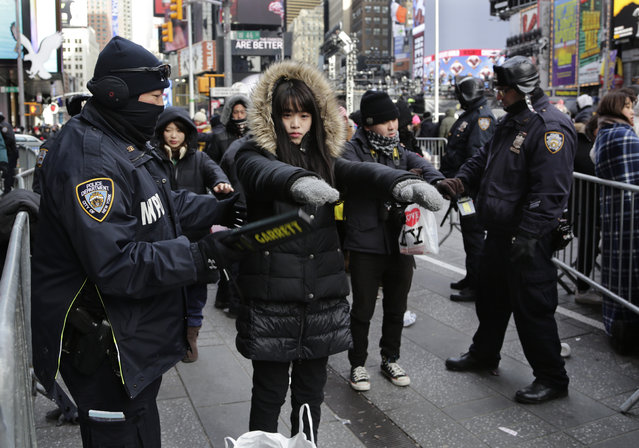
Spectators pass through security screening ahead of the New Year's Eve celebration in Times Square in New York, on Sunday, December 31, 2017. (Photo by Peter Morgan/AP Photo)

Spectators pass through security screening ahead of the New Year's Eve celebration in Times Square in New York, on Sunday, December 31, 2017. (Photo by Peter Morgan/AP Photo)
Details
01 Jan 2018 10:17:00
Max Niedermaier of Germany collides with uncontrolled motorcycle of Niclas Svensson of Sweden during Astana Expo FIM Ice Speedway Gladiators World Championship at the Medeo rink in Almaty, Kazakhstan, February 18, 2017. (Photo by Shamil Zhumatov/Reuters)

Max Niedermaier of Germany collides with uncontrolled motorcycle of Niclas Svensson of Sweden during Astana Expo FIM Ice Speedway Gladiators World Championship at the Medeo rink in Almaty, Kazakhstan, February 18, 2017. (Photo by Shamil Zhumatov/Reuters)
Details
20 Feb 2017 00:03:00
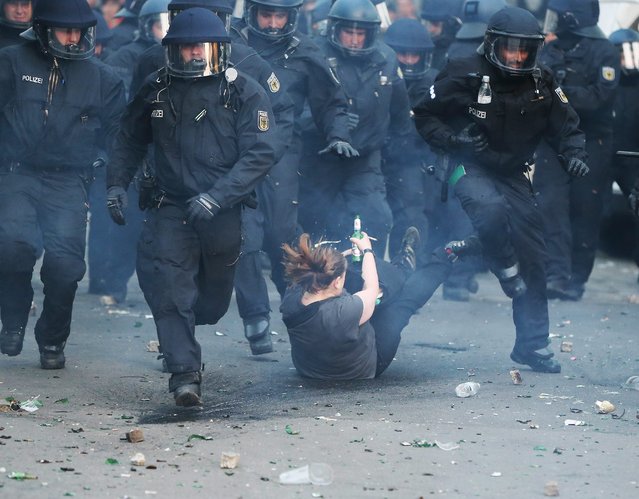
Riot police runs as a woman falls down during a May Day rally in the Kreuzberg district of Berlin, Germany, 01 May 2016. (Photo by Kay Nietfeld/EPA)

Riot police runs as a woman falls down during a May Day rally in the Kreuzberg district of Berlin, Germany, 01 May 2016. (Photo by Kay Nietfeld/EPA)
Details
02 May 2016 10:52:00


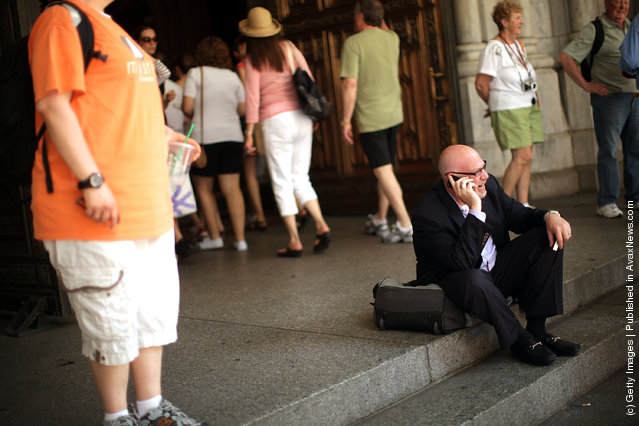
A man speaks on his mobile phone on May 31, 2011 in New York City. In a new report by 31 scientists meeting at the World Health Organization's International Agency for Research on Cancer (WHO/IARC) it was found that using a mobile phone may increase your risk for certain kinds of brain cancers. While further scientific work will be conducted, the group of scientists from 14 countries classified cell phones in the carcinogenic category 2B, which is similar to the pesticide DDT and gasoline engine exhaust. (Photo by Spencer Platt/Getty Images)
Details
01 Jun 2011 06:40:00