Loading...
Done
Amazing Photography Of A Bubble Bursting

Popping bubbles at any age is irresistible. For most of us (and by most I mean anyone who is not a super-hero) we have never truly seen a bubble pop.
Details
19 Feb 2013 11:27:00
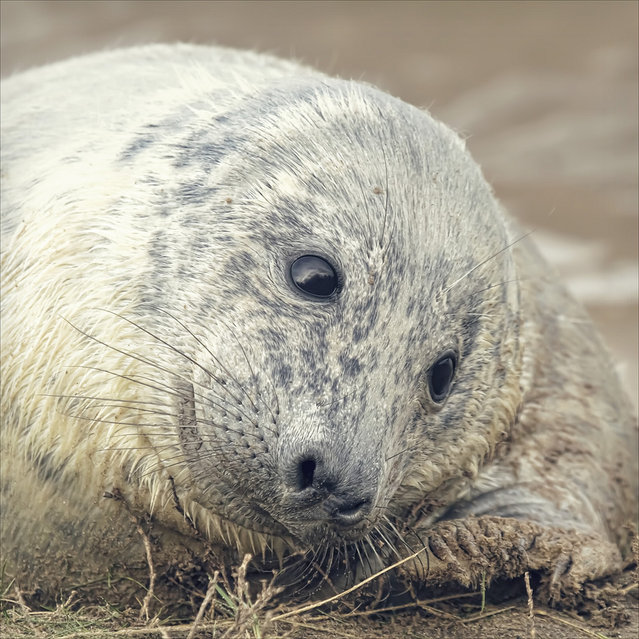
I really need a manicure!

“Nature is beautiful and amazing – i just point my camera at it”. – Black Cat. Photo: “I really need a manicure”! (Photo by Black Cat)

Details
05 Nov 2012 10:26:00
Friendly Monster By Chris Ryniak

Hey Everybody! My name is Chris Ryniak (RYE-KNEE-ACK), and I make monsters. I split my time between sculpting and painting for gallery work, designing toys and being a Dad, but the thing I do the most is DRAW MONSTERS, like every day.
Details
06 Dec 2015 08:23:00
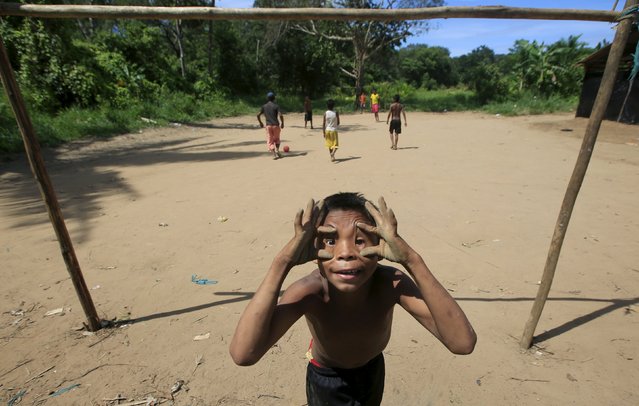
A Colombian Nukak Maku Indian boy gestures in a refugee camp at Agua Bonita near San Jose del Guaviare of Guaviare province September 3, 2015. (Photo by John Vizcaino/Reuters)

A Colombian Nukak Maku Indian boy gestures in a refugee camp at Agua Bonita near San Jose del Guaviare of Guaviare province September 3, 2015. Since emerging from the jungle in 2005, half naked and carrying blowpipes, the Nukak have lived in settlements near the frontier town of San Jose del Guaviare, a humid outpost in the Amazon 400 km (250 miles) southeast of the capital Bogota. (Photo by John Vizcaino/Reuters)
Details
03 Oct 2015 08:01:00
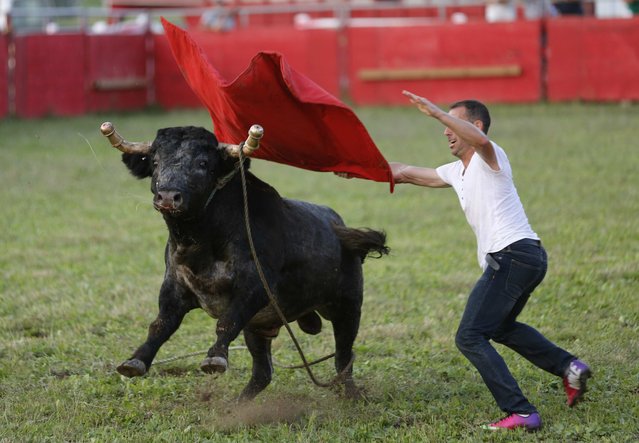
Matador Marco Espinola, who emigrated from the Azores two years ago, challenges a bull during an Azorean “tourada a corda” (bullfight by rope) in Brampton, Ontario August 15, 2015. (Photo by Chris Helgren/Reuters)

Matador Marco Espinola, who emigrated from the Azores two years ago, challenges a bull during an Azorean “tourada a corda” (bullfight by rope) in Brampton, Ontario August 15, 2015. Bulls in a tourada a corda are held by a rope controlled by a team of men to make sure the animal does not cause injury. Bulls are never killed, in contrast with bullfighting in Spain. The Portuguese population in Canada, numbering 429,000 in the 2011 census, mainly centers around Toronto with immigrants from the nine islands of the mid-Atlantic Azores archipelago. (Photo by Chris Helgren/Reuters)

Details
18 Aug 2015 13:39:00
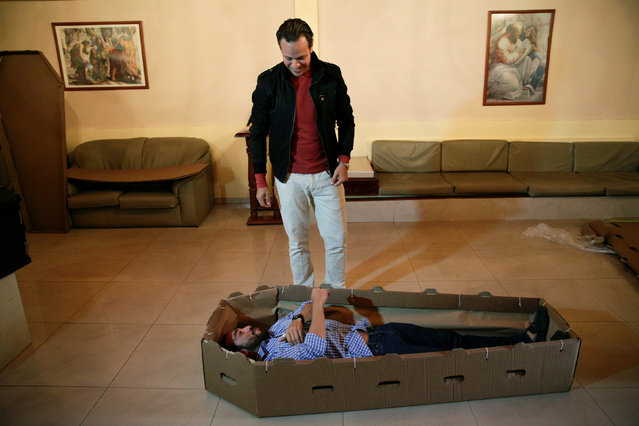
Elio Angulo (bottom C) lies inside a cardboard coffin next to Alejandro Blanchard as they introduce their product to potential customers at a mortuary in Valencia, in the state of Carabobo, Venezuela August 25, 2016. (Photo by Marco Bello/Reuters)

Elio Angulo (bottom C) lies inside a cardboard coffin next to Alejandro Blanchard as they introduce their product to potential customers at a mortuary in Valencia, in the state of Carabobo, Venezuela August 25, 2016. When Venezuelan entrepreneurs Alejandro Blanchard and Elio Angulo decided to create cardboard coffins, they were looking for an ecological selling point to compete against classic wood and brass caskets. Three years on, with the oil-rich country mired in deep economic crisis, their “bio-coffins” are becoming a viable option because of high prices for wooden coffins and shortages of brass ones. (Photo by Marco Bello/Reuters)
Details
27 Aug 2016 11:18:00
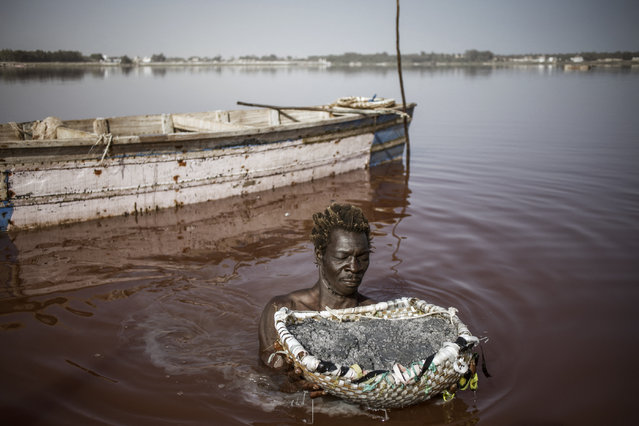
Toure, a Gambian salt harvester, holds a basket filled with  the salt collected from the crust of the bottom of the Lake Retba (Pink Lake) in Senegal on March 16, 2021. Lake Retba, divided from the Atlantic Ocean by a narrow corridor of dunes, owes its name to the pink waters caused by the Dunaliella salina algae and is known for its high salt content, up to 40% in some areas. (Photo by Marco Longari/AFP Photo)

Toure, a Gambian salt harvester, holds a basket filled with the salt collected from the crust of the bottom of the Lake Retba (Pink Lake) in Senegal on March 16, 2021. Lake Retba, divided from the Atlantic Ocean by a narrow corridor of dunes, owes its name to the pink waters caused by the Dunaliella salina algae and is known for its high salt content, up to 40% in some areas. (Photo by Marco Longari/AFP Photo)
Details
24 Mar 2021 10:29:00
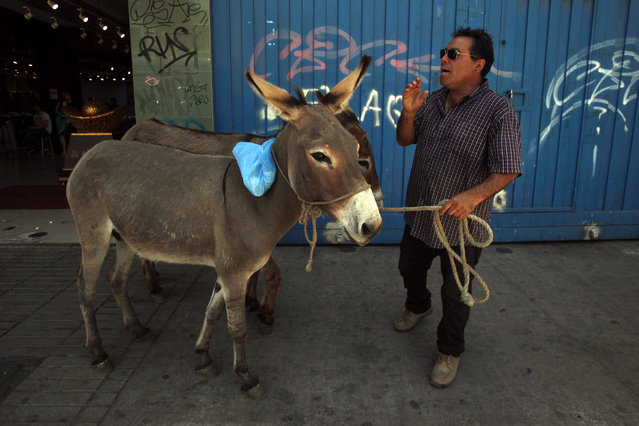
In this December 13, 2014 photo, Ricardo Alegria holds his donkeys by a leash as he yells to sell their milk in the streets of Santiago, Chile. Alegria, along with his brother Marco, has been selling fresh donkey milk for the past 25 years, and says it's recommended as a vitamin boost. Shot glass size cups of the drink sell for about $2 dollars. Half a liter, which is the most he says his donkeys can give in one day, sells for about $20 dollars. (Photo by Luis Hidalgo/AP Photo)

In this December 13, 2014 photo, Ricardo Alegria holds his donkeys by a leash as he yells to sell their milk in the streets of Santiago, Chile. Alegria, along with his brother Marco, has been selling fresh donkey milk for the past 25 years, and says it's recommended as a vitamin boost. Shot glass size cups of the drink sell for about $2 dollars. Half a liter, which is the most he says his donkeys can give in one day, sells for about $20 dollars. (Photo by Luis Hidalgo/AP Photo)
Details
26 Dec 2014 15:01:00