Loading...
Done
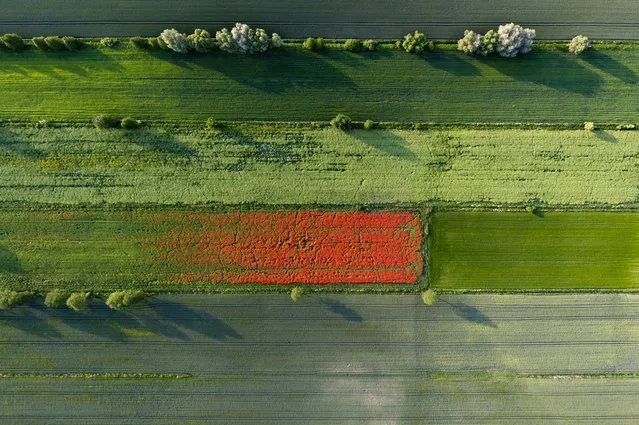
A view over fields of grain in Spring white chamomile, blue cornflower and other weeds growing amongst the grain sprouts. (Photo by Kacper Kowalski/Panos Pictures)

In his book “Side Effects”, aerial photographer Kacper Kowalski took to the skies to paint a portrait of the complex relationship between humans and nature. From the sky, he captured where nature and civilization collide into aesthetic, abstract colors and shapes. Photo: A view over fields of grain in Spring chamomile, cornflower and other weeds growing amongst the grain sprouts. (Photo by Kacper Kowalski/Panos Pictures)
Details
04 Sep 2014 08:19:00
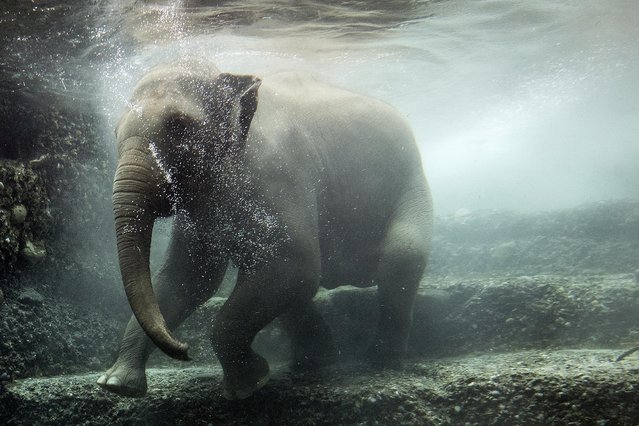
The elephant cow Omysha dives under water in its enclosure at the Zoo in Zurich, Switzerland, Wednesday, February 3, 2021. (Photo by Alexandra Wey/Keystone via AP Photo)

The elephant cow Omysha dives under water in its enclosure at the Zoo in Zurich, Switzerland, Wednesday, February 3, 2021. (Photo by Alexandra Wey/Keystone via AP Photo)
Details
14 Feb 2021 09:33:00
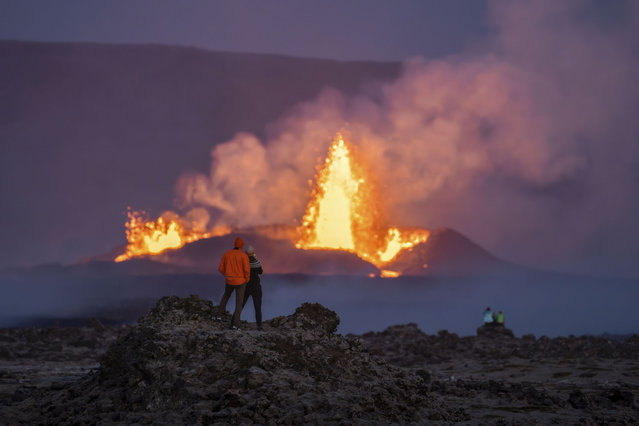
People watch the erupting craters and the lava fountains from the old lava fields around the eruption site on the Reykjanes Peninsula, in Iceland, Wednesday, August 28, 2024. (Photo by Marco di Marco/AP Photo)

People watch the erupting craters and the lava fountains from the old lava fields around the eruption site on the Reykjanes Peninsula, in Iceland, Wednesday, August 28, 2024. (Photo by Marco di Marco/AP Photo)
Details
19 Nov 2024 04:00:00
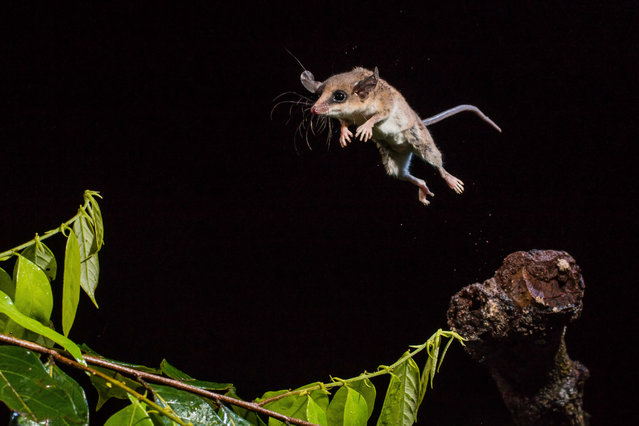
Tropical acrobatics by Adrià López Baucells in Manaus, Brazil. An unidentified South American marsupial, although the characteristic black markings on its face indicate it may be a mouse opossum. These small creatures are nocturnal and feed on bugs, fruit and bird eggs. (Photo by Adrià López Baucells/2019 Royal Society of Biology Photography Competition)

Tropical acrobatics by Adrià López Baucells in Manaus, Brazil. An unidentified South American marsupial, although the characteristic black markings on its face indicate it may be a mouse opossum. These small creatures are nocturnal and feed on bugs, fruit and bird eggs. (Photo by Adrià López Baucells/2019 Royal Society of Biology Photography Competition)
Details
10 Oct 2019 00:03:00
White House Communications Director and presidential advisor Hope Hicks arrives at the U.S. Capitol Visitors Center February 27, 2018 in Washington, DC. Hicks is scheduled to testify behind closed doors to the House Intelligence Committee in its ongoing investigation into Russia's interference in the 2016 election. (Photo by Chip Somodevilla/Getty Images)

White House Communications Director and presidential advisor Hope Hicks arrives at the U.S. Capitol Visitors Center February 27, 2018 in Washington, DC. Hicks is scheduled to testify behind closed doors to the House Intelligence Committee in its ongoing investigation into Russia's interference in the 2016 election. (Photo by Chip Somodevilla/Getty Images)
Details
02 Mar 2018 07:15:00
A team of female cadets takes part in a tug-of-war competition at Budyonny Military Academy of the Signal Corps in St Petersburg, Russia on March 7, 2021. (Photo by Peter Kovalev/TASS/Profimedia)

A team of female cadets takes part in a tug-of-war competition at Budyonny Military Academy of the Signal Corps in St Petersburg, Russia on March 7, 2021. (Photo by Peter Kovalev/TASS/Profimedia)
Details
11 Mar 2021 09:54:00
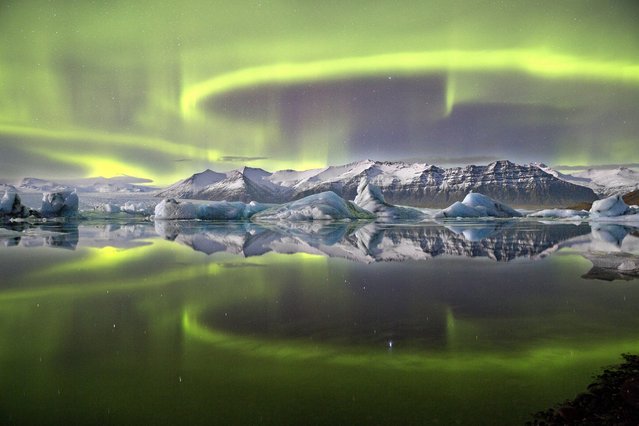
“Aurora over a glacier lagoon”. A vivid green overheaded aurrora pictured in Iceland's Vatnajokull National Park reflected almost symetrically in Jokulsrlon Glacier lagoon. A complete lack of wind and currrent combin in this sheltred lagoon scene to crete an arresting mirror effect giving the image a sensation of utter stillness. Despite theis there is motion on a suprising scale, as the loops and arcs of the aurora are shaped by the shifting forces of the Earth's magnetic field. (Photo by  James Woodend/The Astronomy Photographer of the Year 2014 Contest)

“Aurora over a glacier lagoon”. A vivid green overheaded aurrora pictured in Iceland's Vatnajokull National Park reflected almost symetrically in Jokulsrlon Glacier lagoon. A complete lack of wind and currrent combin in this sheltred lagoon scene to crete an arresting mirror effect giving the image a sensation of utter stillness. Despite theis there is motion on a suprising scale, as the loops and arcs of the aurora are shaped by the shifting forces of the Earth's magnetic field. James Woodend of Great Britain won the grand prize with the image, beating out more than 2,500 other entries. The Astronomy Photographer of the Year 2014 contest is judged by the Royal Observatory Greenwich and BBC Sky at Night magazine. (Photo by James Woodend/The Astronomy Photographer of the Year 2014 Contest)
Details
26 Sep 2014 13:39:00
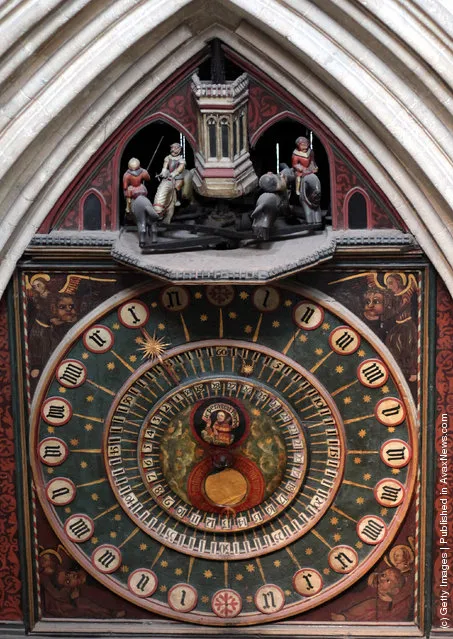
Wells Clock – World's Oldest Mechanical Clock

“Wells Cathedral is a Church of England cathedral in Wells, Somerset, England. Built between 1175 and 1490, Wells Cathedral has been described as “the most poetic of the English Cathedrals”. The Wells clock, an astronomical clock, is located in the north transept. The surviving mechanism, dated to between 1386 and 1392, was replaced in the 19th century, and was eventually moved to the Science Museum in London, where it continues to operate. It is the second-oldest surviving clock in England”. – Wikipedia

Photo: The clock face of world's oldest continually-working mechanical clock is seen as it is hand wound for the very last time on August 21, 2010 in Wells, England. (Photo by Matt Cardy/Getty Images)
Details
10 Aug 2011 11:23:00