Loading...
Done
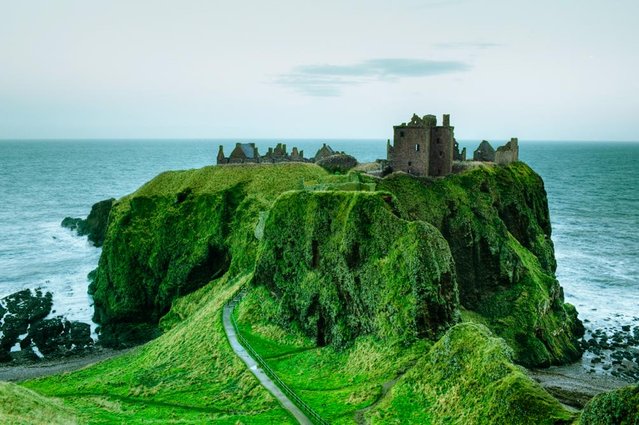
Dunnottar Castle In Scottish

Dunnottar Castleis a ruined medieval fortress located upon a rocky headland on the north-east coast of Scotland, about 3 kilometres (1.9 mi) south of Stonehaven. The surviving buildings are largely of the 15th and 16th centuries, but the site is believed to have been fortified in the Early Middle Ages. Dunnottar has played a prominent role in the history of Scotland through to the 18th-century Jacobite risings because of its strategic location and the strength of its situation. Dunnottar is best known as the place where the Honours of Scotland, the Scottish crown jewels, were hidden from Oliver Cromwell's invading army in the 17th century. The property of the Keiths from the 14th century, and the seat of the Earl Marischal, Dunnottar declined after the last Earl forfeited his titles by taking part in the Jacobite rebellion of 1715. The castle was restored in the 20th century and is now open to the public.
Details
13 Jan 2014 11:31:00
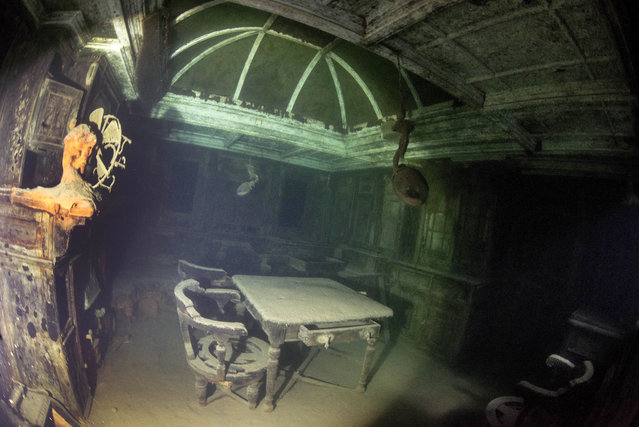
Not many divers visit the Gunilda, due to its remote location, depths of 270 feet, and chilly (38 degrees F/3 degrees C) temperatures. (Photo by Becky Kagan Schott/Caters News Agency)

These stunning images reveal the remains of a more than century-old sunken ship that has been preserved beneath freezing Lake Superior. The ship looks almost exactly the same as it did the day it sunk beneath waves all those years ago. At 60 meters long (approximately 198 feet), the «Gunilda» sunk after it struck some rocks and was not saved. Now, these stunning images have been captured 107 years after the sinking when a small group of divers revisited the vessel. (Photo by Becky Kagan Schott/Caters News Agency)
Details
25 Apr 2018 00:01:00
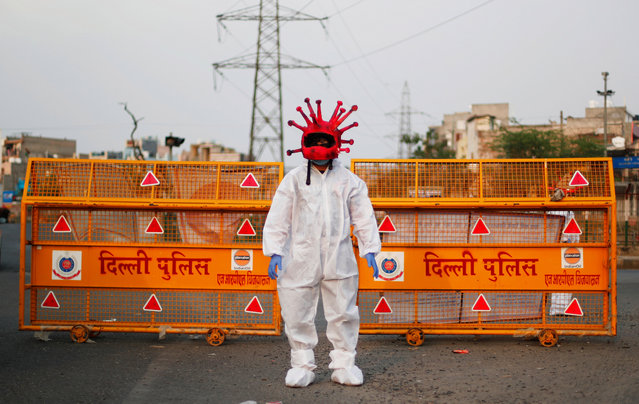
An artist wearing a coronavirus-shaped helmet and a protective suit stands next to a police barricade as he requests people to stay at home during an extended lockdown to slow the spread of the coronavirus disease (COVID-19) in New Delhi, India, April 30, 2020. (Photo by Adnan Abidi/Reuters)

An artist wearing a coronavirus-shaped helmet and a protective suit stands next to a police barricade as he requests people to stay at home during an extended lockdown to slow the spread of the coronavirus disease (COVID-19) in New Delhi, India, April 30, 2020. (Photo by Adnan Abidi/Reuters)
Details
12 May 2020 00:05:00
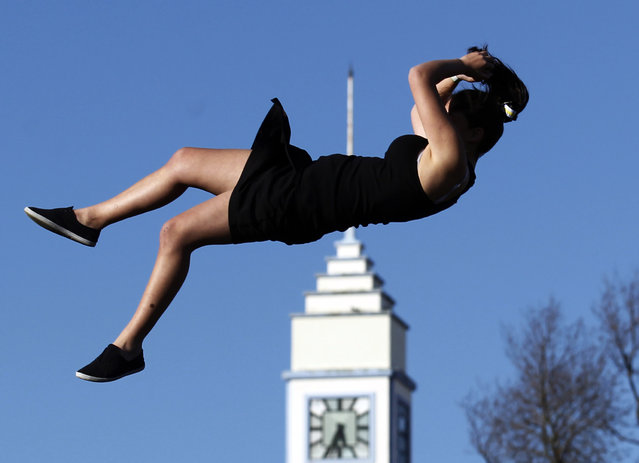
8. NEW ZEALAND: A woman dives from a platform into a giant air bed at a park in Palmerston North September 29, 2011. (Photo by Marcos Brindicci/Reuters)

The report, prepared by the Sustainable Development Solutions Network (SDSN) and the Earth Institute at Columbia University, showed Syria, Afghanistan and eight sub-Saharan countries as the 10 least happy places on earth to live. The top 10 this year were Denmark, Switzerland, Iceland, Norway, Finland, Canada, Netherlands, New Zealand, Australia, and Sweden. Denmark was in third place last year, behind Switzerland and Iceland. The bottom 10 were Madagascar, Tanzania, Liberia, Guinea, Rwanda, Benin, Afghanistan, Togo, Syria and Burundi. The United States came in at 13, the United Kingdom at 23, France at 32, and Italy at 50. Here: #8. NEW ZEALAND: A woman dives from a platform into a giant air bed at a park in Palmerston North September 29, 2011. (Photo by Marcos Brindicci/Reuters)
Details
26 Mar 2016 13:19:00
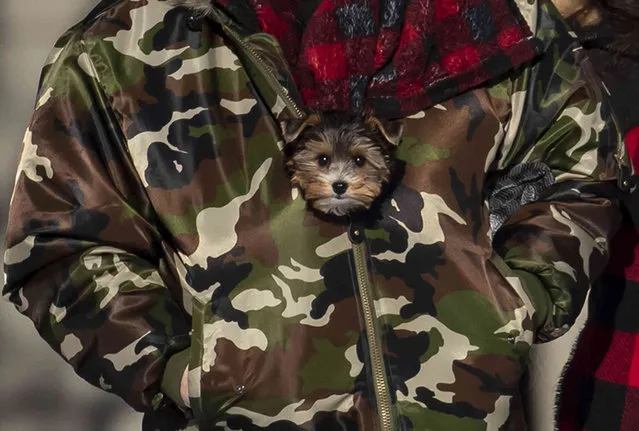
A man bundled up for the cold weather carries a dog in his jacket while walking along the waterfront in New Westminster, British Columbia, Tuesday, December 28, 2021. Environment Canada has issued an arctic outflow warning for Metro Vancouver and the south coast with well below normal temperatures forecast for the region. (Photo by Darryl Dyck/The Canadian Press via AP Photo)

A man bundled up for the cold weather carries a dog in his jacket while walking along the waterfront in New Westminster, British Columbia, Tuesday, December 28, 2021. Environment Canada has issued an arctic outflow warning for Metro Vancouver and the south coast with well below normal temperatures forecast for the region. (Photo by Darryl Dyck/The Canadian Press via AP Photo)
Details
09 Jan 2022 05:06:00
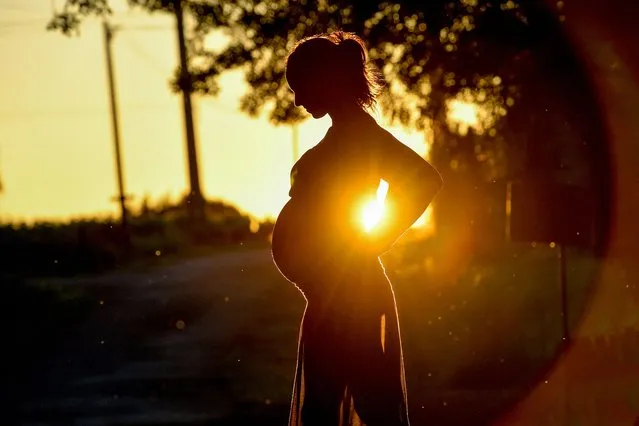
A pregnant woman poses on June 19, 2018 in Vertou, western France. France had an estimated population of 68.4 million by January 1, 2024, representing a further year-on-year increase of 0.3 percent, limited by a marked drop in the birth rate, the INSEE national statistics bureau of France reported on January 16, 2024. In 2023, 678,000 babies were born in France, 6.6 percent fewer than the previous year, the lowest number of births in any year since 1946. Over the same period, there were 631,000 deaths, down 6.5 percent on 2022, a year marked by the consequences of the Covid-19 pandemic and episodes of extreme heat. (Photo by Loic Venance/AFP Photo)

A pregnant woman poses on June 19, 2018 in Vertou, western France. France had an estimated population of 68.4 million by January 1, 2024, representing a further year-on-year increase of 0.3 percent, limited by a marked drop in the birth rate, the INSEE national statistics bureau of France reported on January 16, 2024. In 2023, 678,000 babies were born in France, 6.6 percent fewer than the previous year, the lowest number of births in any year since 1946. Over the same period, there were 631,000 deaths, down 6.5 percent on 2022, a year marked by the consequences of the Covid-19 pandemic and episodes of extreme heat. (Photo by Loic Venance/AFP Photo)
Details
27 Feb 2024 07:29:00
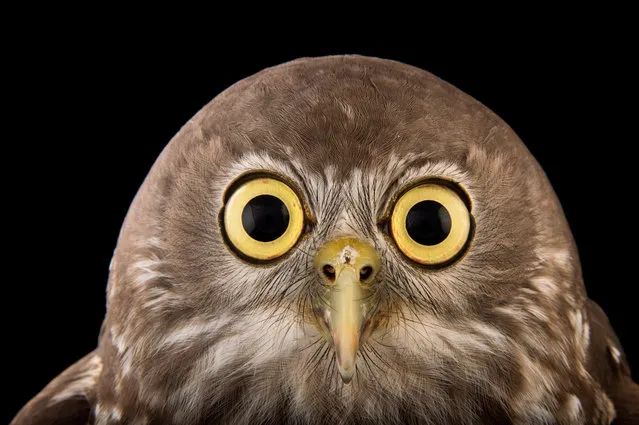
The National Geographic Photo Ark is a travelling exhibition of photographer Joel Sartore’s quest to create a photo archive of biodiversity around the world. So far, Sartore has captured studio portraits of more than 6,000 species – a number that he hopes to double. On 1 July, the ark will open at Melbourne zoo – the first time it has been exhibited in the southern hemisphere. More than 50 portraits will be on display, including many of Australian endangered animals being protected by programs at the zoo itself. These captions have been edited from text supplied by Melbourne zoo. Here: Barking owl. So-named because its call sounds like a barking dog, these birds are native to Australia, Indonesia and Papua New Guinea. In Victoria they are listed as an endangered species, and in 2003 there were estimated to be fewer than 50 breeding pairs. The main threat to the species in Victoria is loss of habitat, especially large trees with hollows in which they can nest and on which many of their prey depend. Apart from a bark, they may utter a chilling scream when they feel threatened. (Photo by Joel Sartore/National Geographic Photo Ark/The Guardian)

The National Geographic Photo Ark is a travelling exhibition of photographer Joel Sartore’s quest to create a photo archive of biodiversity around the world. So far, Sartore has captured studio portraits of more than 6,000 species – a number that he hopes to double. On 1 July, the ark will open at Melbourne zoo – the first time it has been exhibited in the southern hemisphere. More than 50 portraits will be on display, including many of Australian endangered animals being protected by programs at the zoo itself. These captions have been edited from text supplied by Melbourne zoo. Here: Barking owl. (Photo by Joel Sartore/National Geographic Photo Ark/The Guardian)
Details
01 Jul 2017 07:45:00
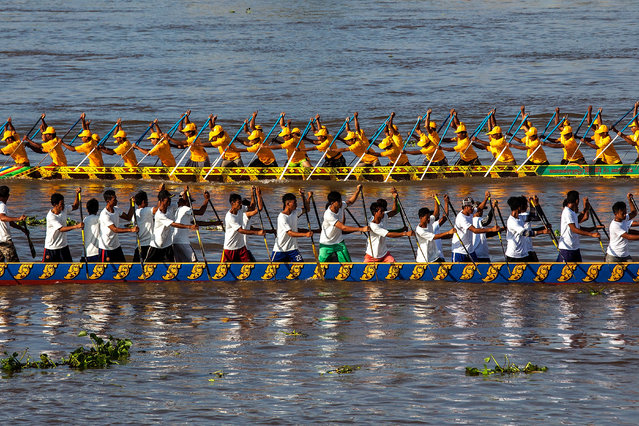
Boat crew members train on the waters of the Tonle Sap River on the morning of the first day of the Water Festival on November 13, 2016 in Phnom Penh, Cambodia. The yearly three-day Water Festival is one of the most important holidays in Cambodia and celebrates the end of the rainy season and the start of the rice harvesting. The Festival also coincides with the Tonle Sap river reversing course, which it does twice a year. Approximately 2 million people are expected to attend this year's festival, during which 259 boats and nearly 20,000 oarsmen will participate in the races. After a fatal stampede resulting in the death of some 353 people during the Water Festival in 2010, it has been cancelled four times over the past five years, with weather used as an official excuse. (Photo by Omar Havana/Getty Images)

Boat crew members train on the waters of the Tonle Sap River on the morning of the first day of the Water Festival on November 13, 2016 in Phnom Penh, Cambodia. The yearly three-day Water Festival is one of the most important holidays in Cambodia and celebrates the end of the rainy season and the start of the rice harvesting. The Festival also coincides with the Tonle Sap river reversing course, which it does twice a year. Approximately 2 million people are expected to attend this year's festival, during which 259 boats and nearly 20,000 oarsmen will participate in the races. After a fatal stampede resulting in the death of some 353 people during the Water Festival in 2010, it has been cancelled four times over the past five years, with weather used as an official excuse. (Photo by Omar Havana/Getty Images)
Details
15 Nov 2016 11:26:00