Loading...
Done
A reef shell lies on a beach as the sun sets on Lady Elliot Island located north-east of the town of Bundaberg in Queensland, Australia, June 10, 2015. (Photo by David Gray/Reuters)

A reef shell lies on a beach as the sun sets on Lady Elliot Island located north-east of the town of Bundaberg in Queensland, Australia, June 10, 2015. UNESCO World Heritage delegates recently snorkelled on Australia’s Great Barrier Reef, thousands of coral reefs, which stretch over 2,000 km off the northeast coast. Surrounded by manta rays, dolphins and reef sharks, their mission was to check the health of the world's largest living ecosystem, which brings in billions of dollars a year in tourism. Some coral has been badly damaged and animal species, including dugong and large green turtles, are threatened. UNESCO will say on Wednesday whether it will place the reef on a list of endangered World Heritage sites, a move the Australian government wants to avoid at all costs, having lobbied hard overseas. Earlier this year, UNESCO said the reef's outlook was “poor”. (Photo by David Gray/Reuters)
Details
30 Jun 2015 12:21:00
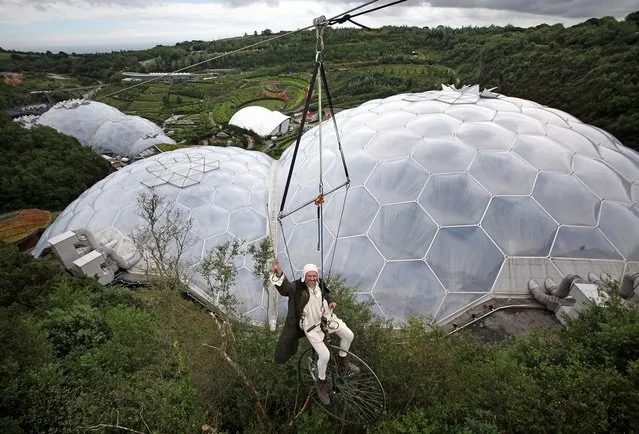
England's Longest Zip Wire Opens At The Eden Project

Marco Fiera from NoFit State Circus tries out the SkyWire, the new zip wire attraction which opens to the public this week at The Eden Project on July 17, 2012 in St Austell, England. The new 740m zip wire, currently the longest in England, allows the public a bird's eye view of the iconic Rainforest and Mediterranean Biome structures as well as the Cornish attractions outdoor gardens. The Eden Project – which opened in 2001 and has attracted over one million visitors – showcases 100,000 plants from around the world in two giant transparent domes, one of which is the world's largest greenhouse, each recreating different climate conditions. (Photo by Matt Cardy)
Details
19 Jul 2012 10:00:00
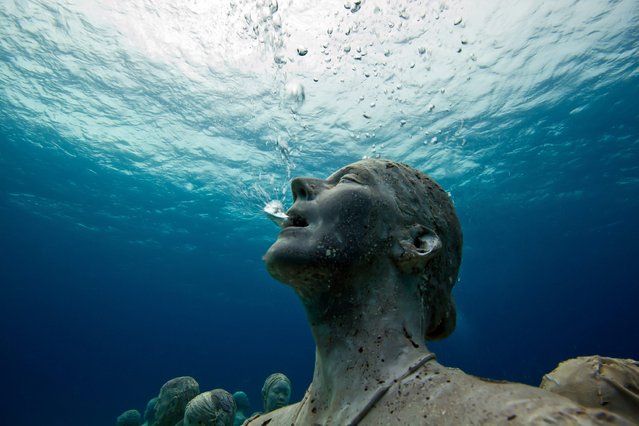
Monumental Underwater Museum MUSA; Jason deCaires Taylor; Silent Evolution

“In 2009 a monumental underwater museum called “MUSA” (Museo Subacuático de Arte) was formed in the waters surrounding Cancun, Isla Mujeres and Punta Nizuc. The project founded by Jaime Gonzalez Cano of The National Marine Park, Roberto Diaz of The Cancun Nautical Association and Jason deCaires Taylor consists of over 450 permanent life-size sculptures and is one of the largest and most ambitious underwater artificial art attractions in the world”. – UnderwaterSculpture (Photos by Jason deCaires Taylor/Intrepidacious/Kozy and Dan Kitchens)

Details
05 Oct 2012 07:26:00
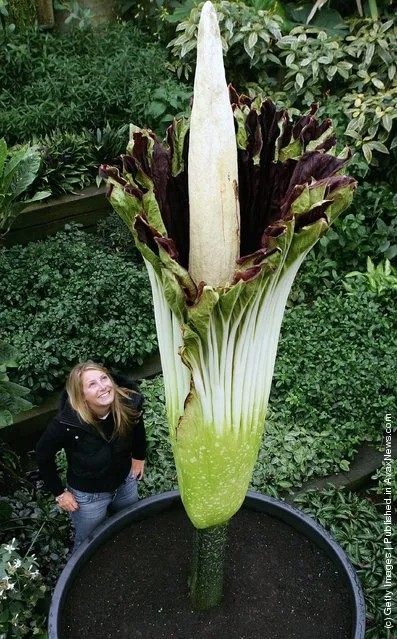
Kew Gardens employee Lauren Bird Royal examines the flowering of the Titan Arum lily at the Botanical Gardens

“The titan arum or Amorphophallus titanum (from Ancient Greek amorphos, “without form, misshapen” + phallos, “phallus”, and titan, “giant”) is a flowering plant with the largest unbranched inflorescence in the world. The titan arum's inflorescence is not as large as that of the Talipot palm, Corypha umbraculifera, but the inflorescence of the Talipot palm is branched rather than unbranched”. – Wikipedia

Photo: Kew Gardens employee Lauren Bird Royal examines the flowering of the Titan Arum lily at the Botanical Gardens at Kew on September 30, 2005 in London, England. For the first time in horticultural history, the Titan Arum lily can be seen at all three active stages in its lifecycle – in flower, fruit and leaf.The flowering corm is nearly three metres tall and weighs 91kg and is very rarely seen outside of the rainforests of Sumatra, Indonesia. (Photo by Scott Barbour/Getty Images)
Details
20 Sep 2011 11:13:00
Devotees bow to a passingTibetan Buddhist monk on his way to take part in a special prayer during Monlam or the Great Prayer rituals on March 5, 2015 at the Labrang Monastery, Xiahe County, Amdo, Tibetan Autonomous Prefecture, Gansu Province, China. (Photo by Kevin Frayer/Getty Images)

Devotees bow to a passingTibetan Buddhist monk on his way to take part in a special prayer during Monlam or the Great Prayer rituals on March 5, 2015 at the Labrang Monastery, Xiahe County, Amdo, Tibetan Autonomous Prefecture, Gansu Province, China. Labrang Monastery is one of the six great monasteries of the Gelug school of Tibetan Buddhism and one of the largest outside of the Tibetan Autonomous Region. Monlam, the most important prayer event for many Tibetans was banned during the Cultural Revolution in China but once again in recent years it is celebrated in many areas. (Photo by Kevin Frayer/Getty Images)
Details
14 Mar 2015 14:37:00
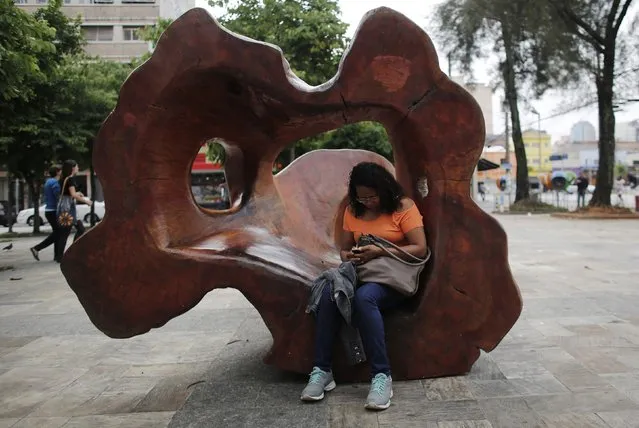
A resident types a text message on her mobile phone, as she sits on a bench made from a tree, which is a creation by Brazilian artist Hugo Franca at Largo da Batata square in Sao Paulo March 17, 2015. (Photo by Nacho Doce/Reuters)

A resident types a text message on her mobile phone, as she sits on a bench made from a tree, which is a creation by Brazilian artist Hugo Franca at Largo da Batata square in Sao Paulo March 17, 2015. Franca, a designer from Sao Paulo is working with the city to make use of fallen trees to turn them into sculpture furniture to line the city's parks, streets and plazas. Brazil's largest city was slammed by several strong storms this rainy season that brought with them heavy rain, lightning and winds as high as 90 kilometres (55 miles) per hour. (Photo by Nacho Doce/Reuters)
Details
20 Mar 2015 11:34:00
North Korean leader Kim Jong Il inspects a military unit in North Korea

“Kim Jong-il, also written as Kim Jong Il, birth name Yuri Irsenovich Kim (according to Soviet records) (16 February 1941/2 – 17 December 2011), was the supreme Leader of the Democratic People's Republic of Korea (North Korea). He was the General Secretary of the Workers' Party of Korea, the ruling party since 1948, Chairman of the the National Defence Commission of North Korea, and the Supreme Commander of the Korean People's Army, the fourth-largest standing army in the world”. – Wikipedia

Photo: North Korean leader Kim Jong Il inspects a military unit in North Korea. (Photo by Korean Central Television/Yonhap)
Details
19 Dec 2011 10:38:00
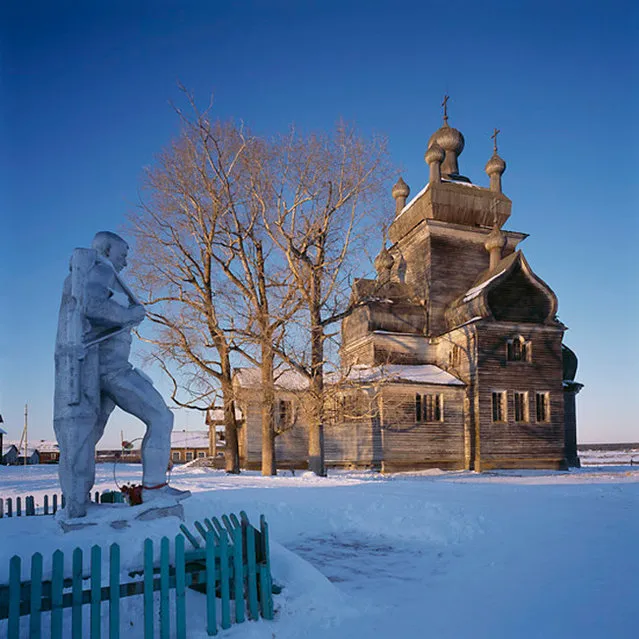
Wooden Churches - Travelling In The Russian North By Richard Davies Part 2

While communism, collectivism, worms, dry rot and casual looting failed to destroy the majestic wooden churches of Russia, it may be ordinary neglect that finally does them in. Dwindled now to several hundred remaining examples, these glories of vernacular architecture lie scattered amid the vastness of the world’s largest country. Just over a decade ago, Richard Davies, a British architectural photographer, struck out on a mission to record the fragile and poetic structures. Austerely beautiful and haunting, “Wooden Churches: Traveling in the Russian North” (White Sea Publishing; $132) is the result. Covering thousands of miles, Mr. Davies described how he and the writer Matilda Moreton tracked down the survivors from among the thousands of onion-domed structures built after Prince Vladimir converted to Christianity in 988.

See also: Wooden Churches Part1
Details
28 Nov 2013 12:13:00