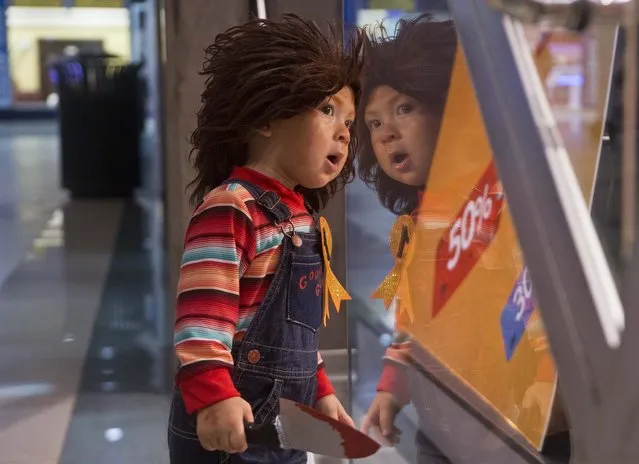
Juan Carlos Vilchez, 18-months-old, dressed to represent horror movie icon Chucky, looks into a storefront mall window, in Managua, Nicaragua, Friday, October 31, 2014. Juan Carlos is wearing a first place winner that he won earlier, for best Halloween costume in his age group. (Photo by Esteban Felix/AP Photo)
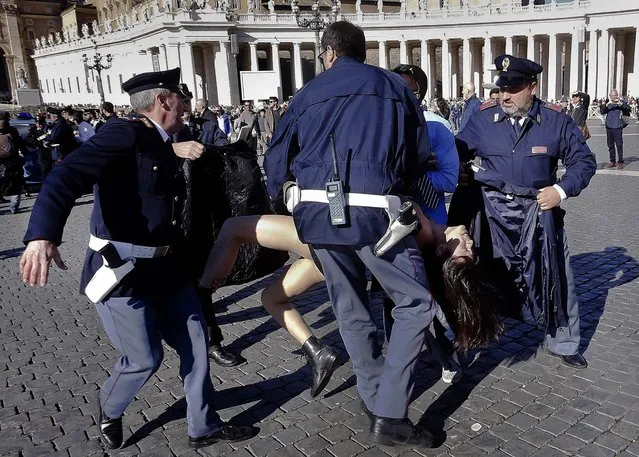
Italian police officers carry away a FEMEN activist during a protest in St. Peter's Square at the Vatican, Friday, November 14, 2014. Members of the Ukrainian feminist group Femen staged a protest against the upcoming visit of Pope Francis at the European Parliament and Council. (Photo by AP Photo)
Damai, 3 years old Bornean orang utan plays courtyard at Surabaya Zoo as he prepares to be released into the wild on May 19, 2014 in Surabaya, Indonesia. The two baby orangutans, brothers, were found in Kutai National Park in a critical condition having been abandoned by their mother on May 14, 2014. The Centre for Orangutan Protection (COP) have since been nursing the animals back to health, treating them for malnourishment and 16 wounds predominantly to the feet and hands. (Photo by Robertus Pudyanto/Getty Images)
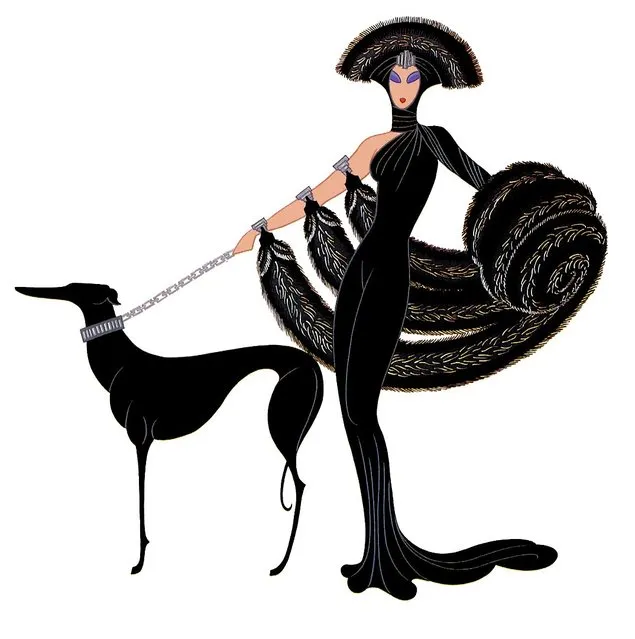
“Romain de Tirtoff (23 November 1892 – 21 April 1990) was a Russian-born French artist and designer known by the pseudonym Erté, the French pronunciation of his initials, R.T. He was a diversely talented 20th-century artist and designer who flourished in an array of fields, including fashion, jewellery, graphic arts, costume and set design for film, theatre, and opera, and interior decor”. – Wikipedia. Photo: Romain de Tirtoff (Erte) – “Symphony In Black” (please click to enlarge).
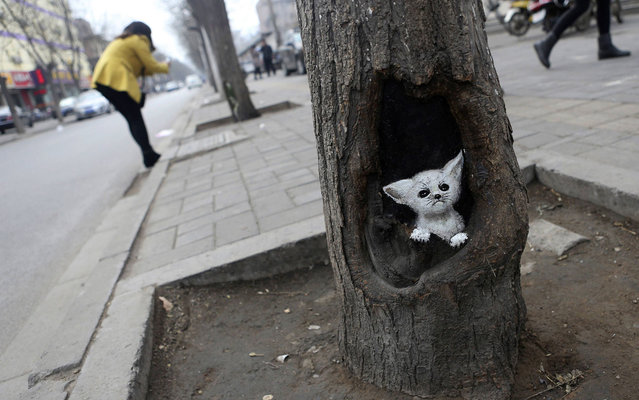
An image of a Fennec fox painted on a tree hole by Wang Yue is seen in Shijiazhuang, on March 13, 2013. Wang Yue, a senior at Dalian Industry University, uses her paintbrush to turn ugly tree holes into lovely views in Shijiazhuang, capital city of Hebei Province, China. Wang and her companions call the tree-hole paintings “meitu”, which means “beautiful journey”. The paintings on the trees have brightened the city during the dull, grey winter. (Photo by Pillar Lee/Reuters)
P.S. All pictures are presented in high resolution. To see Hi-Res images – just TWICE click on any picture. In other words, click small picture – opens the BIG picture. Click BIG picture – opens VERY BIG picture (if available; this principle works anywhere on the site AvaxNews).
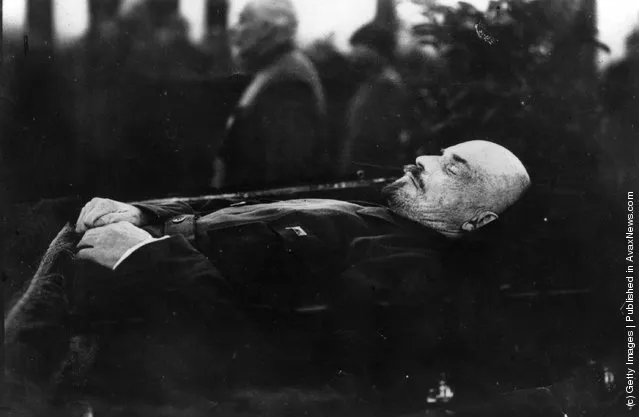
Photo: Vladimir Ilyich Lenin (1870 – 1924) lying in state in the Kremlin. (Photo by Hulton Archive/Getty Images). 1924
Important! For the same article in Russian language click here.
Something quite intriguing is happening within Russian-speaking internet during the last few – should you type a fully academic inquiry (at least, according to Russian academic requirements) in national search engines for "Lenin's mausoleum" – the first thing you get (even in top 10 searches) is website pages talking about black magic and occult. Website authors view this construction differently, but unconditionally agree on one thing: the mausoleum of the "leader of the world proletariat” – the essence of a magical artifact, a sort of “energy vampire”. It was built with a certain purpose: to drain the energy out of miserable Soviet citizens on one hand; and to poison the anthroposphere of one-sixth part of the earth with its vibes (the exact territory that was occupied by the former Soviet Union), depriving the Russian people of will to resist on the other hand. Complete nonsense? No doubt. Nevertheless, an intriguing one. Well, probably because some oddities do exist in mausoleum's history. These oddities are the thing we are going to discuss this time. First, let me refresh you memory on the subject.
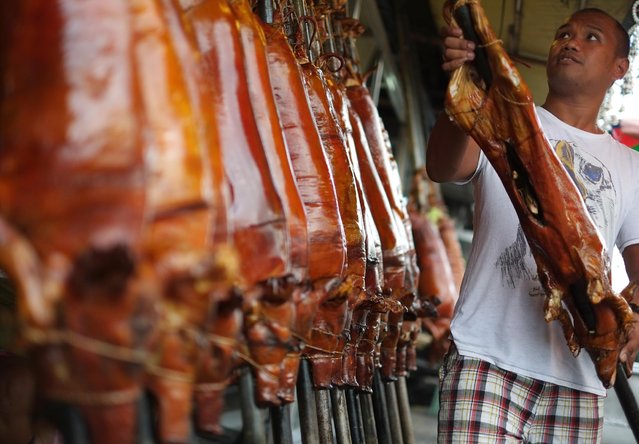
A Filipino worker arranges roasted pigs which they sell in suburban Quezon city, Philippines on Tuesday, December 23, 2014. Roasted pig is popular during Filipino celebrations and traditionally served during a Christmas eve dinner called “Noche Buena” in this predominantly Roman Catholic nation. (Photo by Aaron Favila/AP Photo)