Loading...
Done
A tear rolls down the cheek of Karima el-Mahroug, also known as Ruby, a Moroccan woman at the center of ex-Premier Silvio Berlusconi's s*x-for-hire trial, as she reads a statement to reporters during a protest outside the court house, in Milan, Italy, Thursday, April 4, 2013. The Moroccan woman at the center of ex-Premier Silvio Berlusconi's s*x-for-hire trial has denounced what she says is psychological warfare being waged against her by Italian prosecutors. Ruby, read out a lengthy statement Thursday to a gaggle of reporters in front of Milan's courthouse denying she was a prostitute and insisting that prosecutors hear her side of the story. (Photo by Luca Bruno/AP Photo)

A tear rolls down the cheek of Karima el-Mahroug, also known as Ruby, a Moroccan woman at the center of ex-Premier Silvio Berlusconi's s*x-for-hire trial, as she reads a statement to reporters during a protest outside the court house, in Milan, Italy, Thursday, April 4, 2013. The Moroccan woman at the center of ex-Premier Silvio Berlusconi's s*x-for-hire trial has denounced what she says is psychological warfare being waged against her by Italian prosecutors. Ruby, read out a lengthy statement Thursday to a gaggle of reporters in front of Milan's courthouse denying she was a prostitute and insisting that prosecutors hear her side of the story. (Photo by Luca Bruno/AP Photo)
Details
14 May 2013 10:44:00
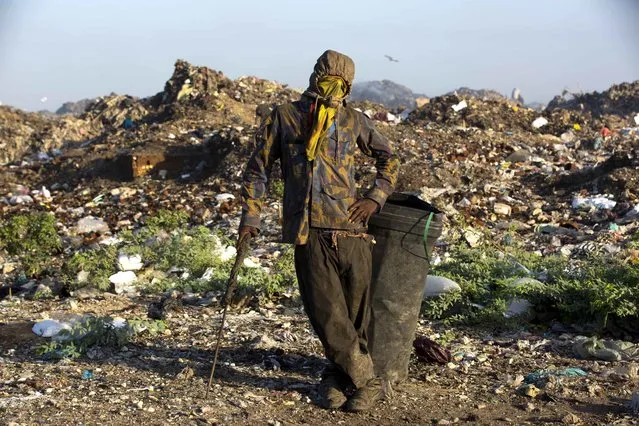
In this August 24, 2018 photo, Changlair Aristide pauses for a portrait, wearing his protective clothing, including an old U.N. peacekeeper's jacket he found in the trash, before scavenging the Truitier landfill in the Cite Soleil slum of Port-au-Prince, Haiti. Before 2004, Aristide recalled having enough money to splurge on shoes, T-shirts and pants, but this year he could not buy his kids anything new for the school year. “Life is like that, up and down”, Aristide said. “They'll go to school anyway, even if I have to sell my pig. I love them”. (Photo by Dieu Nalio Chery/AP Photo)

In this August 24, 2018 photo, Changlair Aristide pauses for a portrait, wearing his protective clothing, including an old U.N. peacekeeper's jacket he found in the trash, before scavenging the Truitier landfill in the Cite Soleil slum of Port-au-Prince, Haiti. Before 2004, Aristide recalled having enough money to splurge on shoes, T-shirts and pants, but this year he could not buy his kids anything new for the school year. “Life is like that, up and down”, Aristide said. “They'll go to school anyway, even if I have to sell my pig. I love them”. (Photo by Dieu Nalio Chery/AP Photo)
Details
03 Oct 2018 00:03:00
Roof-topping enthusiast Daniel Lau takes a selfie with high-rise buildings down below as he stands on the top of a skyscraper in Hong Kong, China on August 15, 2017. Welcome to “roof-topping”, where daredevils take pictures of themselves standing on the tops of tall buildings, or in some cases even dangling from them, without any safety equipment. A craze that began in Russia has now taken hold in Hong Kong, one of the world's most vertical cities, with dramatic results. “I'm an explorer”, said Daniel Lau, one of the three who climbed to the top of The Center. A student, he said roof-topping was “a getaway from my structured life”. “Before doing this, I lived like an ordinary person, having a boring life”, he said. “I wanted to do something special, something memorable. I want to let people see Hong Kong, the place they are living, from a new perspective”. Mr Lau said he had been inspired by Russian climbers and that he was unafraid of the vertiginous heights he scales. (Photo by ImagineChina/Rex Features/Shutterstock)

Roof-topping enthusiast Daniel Lau takes a selfie with high-rise buildings down below as he stands on the top of a skyscraper in Hong Kong, China on August 15, 2017. A craze that began in Russia has now taken hold in Hong Kong, one of the world's most vertical cities. Mr Lau said he had been inspired by Russian climbers and that he was unafraid of the vertiginous heights he scales. (Photo by ImagineChina/Rex Features/Shutterstock)
Details
16 Aug 2017 07:23:00
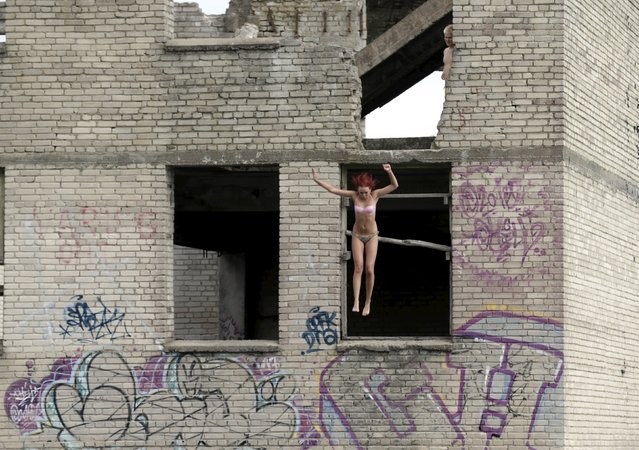
A woman jumps into water from the roof of Murru prison, an abandoned Soviet prison, in Rummu quarry, Estonia, during hot weather July 4, 2015. (Photo by Ints Kalnins/Reuters)

A woman jumps into water from the roof of Murru prison, an abandoned Soviet prison, in Rummu quarry, Estonia, during hot weather July 4, 2015. During the Soviet time, Rummu quarry was used as a mining site for Vasalemma marble and most of the workforce came from among the detainees of Murru prison. When the prison closed after 1991, pumps that once kept the quarry and the prison dry were shut down, causing water to fill the quarry. It has become an unofficial and unguarded swimming and diving spot, attracting locals and tourists. (Photo by Ints Kalnins/Reuters)
Details
05 Jul 2015 09:52:00
Russia-backed separatists stand at the site of the crashed Malaysia Airlines Flight 17 plane, near the village of Hrabove, eastern Ukraine, Thursday, July 16, 2015. The fighters said they have arrived to protect the media and make sure the MH17 crash site is clear of ammunition and mines. (Photo by Antoine E. R. Delaunay/AP Photo)

Russia-backed separatists stand at the site of the crashed Malaysia Airlines Flight 17 plane, near the village of Hrabove, eastern Ukraine, Thursday, July 16, 2015. The fighters said they have arrived to protect the media and make sure the MH17 crash site is clear of ammunition and mines. A year since a Malaysia Airlines Boeing 777 was blown out of the sky over war-ravaged eastern Ukraine, killing 298 people, there has been little official word of progress in determining what brought down Flight MH17. (Photo by Antoine E. R. Delaunay/AP Photo)
Details
18 Jul 2015 12:55:00
A woman poses next to two mailboxes along a street in Taipei on August 11, 2015 that were reportedly bent by strong winds brought by Typhoon Soudelor over the weekend. The two iron mailboxes have become an unlikely attraction, drawing thousands of snap-happy visitors and have even become a backdrop to a wedding photo shoot. (Photo by Benjamin Yeh/AFP Photo)

A woman poses next to two mailboxes along a street in Taipei on August 11, 2015 that were reportedly bent by strong winds brought by Typhoon Soudelor over the weekend. The two iron mailboxes have become an unlikely attraction, drawing thousands of snap-happy visitors and have even become a backdrop to a wedding photo shoot. The typhoon, which hit in the early hours of August 8 and was billed as the most powerful typhoon this year, uprooted trees, brought down electricity poles, knocking out power to a record 4.3 million households, while leaving eight dead and four missing. (Photo by Benjamin Yeh/AFP Photo)
Details
12 Aug 2015 13:44:00
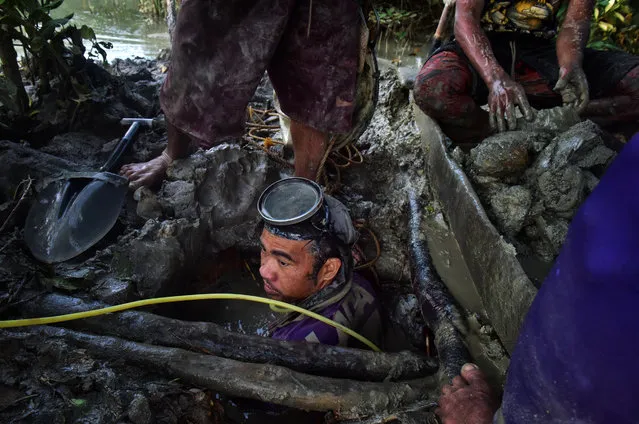
Christian Balderosdasco, 31, is being pulled up a mud pit after diving for 3 hours to look for gold on March 22, 2017 in Paracale, Philippines. (Photo by Jes Aznar/Getty Images)

Christian Balderosdasco, 31, is being pulled up a mud pit after diving for 3 hours to look for gold on March 22, 2017 in Paracale, Philippines. Apart from tunneling and sifting sand, locals dive down murky swamps with the aid of a compressor with air flowing in a small tube for breathing, as they blindly swim under the mud for up to four hours to look for tiny rocks containing gold particles. For decades, local residents at Paracale town work in hazardous conditions scavenging under the earth and diving into tunnels filled with mud using only makeshift tools to mine for gold, often placing their health and lives at risk. (Photo by Jes Aznar/Getty Images)
Details
06 Apr 2017 09:21:00
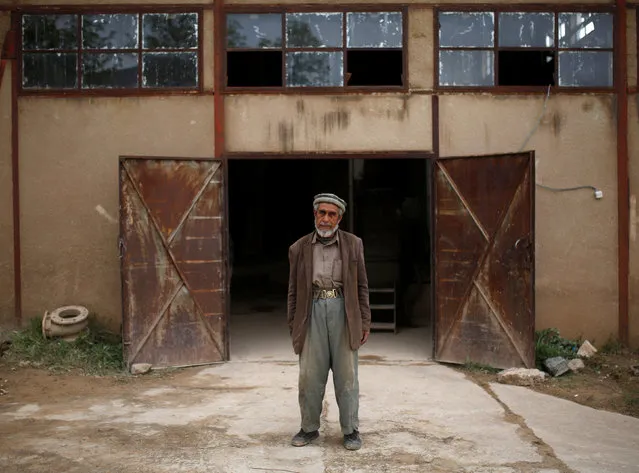
A worker at the Jabal Saraj cement factory poses for a photograph in Jabal Saraj, north of Kabul, Afghanistan April 19, 2016. (Photo by Ahmad Masood/Reuters)

A worker at the Jabal Saraj cement factory poses for a photograph in Jabal Saraj, north of Kabul, Afghanistan April 19, 2016. In an area desperately short of industry and jobs, local workers hope that the relaunch of the plant in Jabal Saraj, built by Czech engineers in 1957 and closed down by the Taliban in 1995, can show that Afghanistan's shattered industry can climb back to its feet after decades of war and destruction. But the outdated state-owned plant some 75 kilometres outside Kabul also shows how far it has to go before that promise can be achieved and there are serious questions over whether it has a viable future unless a new, modern facility is built to replace it. (Photo by Ahmad Masood/Reuters)
Details
31 May 2016 11:29:00