Loading...
Done
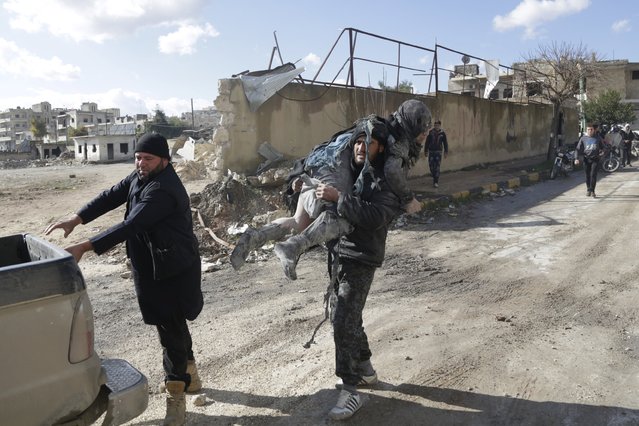
A man carries an injured woman in a site hit by what activists said were airstrikes carried out by the Russian air force in the rebel-controlled area of Maaret al-Numan town in Idlib province, Syria January 9, 2016. (Photo by Khalil Ashawi/Reuters)

A man carries an injured woman in a site hit by what activists said were airstrikes carried out by the Russian air force in the rebel-controlled area of Maaret al-Numan town in Idlib province, Syria January 9, 2016. At least 70 people died in what activists said where four vacuum bombs dropped by the Russian air force in the town of Maaret al-Numan; other air strikes where also carried out in the towns of Saraqib, Khan Sheikhoun and Maar Dabseh, in Idlib. (Photo by Khalil Ashawi/Reuters)
Details
10 Jan 2016 12:08:00
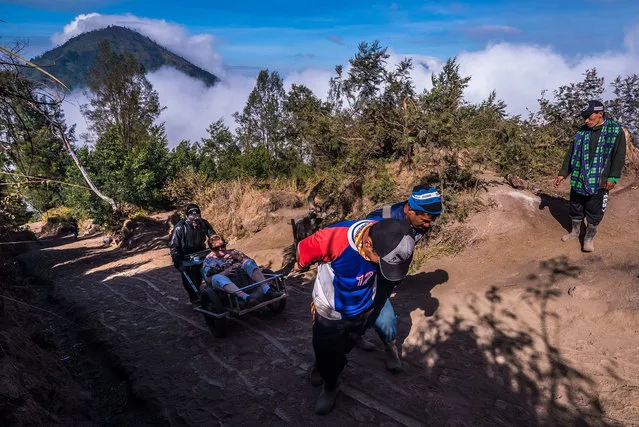
Miners pulling up lazy tourists to the rim of Kawah Ijen (Ijen Volcano), East Java, Indonesia on September 21, 2017. They will earn as much as they would bring down a load of sulfur. Nomadic Explorer, Cultural Lifestyle Photographer Claudio Sieber captured striking images of miners working at Ijen volcanic range in East Java, Indonesia. The sulphur miners risk their lives daily as they climb the active volcano carrying heavy loads, which they sell to sugar refineries. Shortly after midnight curious tourists are flocking in hundreds through the gate of Ijen's foothills to be right on time, driven by the images others took before them. Kawah Ijen is the one of the world's largest acidic volcanic crater lake; famous for its turquoise color as well as the unreal atmosphere it offers during darkness. A dusty path zigzags 3 kilometers up to the crater rim. This doesn't mean anything challenging; in particular, special sights have to be deserved anyway. The irritating smell of sulfur announces the near of the crater's existence. Arriving on the crater's rim the reward for the torture becomes visible. Blue fire darts its tongues through the fumes of sulfur dioxide. Somehow, the spectacle isn't as romantic as expected, since it is also the rough working space of approx. 150 sulfur miners who start their shift at 1 am. Lately, harvesting the abundance of devil's gold received international attention. This did obviously not really improve a miner's lifestyle; neither did it contribute to a better wage. (Photo by Claudio Sieber/Barcroft Images)

Miners pulling up lazy tourists to the rim of Kawah Ijen (Ijen Volcano), East Java, Indonesia on September 21, 2017. They will earn as much as they would bring down a load of sulfur. Nomadic Explorer, Cultural Lifestyle Photographer Claudio Sieber captured striking images of miners working at Ijen volcanic range in East Java, Indonesia. The sulphur miners risk their lives daily as they climb the active volcano carrying heavy loads, which they sell to sugar refineries. (Photo by Claudio Sieber/Barcroft Images)
Details
02 Oct 2017 08:31:00
Golden Retriever Adopted A Kitten

There is nothing more endearing than seeing true friendship and love. Especially, if it as improbable as that of a big dog and a tiny kitten. Somehow, animals feel when they are dealing with a baby. For example, no matter how much a toddler will tug on the tail of a cat and play roughly with it, it will never or very rarely fight back. This set of pictures taken by Jessie Pon shows a tiny kitten mistaking an adult golden retriever for his mother. Though it may hurt the dog’s nose with its sharp claws, the dog does nothing to harm the kitty. On the contrary, it’s watching over the kitty-cat as if it were her own puppy. (Photo by Jessie Pon)
Details
03 Nov 2014 12:34:00
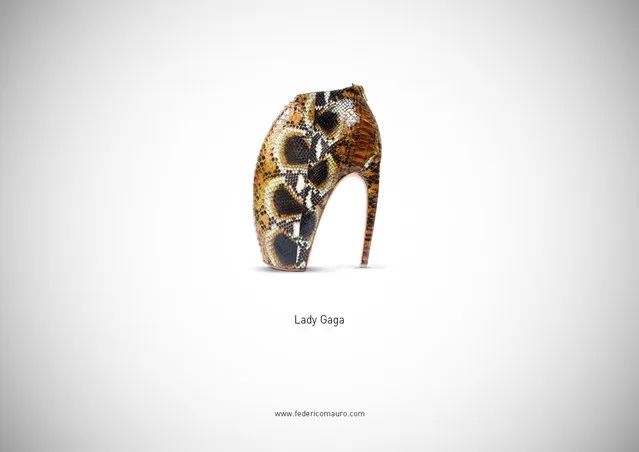
Famous Footwear By Federico Mauro

Ialian artist Federico Mauro latest series takes a look at iconic footwear, and its symbolic representation of the people who wore them. With everything from Steve Jobs’ New Balance 991‘s to the Nike Air Mags sported by Marty McFly in Back to the Future II on show, the minimalist series shows how closely one’s identity can be linked to a single shoe.

See also: Famous Eyeglasses By Federico Mauro / Famous Guns By Federico Mauro
Details
02 Sep 2013 11:50:00
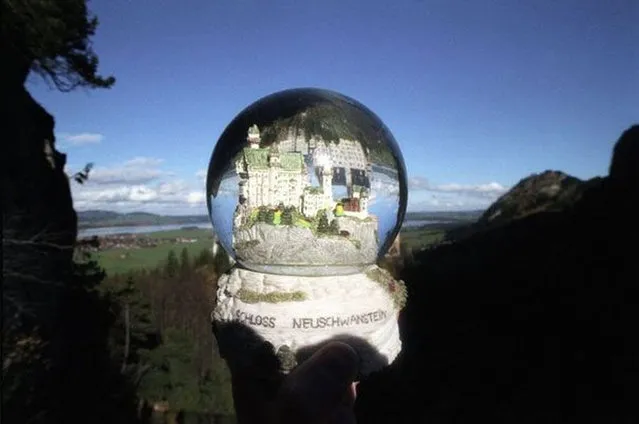
Optical Illusions By Michael Hughes

Michael Hughes creates cool optical illusions by placing cheap souvenirs in front of famous landmarks. Michael has discovered the technique back in 1998 when he held up a postcard he bought for his daughter on the tourist platform at the Lorelei cliffs next to the river Rhine. “I was amazed because it just seemed to fill a massive grey hole that was in the sky and it was the exact position the photographer had taken the picture from,” said Michael to Daily Mail.
Details
14 Dec 2013 11:35:00
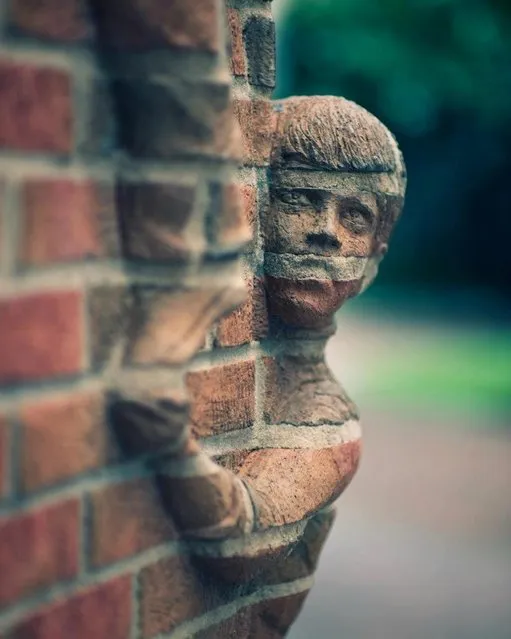
Brick Sculptures By Brad Spencer

Brad Says “Brick sculpture can be dated back to ancient Babylon but remains a fresh and interesting enhancement to any building, wall or environment. The brick medium has all the same characteristics of durability and low maintenance as a brick building, blends well in settings where other brick construction is present, looks good with landscaping and has a familiarity which is comforting to people. Brick sculpture adds intrigue and interest to a commonly understood material as viewers try to figure out the techniques by which it was created.”
Details
20 Feb 2014 13:32:00
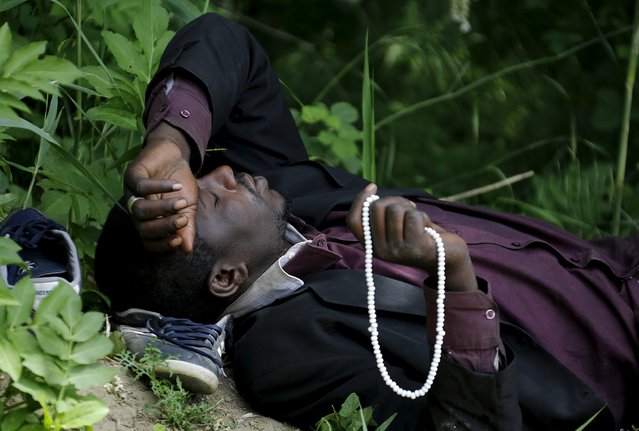
An  immigrant from Mali rests at the Greek-Macedonian border before an attempt to flee to Macedonia  May 13, 2015 village of Idomeni in Kilkis prefecture May 13, 2015. (Photo by Yannis Behrakis/Reuters)

An immigrant from Mali rests at the Greek-Macedonian border before an attempt to flee to Macedonia May 13, 2015 village of Idomeni in Kilkis prefecture May 13, 2015. Hundreds of mostly Afghan, Syrian, and African immigrants cross daily from Greece into Macedonia on their way to northern European countries; most of them are turned back by Macedonian border guards. (Photo by Yannis Behrakis/Reuters)
Details
17 May 2015 11:50:00
Charite Hospital Returns Herero Skulls To Namibia

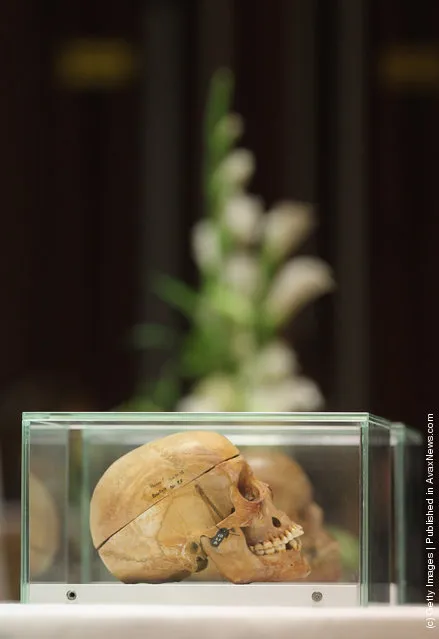
Two of 20 skulls to be taken possession of by a delegation from Namibia stand on display at a ceremony at Charite hospital on September 30, 2011 in Berlin, Germany. The skulls are from Herero and Nama tribespeople taken by German colonial forces between 1904 and 1908, when the Germans violently suppressed an uprising in what was then German Southwest Africa, which is today's Namibia, and in the process killed tens of thousand of Herero and Nama. German scientists at the time took the skulls back to Berlin to demonstrate the racial superiority of Europeans over black Africans. Many Namibians demand a formal apology from the German government. (Photo by Sean Gallup/Getty Images)
Details
02 Oct 2011 11:42:00