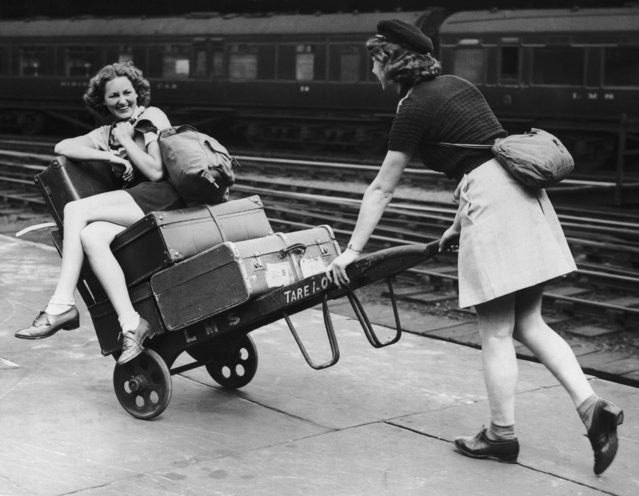
Two holidaymakers amuse themselves with a porter's trolley whilst waiting for their train at Euston Station, London, 5th August 1939. (Photo by A. J. O'Brien/Fox Photos/Getty Images)
Models struggle against strong wind before the rehearsal of Christian Dior's Haute Couture Spring-Summer 2017 live show to celebrate Dior's new flagship store at the rooftop of Ginza Six mall in Tokyo, Japan, April 19, 2017. (Photo by Toru Hanai/Reuters)
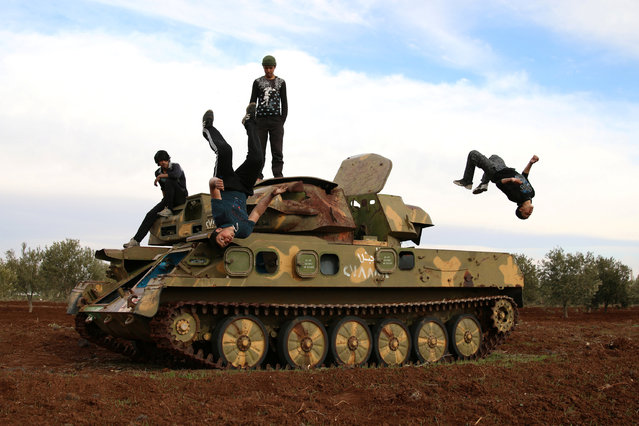
Muhannad al-Kadiri (R),18, and Ibrahim Eid, 16, demonstrate their Parkour skills over a military vehicle in the rebel-held city of Inkhil, west of Deraa, Syria, February 4, 2017. (Photo by Alaa Al-Faqir/Reuters)
On Keo Wa, 25, carries her 9-month-old baby while working at a banana plantation operated by a Chinese company in the province of Bokeo in Laos April 24, 2017. (Photo by Jorge Silva/Reuters)
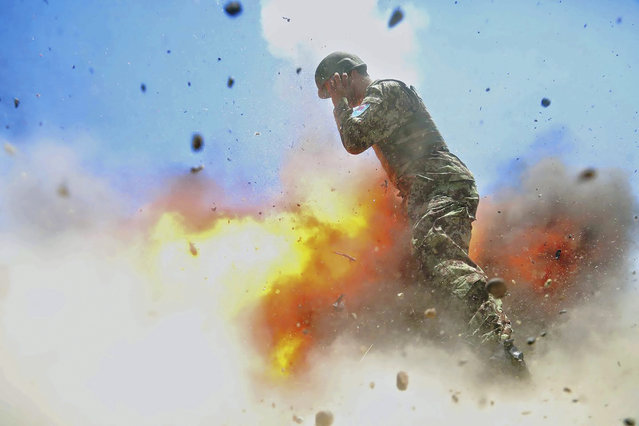
U.S Army combat camera photographer Spc. Hilda Clayton took this photo July 2, 2013 that was released by the U.S. Army, that shows an Afghan soldier engulfed in flame as a mortar tube explodes during an Afghan National Army live-fire training exercise in Laghman Province, Afghanistan. The accident killed Clayton and four Afghan National Army soldiers. (Photo by Spc. Hilda Clayton/U.S. Army via AP Photo)
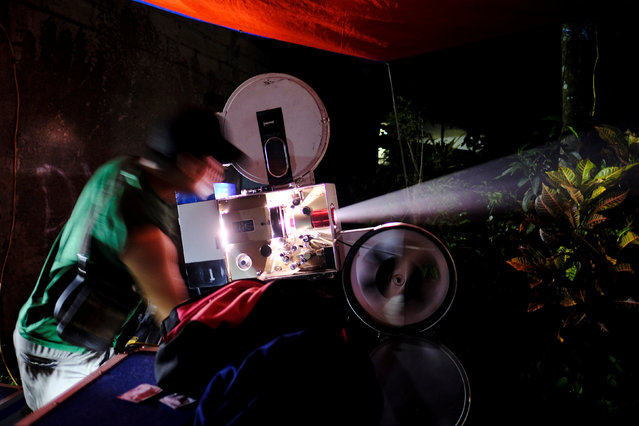
An operator adjusts a film projector during a wedding party in Bogor, Indonesia, February 18, 2017. Indonesian entrepreneur Kamaluddin loves the gritty look of old 35-millimeter film so much that he spends most of his nights screening vintage movies at weddings and parties around Jakarta, the capital. (Photo by Reuters/Beawiharta)
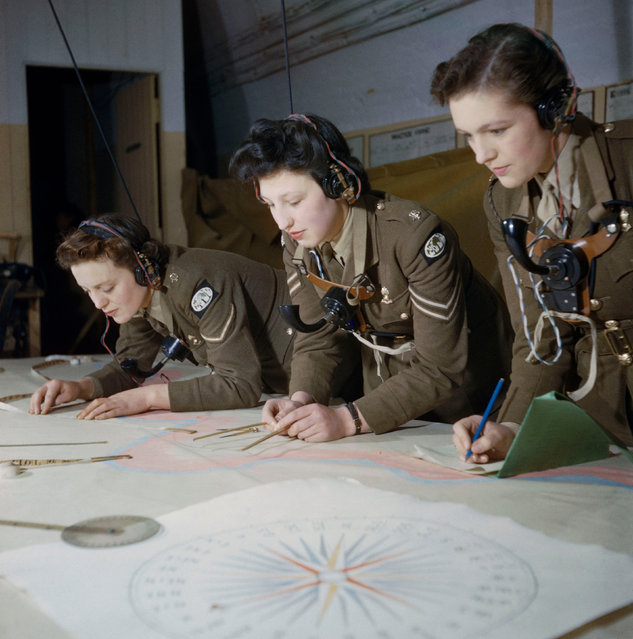
Auxiliary Territorial Service (ATS) plotters at work at Coastal Artillery Headquarters in Dover, December 1942. The Auxiliary Territorial Service was the women's branch of the British Army during the Second World War. It was formed on 9 September 1938, initially as a women's voluntary service, and existed until 1 February 1949, when it was merged into the Women's Royal Army Corps. The ATS had its roots in the Women's Auxiliary Army Corps (WAAC), which was formed in 1917 as a voluntary service. During the First World War its members served in a number of jobs including clerks, cooks, telephonists and waitresses. The WAAC was disbanded after four years in 1921. (Photo by Ted Dearberg/IWM/PA Wire)