Loading...
Done
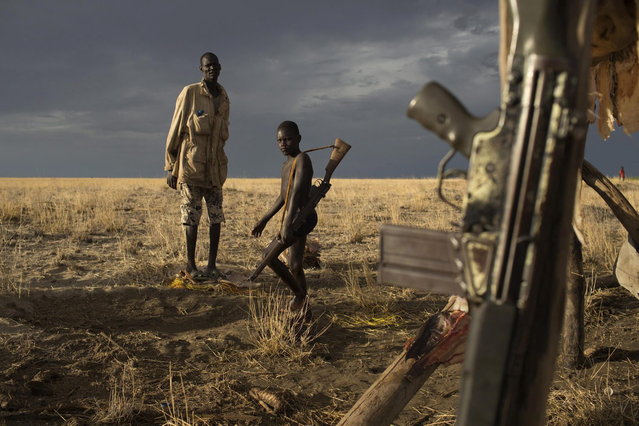
A Turkana man and a boy carrying a gun look on as a G3 battle rifle hangs from a structure used to dry fish at a fishing camp on the shores of Lake Turkana, some kilometres from Todonyang near the Kenya-Ethiopia border in northwestern Kenya October 12, 2013. (Photo by Siegfried Modola/Reuters)

A Turkana man and a boy carrying a gun look on as a G3 battle rifle hangs from a structure used to dry fish at a fishing camp on the shores of Lake Turkana, some kilometres from Todonyang near the Kenya-Ethiopia border in northwestern Kenya October 12, 2013The Turkana are traditionally nomadic pastoralists, but they have seen the pasture that they need to feed their herds suffer from recurring droughts and many have turned to fishing. However, Lake Turkana is overfished, and scarcity of food and pastureland is fuelling long-standing conflict with Ethiopian indigenous Dhaasanac, who have seen grazing grounds squeezed by large-scale government agricultural schemes in southern Ethiopia. The Dhaasanac now venture ever deeper into Kenyan territory in search of fish and grass, clashing with neighbours. Fighting between the communities has a long history, but the conflict has become ever more fatal as automatic weapons from other regional conflicts seep into the area. While the Turkana region is short of basics like grass and ground-water, it contains other resources including oil reserves and massive, newly discovered underground aquifers. (Photo by Siegfried Modola/Reuters)
Details
05 Dec 2013 12:08:00
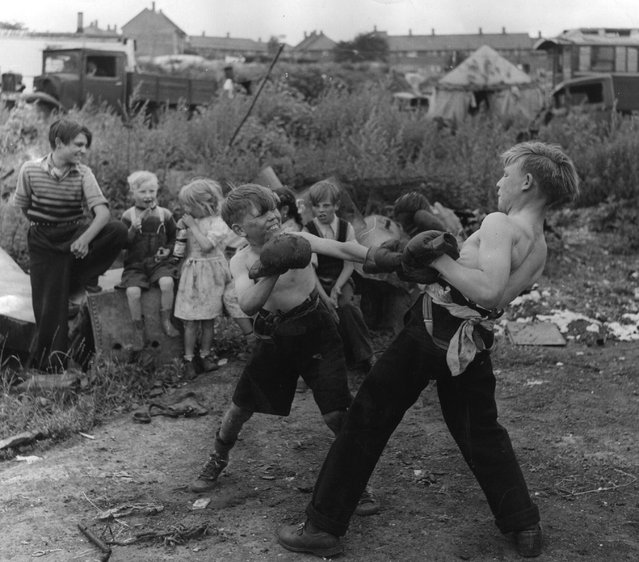
The unromantic gypsies. Children boxing in a gypsy camp in Kent, England on July 1, 1951. Like all boys these gypsy lads like to try their hand at boxing. Encouraged by their friends they fight it out on Corke's Meadow. Few Romanies now live a life of wandering romance. Most are like the three hundred squatters of Corke's Meadow, Kent, which is part of a “gypsy problem” that involves about 100,000 today. Of those about 25,000 can be rightly called gypsies, the rest are Mumpers and Posh-rats and Hobos. Corke's Meadow has both kinds. “Picture Post” cameraman Bert Hardy photographs the Corke's Meadow gypsies in their encampment. (Photo by Hulton-Deutsch Collection/Corbis via Getty Images)

The unromantic gypsies. Children boxing in a gypsy camp in Kent, England on July 1, 1951. Like all boys these gypsy lads like to try their hand at boxing. Encouraged by their friends they fight it out on Corke's Meadow. Few Romanies now live a life of wandering romance. Most are like the three hundred squatters of Corke's Meadow, Kent, which is part of a “gypsy problem” that involves about 100,000 today. Of those about 25,000 can be rightly called gypsies, the rest are Mumpers and Posh-rats and Hobos. Corke's Meadow has both kinds. “Picture Post” cameraman Bert Hardy photographs the Corke's Meadow gypsies in their encampment. (Photo by Hulton-Deutsch Collection/Corbis via Getty Images)
Details
12 Mar 2017 00:01:00
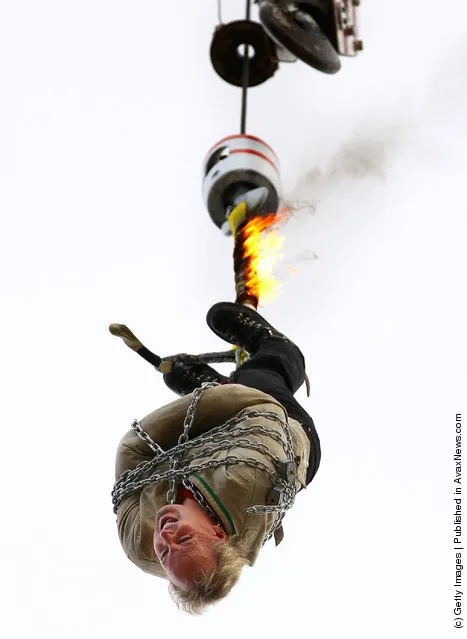
Canadian escape artist Dean Gunnarson attempts to work his way out of a straight jacket while hanging from a crane by a rope which is on fire during a Royal Melbourne Show

Canadian escape artist Dean Gunnarson attempts to work his way out of a straight jacket while hanging from a crane by a rope which is on fire during a Royal Melbourne Show preview at the Melbourne Showgrounds on September 23, 2011 in Melbourne, Australia. The Royal Melbourne Show officially kicks off tomorrow, and continues until October 4. (Photo by Mark Dadswell/Getty Images)
Details
23 Sep 2011 10:07:00
Shi Yongxin, abbot of the Shaolin Temple, works on the computer

“The popularity of the Internet in China has driven the explosive growth of profitable Web companies and made fortunes for some Chinese entrepreneurs despite government controls on what the public can see online. The number of mainland Internet users rose to 513 million in December, up 12 percent from a year earlier, the government-sanctioned China Internet Network Information Center said”. – AP Business Writer

Photo: Shi Yongxin, abbot of the Shaolin Temple, works on the computer April 8, 2005 in Dengfeng, Henan Province, China. (Photo by Cancan Chu/Getty Images)
Details
16 Jan 2012 13:19:00
N.C. Dezendorf, wife of the general manager of the Electro-Motive division of General Motors, christens the new lightweight “Aerotrain” at the company's locomotive works in La Grange, Ill. on August 22, 1955. (Photo by Edward Kitch/AP Photo)

N.C. Dezendorf, wife of the general manager of the Electro-Motive division of General Motors, christens the new lightweight “Aerotrain” at the company's locomotive works in La Grange, Ill. on August 22, 1955. (Photo by Edward Kitch/AP Photo)
Details
07 Sep 2017 09:38:00
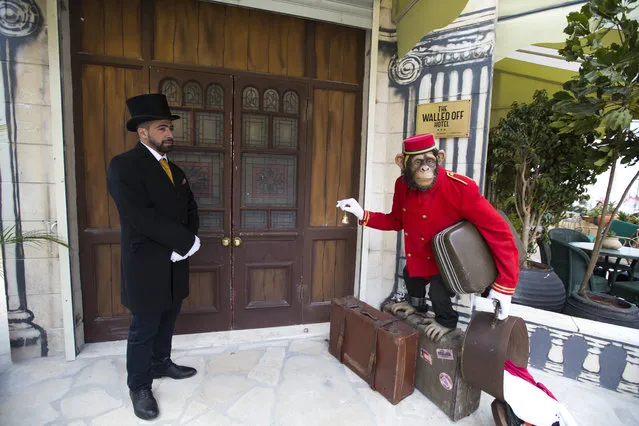
A doorman stands at the entrance of the “The Walled Off Hotel” in the West Bank city of Bethlehem, Friday, March 3, 2017. (Photo by Dusan Vranic/AP Photo)

A doorman stands at the entrance of the “The Walled Off Hotel” in the West Bank city of Bethlehem, Friday, March 3, 2017. The owner of a guest house packed with the elusive artist Banksy's work has opened the doors of his West Bank establishments to media, showcasing its unique “worst view in the world”. The hotel, several of whose rooms look onto an Israeli security watchtower, is awash in the trademark satirical work of the mysterious artist. (Photo by Dusan Vranic/AP Photo)
Details
05 Mar 2017 00:01:00
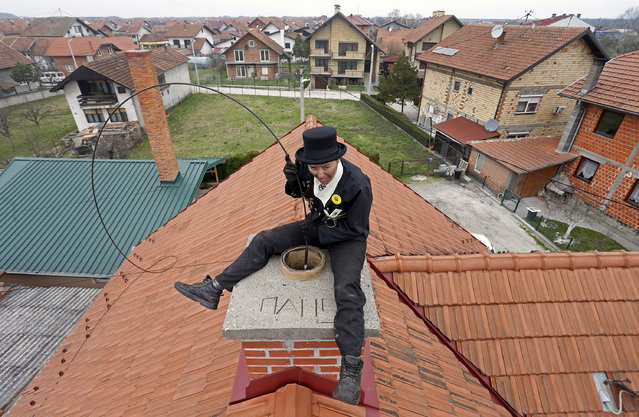
Dajana Djuric, 25, who has worked as a chimney sweep since the age of six, cleans a chimney in Brcko, Bosnia and Herzegovina. Picture taken March 3, 2016. (Photo by Dado Ruvic/Reuters)

Dajana Djuric, 25, who has worked as a chimney sweep since the age of six, cleans a chimney in Brcko, Bosnia and Herzegovina. Dajana Djuric, believed to be the only female chimney sweep in Bosnia and Herzegovina, has to contend with perilous roofs in the depth of winter. (Photo by Dado Ruvic/Reuters)
Details
09 Mar 2016 13:07:00
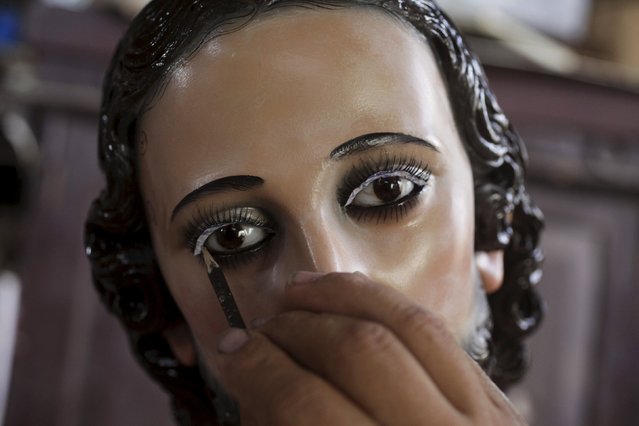
Jose Sabas Gomez pastes eyelashes to a statue of El Jesus Nazareno in his workshop in Apastepeque, El Salvador March 9, 2016. (Photo by Jose Cabezas/Reuters)

Jose Sabas Gomez pastes eyelashes to a statue of El Jesus Nazareno in his workshop in Apastepeque, El Salvador March 9, 2016. Sabas is one of a small number of artists still working on traditional religious art in El Salvador. According to him, there used to be more workshops engaged in the work of restoring statues of saints, but only four remain today as the labor-intensive craft is no longer a popular choice of profession. (Photo by Jose Cabezas/Reuters)
Details
16 Mar 2016 14:14:00