Loading...
Done
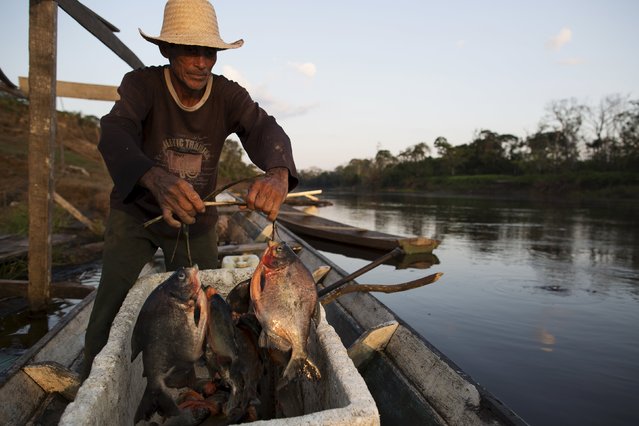
Francisco da Silva Vale, 61, cools off fish with ice produced on solar-powered ice machines at Vila Nova do Amana community in the Sustainable Development Reserve, in Amazonas state, Brazil, September 23, 2015. Three solar-powered machines, are producing about ninety kilos of ice per day, in a region with poor access to electric energy, which used to be produced only with diesel oil, in the Amazon rain forest. (Photo by Bruno Kelly/Reuters)

Francisco da Silva Vale, 61, cools off fish with ice produced on solar-powered ice machines at Vila Nova do Amana community in the Sustainable Development Reserve, in Amazonas state, Brazil, September 23, 2015. Three solar-powered machines, are producing about ninety kilos of ice per day, in a region with poor access to electric energy, which used to be produced only with diesel oil, in the Amazon rain forest. (Photo by Bruno Kelly/Reuters)
Details
10 Oct 2015 08:03:00
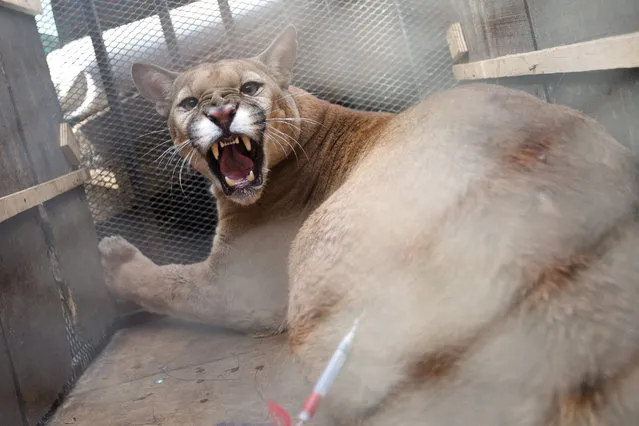
A male puma, named Bordo arrives for an examination and tests at a veterinary in Brasilia, Brazil, 31 October 2017 (issued 01 November 2017). Bordo, a young male puma, captured when he was a cub, will become the first animal of his species to be released in a sanctuary in the Brazilian savannah in Goias State close to Brasilia. The sanctuary, a preserve for wild cats,  is in the first phase and is located on private lands but state funded. (Photo by Joedson Alves/EPA/EFE)

A male puma, named Bordo arrives for an examination and tests at a veterinary in Brasilia, Brazil, 31 October 2017 (issued 01 November 2017). Bordo, a young male puma, captured when he was a cub, will become the first animal of his species to be released in a sanctuary in the Brazilian savannah in Goias State close to Brasilia. The sanctuary, a preserve for wild cats, is in the first phase and is located on private lands but state funded. (Photo by Joedson Alves/EPA/EFE)
Details
05 Nov 2017 08:13:00
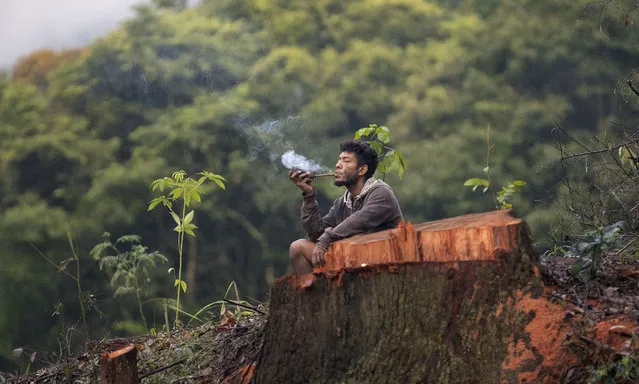
A Guarani Mbya man smokes a pipe next to a cut tree as he occupies land as a protest against real estate developer Tenda which plans to build apartment buildings here, next to his indigenous community's land in Sao Paulo, Brazil, Thursday, February 6, 2020. In response to an injunction filed by the builder, a judge has authorized the eviction of the indigenous protesters from the builder's property. (Photo by Andre Penner/AP Photo)

A Guarani Mbya man smokes a pipe next to a cut tree as he occupies land as a protest against real estate developer Tenda which plans to build apartment buildings here, next to his indigenous community's land in Sao Paulo, Brazil, Thursday, February 6, 2020. In response to an injunction filed by the builder, a judge has authorized the eviction of the indigenous protesters from the builder's property. (Photo by Andre Penner/AP Photo)
Details
22 Feb 2020 00:05:00
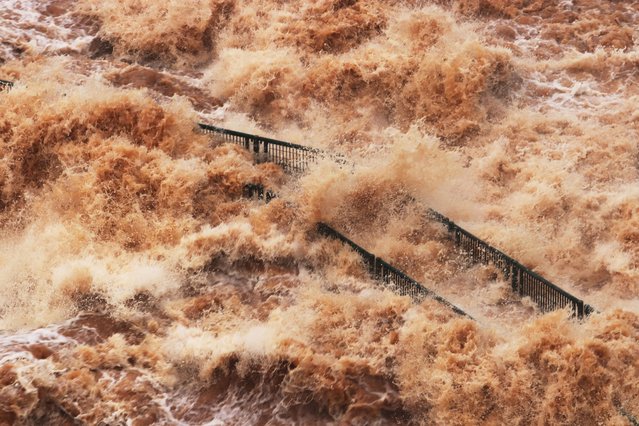
View of the visitor walkway at the Iguazu Falls, which was destroyed by the strong current of the river on the triple border between Brazil, Argentina and Paraguay, on October 30, 2023. The Falls are flowing at over 24 million liters of water per second, according to hydrological monitoring by Companhia Paranaense de Energia (Copel). This is the second highest flow since 1997, when monitoring became automatic and was measured hourly. (Photo by Christian Rizzi/AFP Photo)

View of the visitor walkway at the Iguazu Falls, which was destroyed by the strong current of the river on the triple border between Brazil, Argentina and Paraguay, on October 30, 2023. The Falls are flowing at over 24 million liters of water per second, according to hydrological monitoring by Companhia Paranaense de Energia (Copel). This is the second highest flow since 1997, when monitoring became automatic and was measured hourly. (Photo by Christian Rizzi/AFP Photo)
Details
21 Dec 2024 03:30:00
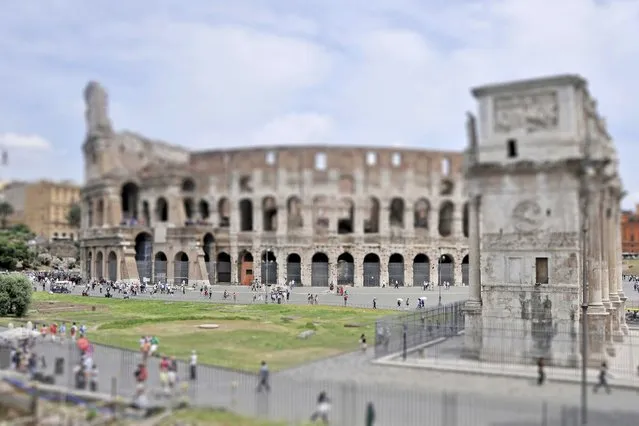
Coliseum, Rome. (Photo by Richard Silver)

Richard Silver's photographs show us the world's biggest sights like Machu Picchu in Peru or Copacabana in Brazil. His photos, however, are not simply depictions of the landmarks but planned, artistic visual constructions that, with their playful combinations of sharpness and blur, create new worlds of experience. Photo: Coliseum, Rome. (Photo by Richard Silver)
Details
04 May 2013 11:19:00
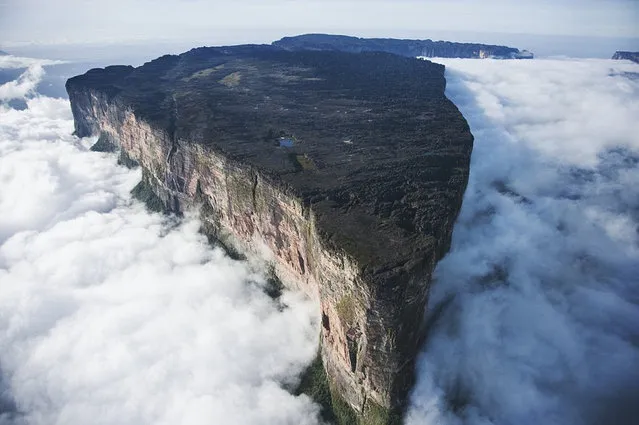
Mount Roraima

Mount Roraima (Spanish: Monte Roraima, also known as Tepuy Roraima and Cerro Roraima; Portuguese: Monte Roraima [ˈmõtʃi ʁoˈɾajmɐ]) is the highest of the Pakaraima chain of tepui plateau in South America. First described by the English explorer Sir Walter Raleigh in 1596, its 31 km2 summit area is defended by 400-metre-tall cliffs on all sides. The mountain includes the triple border point of Venezuela, Brazil and Guyana.
Details
11 Sep 2012 08:04:00
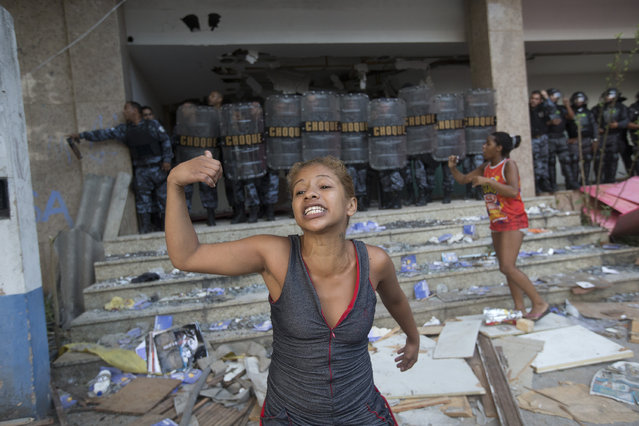
A woman shouts asking for help during an eviction in Rio de Janeiro, Brazil, Friday, April 11, 2014. Squatters in Rio de Janeiro are clashing with police after a Brazilian court ordered that 5,000 people be evicted from abandoned buildings of a telecommunications company. Officers have used tear gas and stun grenades to try to disperse the families. (Photo by Silvia Izquierdo/AP Photo)

A woman shouts asking for help during an eviction in Rio de Janeiro, Brazil, Friday, April 11, 2014. Squatters in Rio de Janeiro are clashing with police after a Brazilian court ordered that 5,000 people be evicted from abandoned buildings of a telecommunications company. Officers have used tear gas and stun grenades to try to disperse the families. (Photo by Silvia Izquierdo/AP Photo)
Details
13 Apr 2014 07:22:00
Carolaine Reis and her son Miguel Alves, residents of the Aglomerado da Serra favela, wear a protective mask against the spread of the new Coronavirus (COVID-19) made by the seamstresses of the Remexe Favelinha studio, in the Aglomerado da Serra favela, on April 13, 2020 in Belo Horizonte, Brazil. Facial masks follow the protocol and guidelines defined by the Ministry of Health. Around 6,000 masks have already been produced. The masks are being distributed to a part of the population and sold throughout the country, in the amount of 5 reais per unit. (Photo by Pedro Vilela/Getty Images)

Carolaine Reis and her son Miguel Alves, residents of the Aglomerado da Serra favela, wear a protective mask against the spread of the new Coronavirus (COVID-19) made by the seamstresses of the Remexe Favelinha studio, in the Aglomerado da Serra favela, on April 13, 2020 in Belo Horizonte, Brazil. Facial masks follow the protocol and guidelines defined by the Ministry of Health. Around 6,000 masks have already been produced. The masks are being distributed to a part of the population and sold throughout the country, in the amount of 5 reais per unit. (Photo by Pedro Vilela/Getty Images)
Details
16 Apr 2020 00:03:00