Loading...
Done
Lola is seen at left in everyday clothes – and then at right in her work clothes. She works as a clown in Paris. (Photo by Bruno Fert/Picturetank)

“The series of photos called Workwears, by French photographer Bruno Fert, visually juxtaposes people’s private lives with their lives at work. A firefighter, a fisherman, a nurse, a diver, a judge. One by one, Fert’s photos show people in their homes wearing everyday clothing – followed by another photo showing them dressed in the clothing of their chosen professions. Our reaction, Fert said, reminds us how tightly humans hold on to certain stereotypes about some professions. “I like to break those stereotypes”, he said”. – Thom Patterson via CNN. Here: Lola is seen at left in everyday clothes – and then at right in her work clothes. She works as a clown in Paris. (Photo by Bruno Fert/Picturetank)
Details
29 Oct 2014 12:40:00
Katjinga, a Rhodesian ridgeback dog who lives on a 20-acre farm in Germany, adopted an abandoned pot-bellied piglet in August 2009. The tiny black piglet, named Paulinchen, had been so small at birth that her mother likely overlooked it. Katjinga's owner, Roland Adam, found the piglet alone and cold and brought it to his 8-year-old dog

Katjinga, a Rhodesian ridgeback dog who lives on a 20-acre farm in Germany, adopted an abandoned pot-bellied piglet in August 2009. The tiny black piglet, named Paulinchen, had been so small at birth that her mother likely overlooked it. Katjinga's owner, Roland Adam, found the piglet alone and cold and brought it to his 8-year-old dog. (Photo by Fame Pictures)
Details
23 Apr 2012 13:45:00


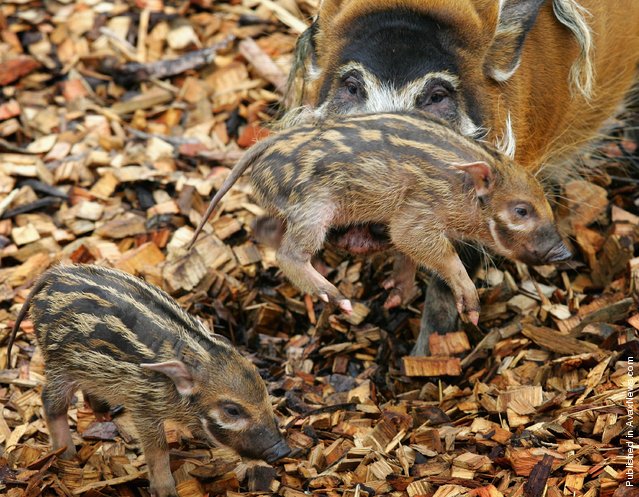
“The Red River Hog (Potamochoerus porcus), also known as the Bush Pig (but not to be confused with P. larvatus, common name “Bushpig”), is a wild member of the pig family living in Africa, with most of its distribution in the Guinean and Congolian forests. It is rarely seen away from rainforests, and generally prefers areas near rivers or swamps.

Red River Hogs eat grass, berries, roots, insects, molluscs, small vertebrates and carrion. They are capable of causing damage to plantations. Red River Hogs typically live in herds of 6-20 members led by a dominant boar. Sows rear 3-6 piglets at a time.”

Photo: Two 17 day old red river hoglet twins forage for food next to their mother Bahiti at London Zoo on August 23, 2007 in London, England. Red River hoglets inhabit the forests and swamps of West and Central Africa. The recent additions to the London Zoo pig pen have been eagerly awaited by zoo keepers. (Photo by Chris Jackson/Getty Images)

Details
18 Mar 2011 15:15:00
Syrian refugee girl Nur El-Huda, 9, shows a drawing of her home in Syria, in her classroom in Yayladagi refugee camp in Hatay province near the Turkish-Syrian border, Turkey, December 16, 2015. (Photo by Umit Bektas/Reuters)

Syrian refugee girl Nur El-Huda, 9, shows a drawing of her home in Syria, in her classroom in Yayladagi refugee camp in Hatay province near the Turkish-Syrian border, Turkey, December 16, 2015. Syria's conflict has left hundreds of thousands dead, pushed millions more into exile, and had a profound effect on children who lost their homes or got caught up in the bloodletting. The drawings of young refugees living in Turkey show their memories of home and hopes for its future. The pictures also point to the mental scars borne by 2.3 million Syrian refugees living in Turkey, more than half of them children. (Photo by Umit Bektas/Reuters)
Details
16 Jan 2016 08:05:00
A 14 year-old Myanmar girl carries three bags of powdered-limestone to load in to a boat on the bank of Ayeyarwaddy River, on International Women's Day in Mandalay, Myanmar, Tuesday, March 8, 2016. Migrant workers living along Ayeyarwaddy riverbank earn bout 5000 Kyats (US Dollar 4) a day for loading and unloading goods. (Photro by Hkun Lat/AP Photo)

A 14 year-old Myanmar girl carries three bags of powdered-limestone to load in to a boat on the bank of Ayeyarwaddy River, on International Women's Day in Mandalay, Myanmar, Tuesday, March 8, 2016. Migrant workers living along Ayeyarwaddy riverbank earn bout 5000 Kyats (US Dollar 4) a day for loading and unloading goods. (Photro by Hkun Lat/AP Photo)
Details
09 Mar 2016 12:52:00
A Thai man climbs down from his home in a disused airplane on September 12, 2015 in Bangkok, Thailand. 3 impoverished Thai families have begun living in disused airplanes on a private field. The families, who collect and recycle garbage earning a few dollars a day, can't afford to rent and prefer to stay in the planes. (Photo by Taylor Weidman/Getty Images)

A Thai man climbs down from his home in a disused airplane on September 12, 2015 in Bangkok, Thailand. 3 impoverished Thai families have begun living in disused airplanes on a private field. The families, who collect and recycle garbage earning a few dollars a day, can't afford to rent and prefer to stay in the planes. (Photo by Taylor Weidman/Getty Images)
Details
05 Oct 2015 08:04:00
(L-R) A man nicknamed "Barcelona", Alexey Bolotov and Alexey Jakushin drink vodka as they travel by a pioneer motorised railcar on their way to Kalach, Sverdlovsk region, Russia October 18, 2015. The "pioneer," a light auxiliary rail vehicle, is a popular form of transport among people who live along the Alapayevsk railway. (Photo by Maxim Zmeyev/Reuters)

(L-R) A man nicknamed "Barcelona", Alexey Bolotov and Alexey Jakushin drink vodka as they travel by a pioneer motorised railcar on their way to Kalach, Sverdlovsk region, Russia October 18, 2015. The "pioneer," a light auxiliary rail vehicle, is a popular form of transport among people who live along the Alapayevsk railway. In a remote corner of the Urals region at the end of a narrow-gauge railway is Kalach, population about a dozen. Three decades ago 600 people called the village home, but the local forestry industry suffered as the former Soviet Union imploded and people moved away in search of work. In Kalach today there are no telephones, no mobile reception and only a few hours of electricity a day. (Photo by Maxim Zmeyev/Reuters)
Details
15 Nov 2015 08:06:00
A model of the New Horizons spacecraft is seen at a live television program on NASA television celebrating the spacecraft's closest proximity to Pluto, at Johns Hopkins University Applied Physics Laboratory, site of the mission operations center, in Laurel, Maryland, USA, 14 July 2015. (Photo by Michael Reynolds/EPA)

A model of the New Horizons spacecraft is seen at a live television program on NASA television celebrating the spacecraft's closest proximity to Pluto, at Johns Hopkins University Applied Physics Laboratory, site of the mission operations center, in Laurel, Maryland, USA, 14 July 2015. At approximately 7:49 am ET (11:49 am GMT), 14 July, New Horizons was scheduled to be as close to Pluto as the spacecraft will get; about 7,800 miles (12,500 kilometers) above the surface, following a journey of more than nine years and three billion miles. This is the first mission to the Pluto System and the Kuiper Belt. (Photo by Michael Reynolds/EPA)
Details
15 Jul 2015 10:08:00