Loading...
Done
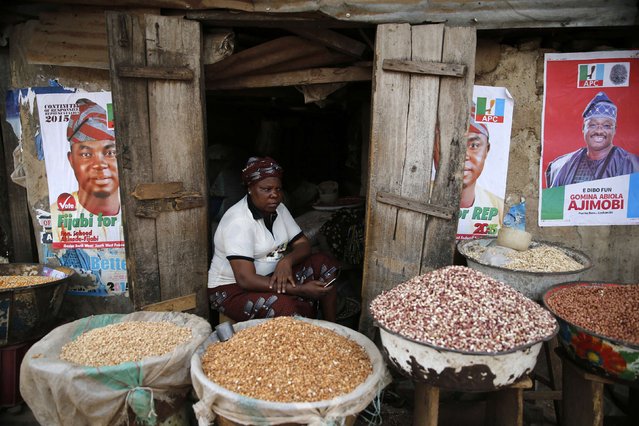
Latefat Alao, 56, a ethnic Yoruba Muslim woman, waits for customers in front of her in Beere market in Ibadan, southwest Nigeria, January 29, 2015. Much of the grain and wheat traders like Alao sell comes from the north and Boko Haram's campaign has negatively affected farmers and food markets. (Photo by Akintunde Akinleye/Reuters)

Latefat Alao, 56, a ethnic Yoruba Muslim woman, waits for customers in front of her in Beere market in Ibadan, southwest Nigeria, January 29, 2015. Much of the grain and wheat traders like Alao sell comes from the north and Boko Haram's campaign has negatively affected farmers and food markets. Reuters photographer Akintunde Akinleye photographed Nigerians and asked them about their views on the elections as well as their hopes and concerns for the country. (Photo by Akintunde Akinleye/Reuters)
Details
12 Feb 2015 12:44:00
Interior designer Zahra Afridi (R) kicks a punching bag during a kickboxing training session at her home in Islamabad February 10, 2014. Afridi runs her own interior design company. Her most recent project was a Classic Rock Coffee cafe in Islamabad. (Photo by Zohra Bensemra/Reuters)

Interior designer Zahra Afridi (R) kicks a punching bag during a kickboxing training session at her home in Islamabad February 10, 2014. Afridi runs her own interior design company. Her most recent project was a Classic Rock Coffee cafe in Islamabad. Though instability continues to plague Pakistan and many areas are dominated by social conservatism, some of the country's more affluent residents have worked to fashion a very different kind of lifestyle for themselves. Pictures of men and women taking part in all sorts of activities and professions – from being a pilates instructor, to a textile retail entrepreneur, to a member of a rock band – offer a different view of Pakistan to images of conflict that often make the news. (Photo by Zohra Bensemra/Reuters)
Details
13 Jul 2014 10:47:00


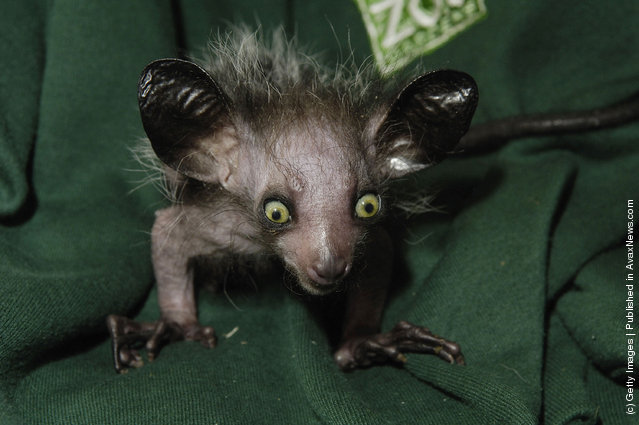
“The aye-aye (Daubentonia madagascariensis) is a lemur, a strepsirrhine primate native to Madagascar that combines rodent-like teeth and a special thin middle finger to fill the same ecological niche as a woodpecker. It is the world's largest nocturnal primate, and is characterized by its unusual method of finding food; it taps on trees to find grubs, then gnaws holes in the wood and inserts its narrow middle finger to pull the grubs out. The only other animal species known to find food in this way is the striped possum. From an ecological point of view the aye-aye fills the niche of a woodpecker as it is capable of penetrating wood to extract the invertebrates within”. – Wikipedia

Photo: In this handout image from Bristol Zoo is seen the first captive bred aye-aye in the UK named “Kintana” (meaning star in Malagasy) April 15, 2005 at Bristol Zoo Gardens, England. The zoo announced today only the second baby aye-aye to be hand-reared in the world (the first was in Jersey Zoo) and has now made his first public appearance since his birth on 11 February 2005. (Photo by Rob Cousins/Bristol Zoo via Getty Images)
Details
13 Apr 2011 13:33:00
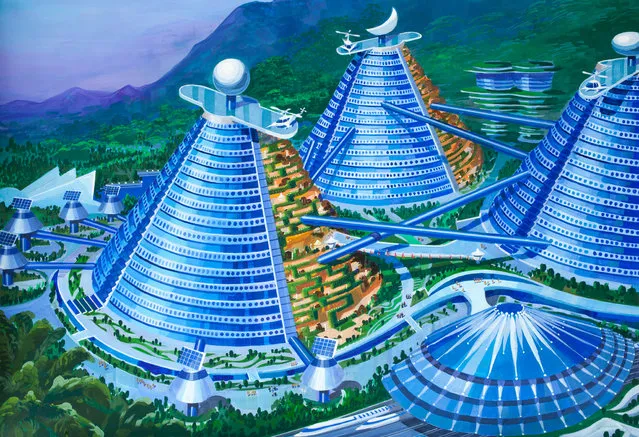
The following “Utopian Tours” drawings are conceptual images of what tourism in North Korea might one day look like, created by North Korean architects. The images, curated by Nick Bonner, are on view as part of the exhibition at the Venice Architecture Biennale in the Korean Pavilion. Bonner runs the Beijing-based Koryo Tours – a company that organizes tours of outsiders into North Korea. (Photo by Nick Bonner/Kyle Vanhemert/Venice Architecture Biennale)

At this year’s Venice Bienniale in Italy, the Korean pavilion has a curious exhibit called “Commissions for Utopia”. It includes renderings from North Korea’s top architects and artists (all anonymous), many of whom studied at the Paekho Institute of Architecture, North Korea’s state-run architectural college, and none of whom have ever left the country. They were asked to create a vision of North Korea’s future sustainable architecture for its expanding tourism industry. Their final products are a glimpse into what it would be like to envision the future after being entirely cut off from the present for almost 70 years. (Photo by Nick Bonner/Kyle Vanhemert/Venice Architecture Biennale)
Details
08 Aug 2014 11:03:00
A man walking his dog in a park made using chalk and keys. (Photo by Stanislav Aristov/Caters News)

“This quirky collection of photos proves that a little imagination is the key to a good a picture. By simply using a collection of keys and a strip of chalk, photographer, Stanislav Aristov, 32, is able to re-create everyday scenes and objects. Stanislav wanted to show that even the simplest of items can help change your view on the world. After acquiring a large selection of keys from friends and family as well as local charity shops, Stanislav then went about scrawling anything from a key shaped rain drops to a key-eyed crab”. – Caters News. Photo: A man walking his dog in a park made using chalk and keys. (Photo by Stanislav Aristov/Caters News)
Details
22 Aug 2014 12:11:00
What the World Eats By Peter Menzel And Faith D'Aluisio Part 2

A stunning photographic collection featuring portraits of people from 30 countries and the food they eat in one day. In this fascinating study of people and their diets, 80 profiles are organized by the total number of calories each person puts away in a day. Featuring a Japanese sumo wrestler, a Massai herdswoman, world-renowned Spanish chef Ferran Adria, an American competitive eater, and more, these compulsively readable personal stories also include demographic particulars, including age, activity level, height, and weight. Essays from Harvard primatologist Richard Wrangham, journalist Michael Pollan, and others discuss the implications of our modern diets for our health and for the planet. This compelling blend of photography and investigative reportage expands our understanding of the complex relationships among individuals, culture, and food.
Details
02 May 2014 09:20:00
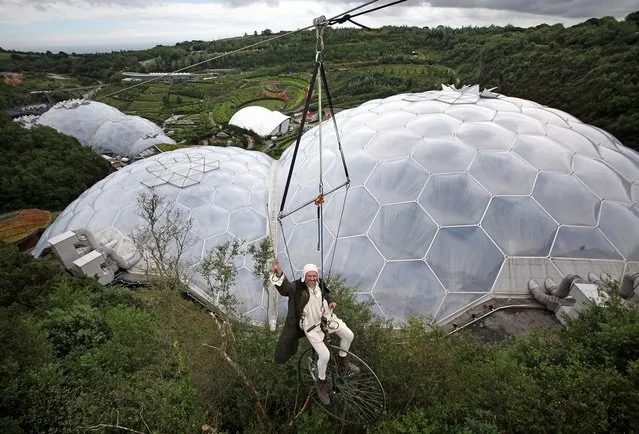
England's Longest Zip Wire Opens At The Eden Project

Marco Fiera from NoFit State Circus tries out the SkyWire, the new zip wire attraction which opens to the public this week at The Eden Project on July 17, 2012 in St Austell, England. The new 740m zip wire, currently the longest in England, allows the public a bird's eye view of the iconic Rainforest and Mediterranean Biome structures as well as the Cornish attractions outdoor gardens. The Eden Project – which opened in 2001 and has attracted over one million visitors – showcases 100,000 plants from around the world in two giant transparent domes, one of which is the world's largest greenhouse, each recreating different climate conditions. (Photo by Matt Cardy)
Details
19 Jul 2012 10:00:00
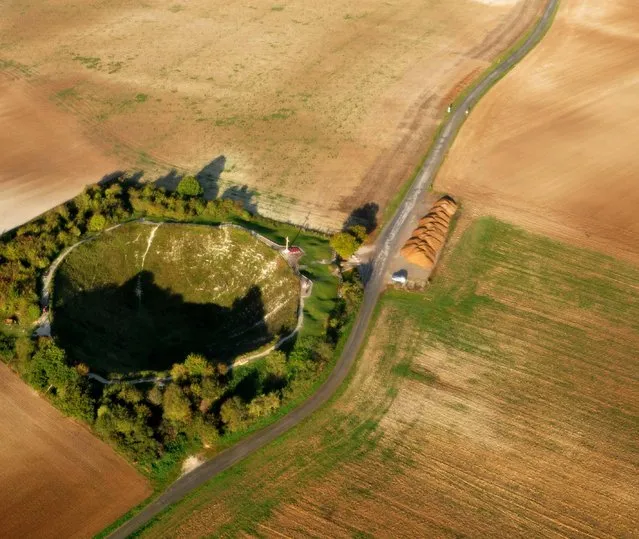
Lochnagar Crater Somme In France

It is amazing how much the humanity can change the face of the earth. Not only can it create huge craters, which look a lot like craters from meteors, they leave a big enough impact that it can be seen from space. Though this crater, caused by a massive explosion on 1 July 1916, looks large, being 90 feet deep and 300 feet across; it is nowhere big enough to be viewed for space. A common misconception is that the Great Wall of China can be seen from space. In reality, however, it is impossible. Not only is it of the same color as the earth near it, it is also not that wide. Deforestation, on the other hand, can be clearly seen from space. Also, at night, all the lights that the large cities produce are also very visible.
Details
17 Nov 2014 12:48:00