Loading...
Done
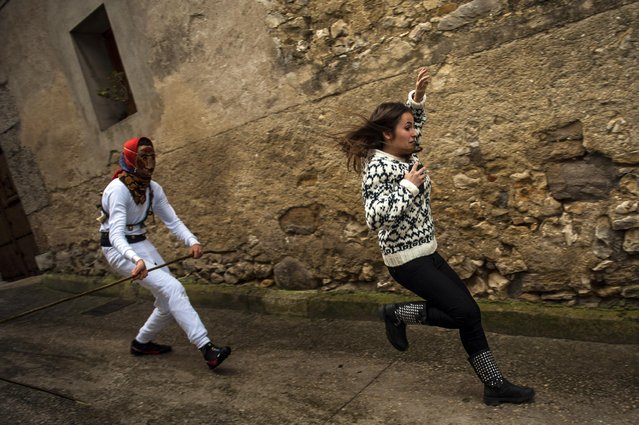
In this photo taken on Sunday, February 15, 2015 a girl runs away from a “Mamuxarro” during the carnival, in the small town of Unanu, northern Spain. While Rio de Janeiro may boast the world’s most famous carnival, the festive period of masquerades and wild and colorful costumes that precedes the Christian religious season of Lent is also a permanent and popular fixture for celebration in Spain and Portugal, with each country having its own strange and unique way of doing it. (Photo by Alvaro Barrientos/AP Photo)

In this photo taken on Sunday, February 15, 2015 a girl runs away from a “Mamuxarro” during the carnival, in the small town of Unanu, northern Spain. In the northern Spanish ancient village of Unamu, people dress up as “Mamuxarro”, folkloric figures in white with a red sash and a metal mask to cover their faces as they pursue townsfolk with sticks. According to custom, their “victims” (usually young women) must kneel and kiss the mamuxarro’s knee after he makes the sign of the cross on their forehead. (Photo by Alvaro Barrientos/AP Photo)
Details
22 Feb 2015 10:51:00
Super Hero Minimalist Posters By Michael Turner Part 1

Have you ever heard of a psychological phenomenon which lets us easily understand words, even if the order of letters is mixed up, as long as the first and last letters remain in their rightful place? Similarly, the art works of Michael Turner use only two colors to highlight the main futures of well-recognized superheroes, allowing our imagination to create the rest of the picture. The colors used in the pictures weren’t chosen at random. They perfectly reflect the key characteristics of the superheroes that they depict. For example, the picture of Flash uses red and yellow colors, which are exactly the colors of his costume. While the picture of Green Lantern is, you’ve guessed it, green and black. (Photo by Michael Turner)
Details
10 Dec 2014 11:38:00
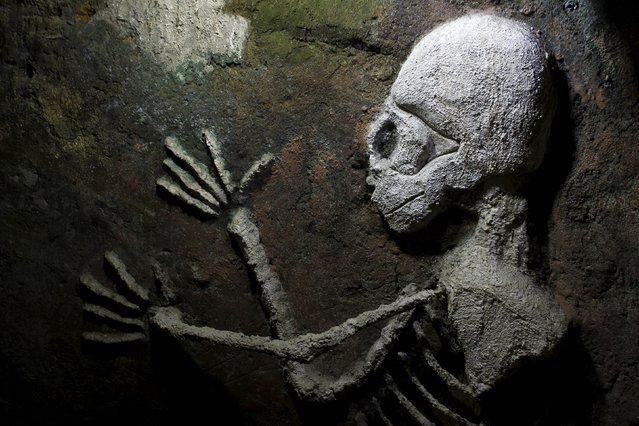
A figure of a skeleton is seen painted in a hallway of the house built underground by Manuel Barrantes in San Isidro de Perez Zeledon, Costa Rica, March 14, 2016. (Photo by Juan Carlos Ulate/Reuters)

A figure of a skeleton is seen painted in a hallway of the house built underground by Manuel Barrantes in San Isidro de Perez Zeledon, Costa Rica, March 14, 2016. Barrantes started digging through red soil and volcanic rock on his farm 12 years ago to build his subterranean house, between 15 and 63 feet (4.57 and 19.2m) underground. The dwelling, which Barrantes says provides a peaceful and comfortable home for him and his family away from noise pollution and the effects of climate change, now covers about 2,000 square feet (185.8 square metres). (Photo by Juan Carlos Ulate/Reuters)
Details
17 Mar 2016 15:34:00
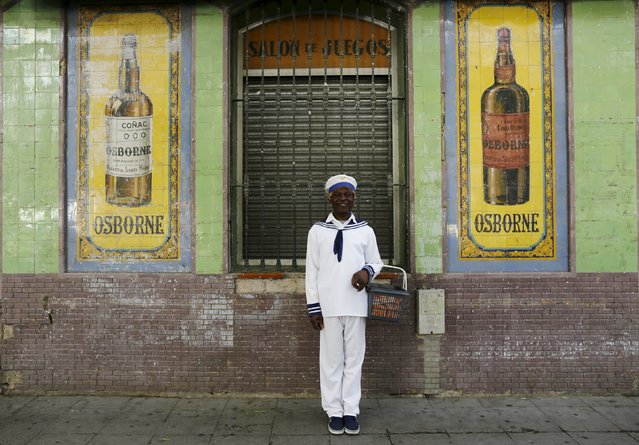
Howard Jackson, a Liberian migrant, poses for a portrait in the Andalusian capital of Seville, southern Spain March 7, 2016. (Photo by Marcelo del Pozo/Reuters)

Howard Jackson, a Liberian migrant, poses for a portrait in the Andalusian capital of Seville, southern Spain March 7, 2016. Jackson escaped civil war and spent three years crossing Africa before reaching Spain. Dressed up in one of his more than 200 costumes, from Peter Pan to Little Red Riding Hood, he is a well-known figure at an intersection entering the Spanish city of Seville where he has sold tissues to motorists for over a decade. Jackson is studying law and wants to become a judge. (Photo by Marcelo del Pozo/Reuters)
Details
24 Mar 2016 12:14:00
Students of the "Escola de Papai Noel do Brasil" (Brazil's school of Santa Claus)  travel on a ferry through Guanabara bay, during their graduation ceremony in Rio de Janeiro, Brazil, November 10, 2015. (Photo by Pilar Olivares/Reuters)

Students of the "Escola de Papai Noel do Brasil" (Brazil's school of Santa Claus) travel on a ferry through Guanabara bay, during their graduation ceremony in Rio de Janeiro, Brazil, November 10, 2015. The school holds 4 days' lessons in Santa-training, teaching Christmas carols, how to interact with children, and also how to wear the heavy red suit in Rio's typical 104-degree (40 degrees celsius) summer weather that is common around the holidays. (Photo by Pilar Olivares/Reuters)
Details
13 Nov 2015 08:01:00
A visitor looks at portraits of Mao Zedong amid his statues on display at a wholesale souvenir store in Shaoshan, Hunan Province in central China, 28 April 2016. Shaoshan is the hometown of former Communist leader Mao Zedong, popularly known as Chairman Mao. Thousands of visitors descend on this small Chinese town burrowed in the hills of Central China's Hunan province to pay homage to the “Great Helmsman” everyday. (Photo by How Hwee Young/EPA)

A visitor looks at portraits of Mao Zedong amid his statues on display at a wholesale souvenir store in Shaoshan, Hunan Province in central China, 28 April 2016. Shaoshan is the hometown of former Communist leader Mao Zedong, popularly known as Chairman Mao. Thousands of visitors descend on this small Chinese town burrowed in the hills of Central China's Hunan province to pay homage to the “Great Helmsman” everyday. It is one of the core sites of the “Red Tourism” industry, where communist party cadres and ordinary Chinese tourists alike seek to relive the experiences and rekindle the spirit of the revolutionaries. (Photo by How Hwee Young/EPA)
Details
08 May 2016 11:19:00
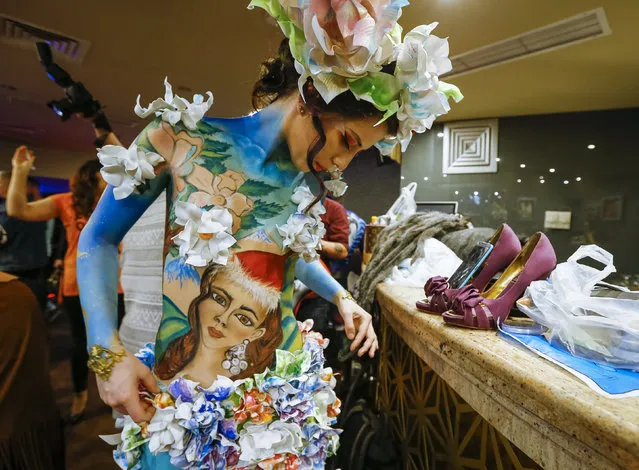
A model gets ready backstage during a body art festival in Almaty, Kazakhstan, March 23, 2016. (Photo by Shamil Zhumatov/Reuters)

A model gets ready backstage during a body art festival in Almaty, Kazakhstan, March 23, 2016. (Photo by Shamil Zhumatov/Reuters)
Details
24 Mar 2016 12:21:00
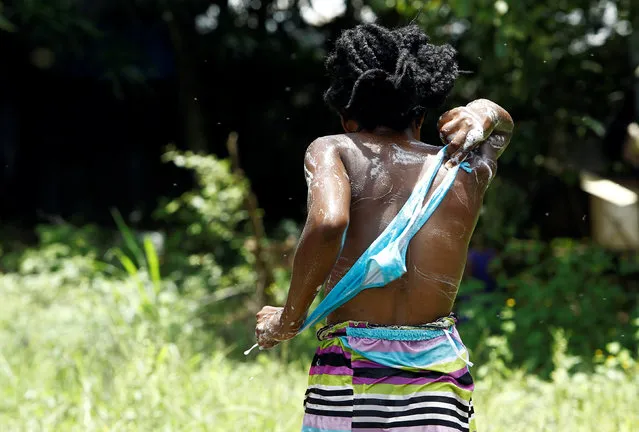
An African migrant stranded in Costa Rica bathes at a makeshift camp at the border between Costa Rica and Nicaragua, in Penas Blancas, Costa Rica, July 14, 2016. (Photo by Juan Carlos Ulate/Reuters)

An African migrant stranded in Costa Rica bathes at a makeshift camp at the border between Costa Rica and Nicaragua, in Penas Blancas, Costa Rica, July 14, 2016. Thousands of African migrants are currently stranded in Costa Rica after they were denied entry into neighbouring Nicaragua, which they have been using as a crossing point in order to reach the United States. According to the Costa Rican Red Cross, most of these people from Africa, Asia and Haiti. It has been reported that many of them paid smugglers to reach Central America. However, when they arrived at the border gates, they were denied entry and were left with nowhere to go. (Photo by Juan Carlos Ulate/Reuters)
Details
16 Jul 2016 08:17:00