Loading...
Done
The Machines Of The Isle Of Nantes

Due to the influence of Sci-Fi movies, many of us have an obsession with giant robots. How cool would it be to ride a gigantic robotic dinosaur or elephant? It would be even cooler to control one! Regretfully, the modern technologies are not yet sophisticated enough to fulfill this dream. Pierre Orefice and François Delarozière, however, came very close. These two artists have made it their goal to turn Nantes, France, into a hot tourist destination spot for people who love robots. In their project of Machines de l'île in Nantes, they have created a whole park of robotic monstrosities, ranging from a giant 3 story high elephant to a 2 meter long centipede crawling on a rail track.
Details
05 Jan 2015 13:21:00
Shi Yongxin, abbot of the Shaolin Temple, works on the computer

“The popularity of the Internet in China has driven the explosive growth of profitable Web companies and made fortunes for some Chinese entrepreneurs despite government controls on what the public can see online. The number of mainland Internet users rose to 513 million in December, up 12 percent from a year earlier, the government-sanctioned China Internet Network Information Center said”. – AP Business Writer

Photo: Shi Yongxin, abbot of the Shaolin Temple, works on the computer April 8, 2005 in Dengfeng, Henan Province, China. (Photo by Cancan Chu/Getty Images)
Details
16 Jan 2012 13:19:00
Oracle Team USA Capsizes Its Biggest, Baddest Boat

In this photo taken October 16, 2012 and provided by Oracle Team USA, crew members of the capsized Oracle Team USA AC72 boat are rescued after being swept past the Golden Gate Bridge in San Francisco. The America's Cup champion syndicate is assessing the damage to its 72-foot catamaran, after it capsized and was swept by a strong current more than four miles past the Golden Gate Bridge before rescue boats could control it. (Photo by Guilain Grenier/Oracle Team USA/Associated Press)
Details
18 Oct 2012 09:11:00
Camp director and “duck walk” inventor Rodin Gilbert Flores, 2nd R) teaches aspiring beauty queens how to “duck walk” at a beauty boot camp in Manila in this picture taken on March 8, 2015. From wading in muddy Philippine rice paddies, former housemaid Janicel Lubina now struts down runways for the country's top designers, and is poised to be crowned among the world's most beautiful. (Photo by Noel Celis/AFP Photo)

Camp director and “duck walk” inventor (Rodin Gilbert Flores, 2nd R) teaches aspiring beauty queens how to “duck walk” at a beauty boot camp in Manila in this picture taken on March 8, 2015. From wading in muddy Philippine rice paddies, former housemaid Janicel Lubina now struts down runways for the country's top designers, and is poised to be crowned among the world's most beautiful. Lubina is a star recruit in one of Manila's beauty pageant boot camps, where shy, lanky teenage girls from remote farming provinces are transformed into poised Barbie dolls who can preach about world peace in six-inch heels. (Photo by Noel Celis/AFP Photo)
Details
15 Mar 2015 06:51:00
Girls of the Long Horn Miao ethnic minority group wear headdresses as they prepare gather for Tiaohua or Flower Festival as part of the Lunar New Year on February 6, 2017 in Longga village, Guizhou province, southern China. The Long Horn Miao are recognized for their declining practice of wrapping a blend of linen, wool, and the hair of their ancestors around animal horns or a wooden clip to make headdresses. Many young women say they now wear the headdresses only for special occasions and festivals, as the ornaments, which are attached by the horns to their real hair, have proved impractical for modern daily life in a fast changing world. China officially recognizes 56 different ethnic minorities, and statistics show over 7 million Chinese identifying themselves as Miao. But the small Long Horn Miao community counts only around 5000 people living in 12 villages, whose age-old traditions, language, and culture are fading. It is increasingly difficult in a modernizing China, as young people are drawn from remote rural villages to opportunities in bigger cities amongst wide-scale urbanization. Farming and labour remain the mainstays of life for the Long Horn Miao, leaving the area relatively poor in comparison with many parts of China. The government has invested significant amounts into local infrastructure and the tourism industry to try to bolster the local economy. (Photo by Kevin Frayer/Getty Images)

Girls of the Long Horn Miao ethnic minority group wear headdresses as they prepare gather for Tiaohua or Flower Festival as part of the Lunar New Year on February 6, 2017 in Longga village, Guizhou province, southern China. (Photo by Kevin Frayer/Getty Images)
Details
13 Feb 2017 00:01:00
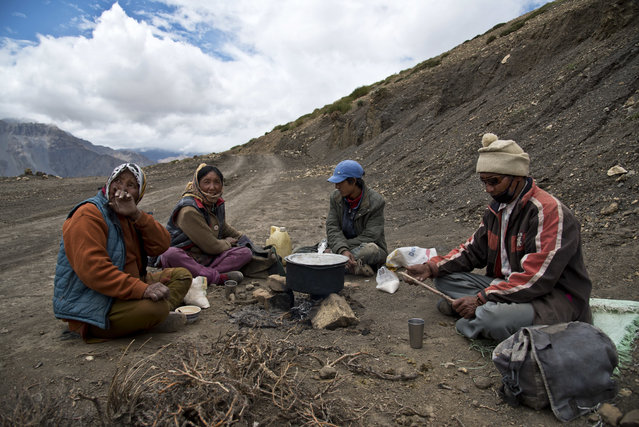
In this August 17, 2016, photo, from left to right, Chhering Chodom, 60, Tashi Yangzom, 50, Lobsang Chhering, 27, and Dorje Tandup, 58, drink milk tea on the side of the road. For centuries, the sleepy valley nestled in the Indian Himalayas remained a hidden Buddhist enclave forbidden to outsiders. Enduring the harsh year-round conditions of the high mountain desert, the people of Spiti Valley lived by a simple communal code – share the Earth's bounty, be hospitable to neighbors, and eschew greed and temptation at all turns. That's all starting to change, for better or worse. Since India began allowing its own citizens as well as outsiders to visit the valley in the early 1990s, tourism and trade have boomed. And the marks of modernization, such as solar panels, asphalt roads and concrete buildings, have begun to appear around some of the villages that dot the remote landscape at altitudes above 4,000 meters (13,000 feet). (Photo by Thomas Cytrynowicz/AP Photo)

In this August 17, 2016, photo, from left to right, Chhering Chodom, 60, Tashi Yangzom, 50, Lobsang Chhering, 27, and Dorje Tandup, 58, drink milk tea on the side of the road. For centuries, the sleepy valley nestled in the Indian Himalayas remained a hidden Buddhist enclave forbidden to outsiders. Enduring the harsh year-round conditions of the high mountain desert, the people of Spiti Valley lived by a simple communal code – share the Earth's bounty, be hospitable to neighbors, and eschew greed and temptation at all turns. That's all starting to change, for better or worse. (Photo by Thomas Cytrynowicz/AP Photo)
Details
15 Sep 2016 09:22:00
An Indian bride, sits during a mass marriage of 162 Muslim couples in Ahmadabad, India, Sunday, March 3, 2013. Mass marriages in India are organized by social organizations primarily to help the economically backward families who cannot afford the high ceremony costs as well as the customary dowry and expensive gifts that are still prevalent in many communities. (Photo by Ajit Solanki/AP Photo/LaPresse)

An Indian bride, sits during a mass marriage of 162 Muslim couples in Ahmadabad, India, Sunday, March 3, 2013. Mass marriages in India are organized by social organizations primarily to help the economically backward families who cannot afford the high ceremony costs as well as the customary dowry and expensive gifts that are still prevalent in many communities. (Photo by Ajit Solanki/AP Photo/LaPresse)
Details
04 Mar 2013 12:07:00
Prints of R$ 50 Brazilian reais bills sit on a table for inspection at at the Casa da Moeda, the national mint, in the Santa Cruz suburb of Rio de Janeiro, Brazil, on Tuesday, March 5, 2013. Brazil is likely to keep its key interest rate at a record low for the third straight meeting, as policy makers are caught between a fragile economic recovery and faster-than-expected inflation. (Photo by Dado Galdieri/Bloomberg)

Prints of R$ 50 Brazilian reais bills sit on a table for inspection at at the Casa da Moeda, the national mint, in the Santa Cruz suburb of Rio de Janeiro, Brazil, on Tuesday, March 5, 2013. Brazil is likely to keep its key interest rate at a record low for the third straight meeting, as policy makers are caught between a fragile economic recovery and faster-than-expected inflation. (Photo by Dado Galdieri/Bloomberg)
Details
08 Mar 2013 06:41:00