Loading...
Done
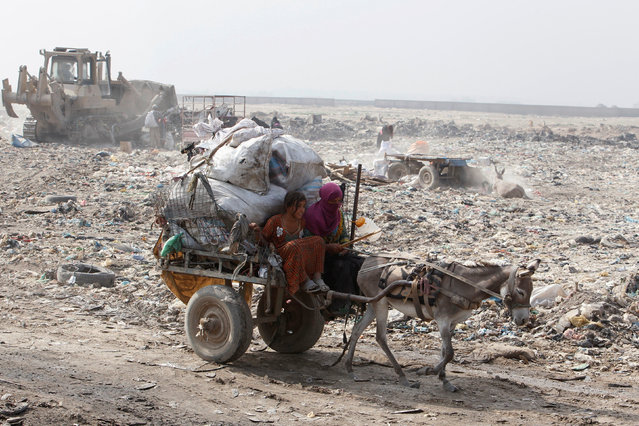
A waste picker unloads garbage at a waste transfer station in Bamako, Mali, August 19, 2018. In the Malian capital of Bamako, donkey carts driven by young men like 19-year-old Arouna Diabate play a vital role battling the fast-growing city's waste problem. Every morning before dawn, Diabate hitches his donkey to a cart and sets off on his rounds, going door-to-door to collect household garbage which he delivers to a local waste transfer station for a monthly salary of around $35. “I won't be picking up trash with a donkey cart for the rest of my life, but for now people appreciate us because we help clean up the homes of Bamako”, Diabate said. (Photo by Luc Gnago/Reuters)

A waste picker unloads garbage at a waste transfer station in Bamako, Mali, August 19, 2018. In the Malian capital of Bamako, donkey carts driven by young men like 19-year-old Arouna Diabate play a vital role battling the fast-growing city's waste problem. Every morning before dawn, Diabate hitches his donkey to a cart and sets off on his rounds, going door-to-door to collect household garbage which he delivers to a local waste transfer station for a monthly salary of around $35. “I won't be picking up trash with a donkey cart for the rest of my life, but for now people appreciate us because we help clean up the homes of Bamako”, Diabate said. (Photo by Luc Gnago/Reuters)
Details
18 Sep 2018 00:01:00
A newly-hatched baby sea turtle makes its way into the Mediterranean Sea for the first time, as part of the Israeli Sea Turtle Rescue Center's conservation program, at a beach near Mikhmoret north of Tel Aviv, Israel September 9, 2019. Green turtles are endangered worldwide, the World Wildlife Fund says. Among other hazards, they are threatened by hunting, human encroachment on the beaches where they nest, and pollution of their feeding grounds offshore. According to the Israeli rescue center, only about 20 female green turtles nest along the Israeli Mediterranean coast during a breeding season that usually lasts from May until August. (Photo by Amir Cohen/Reuters)

A newly-hatched baby sea turtle makes its way into the Mediterranean Sea for the first time, as part of the Israeli Sea Turtle Rescue Center's conservation program, at a beach near Mikhmoret north of Tel Aviv, Israel September 9, 2019. Green turtles are endangered worldwide, the World Wildlife Fund says. Among other hazards, they are threatened by hunting, human encroachment on the beaches where they nest, and pollution of their feeding grounds offshore. According to the Israeli rescue center, only about 20 female green turtles nest along the Israeli Mediterranean coast during a breeding season that usually lasts from May until August. (Photo by Amir Cohen/Reuters)
Details
27 Sep 2019 00:05:00
Life reconstruction of the new oviraptorosaurian dinosaur species Anzu wyliei in its 66 million-year-old environment in western North America as seen in an undated handout illustration by Mark A. Klinger, Carnegie Museum of Natural History. Some 18,000 species, great and small, were discovered in 2014, adding to the 2 million already known, scientists said on May 21, 2015 as they released a “Top 10” list that highlights the diversity of life. (Photo by Mark A. Klingler/Reuters/Carnegie Museum of Natural History)

Life reconstruction of the new oviraptorosaurian dinosaur species Anzu wyliei in its 66 million-year-old environment in western North America as seen in an undated handout illustration by Mark A. Klinger, Carnegie Museum of Natural History. Some 18,000 species, great and small, were discovered in 2014, adding to the 2 million already known, scientists said on May 21, 2015 as they released a “Top 10” list that highlights the diversity of life. Anzu wyliei, one of the top 10, dubbed “the chicken from hell”, is extinct. The feathered dinosaur whose partial skeletons were unearthed in the Dakotas was a contemporary of T. rex and Triceratops. (Photo by Mark A. Klingler/Reuters/Carnegie Museum of Natural History)
Details
22 May 2015 12:31:00
Bottles of vintage cognac, with a royal warrant stamp, are seen in storage inside Berry Bros and Rudd wine merchants in central London, Britain, August 21, 2015. Berry Bros. & Rudd, which started as grocers over 300 years ago in St. James's, central London, has two royal warrants. (Photo by Toby Melville/Reuters)

Bottles of vintage cognac, with a royal warrant stamp, are seen in storage inside Berry Bros and Rudd wine merchants in central London, Britain, August 21, 2015. Berry Bros. & Rudd, which started as grocers over 300 years ago in St. James's, central London, has two royal warrants. Every year Queen Elizabeth grants about 20 royal warrants, the gold emblem of the British monarchy, in a practice dating back to medieval times. The warrant holders can display the certificate and use the royal coat of arms in their marketing. The warrants lasting five years can help businesses break into new markets overseas, using their role as supplier to the royal family as a gauge of quality. On September 9, Queen Elizabeth will overtake Queen Victoria as Britain's longest-serving monarch. (Photo by Toby Melville/Reuters)
Details
03 Sep 2015 12:37:00
A heifer, tied with a rope, turns during “Toro de Cuerda” in the white village of Villaluenga del Rosario, southern Spain September 3, 2016. Dazzling clusters of cube-shaped houses perched on top of Andalusia's olive tree-studded mountains, the “Pueblos Blancos”, or white villages, of southern Spain are named for the lime wash the buildings are painted with to keep the interiors cool. The labyrinths of narrow alleyways are a throwback to when this region was known as Al-Andalus and was part of a medieval Muslim territory. While this region is stunningly beautiful and a big draw to tourists visiting the south of Spain, it is also one of the poorest areas in the country and has one of the highest unemployment rates in the European Union. (Photo by Marcelo del Pozo/Reuters)

A heifer, tied with a rope, turns during “Toro de Cuerda” in the white village of Villaluenga del Rosario, southern Spain September 3, 2016. Dazzling clusters of cube-shaped houses perched on top of Andalusia's olive tree-studded mountains, the “Pueblos Blancos”, or white villages, of southern Spain are named for the lime wash the buildings are painted with to keep the interiors cool. The labyrinths of narrow alleyways are a throwback to when this region was known as Al-Andalus and was part of a medieval Muslim territory. While this region is stunningly beautiful and a big draw to tourists visiting the south of Spain, it is also one of the poorest areas in the country and has one of the highest unemployment rates in the European Union. (Photo by Marcelo del Pozo/Reuters)
Details
20 Oct 2016 11:09:00
A Polisario fighter sits on a rock at a forward base on the outskirts of Tifariti, Western Sahara, September 9, 2016. At a rocky outpost in Western Sahara, a new generation of soldiers who have never known war are mobilising as tensions resurface in one of Africa's oldest disputes after a quarter century of uneasy peace. Young Sahrawi troops man new desert posts for the Polisario Front, which for more than 40 years has sought independence for the vast desert region - first in a guerrilla war against Morocco and then politically since a ceasefire deal in 1991. Now a standoff with Morocco, which controls the majority of Western Sahara, is renewing pressure for a diplomatic solution to ensure foot soldiers don't return to fighting as the last generation of commanders once did. The standoff since August has brought Moroccan and Polisario forces within 200 metres of each other in a narrow strip of land near the Mauritanian border. Rich in phosphate, Western Sahara has been contested since 1975 when Spanish colonial powers left. Morocco claimed the territory and fought the 16-year war with Polisario. (Photo by Zohra Bensemra/Reuters)

A Polisario fighter sits on a rock at a forward base on the outskirts of Tifariti, Western Sahara, September 9, 2016. At a rocky outpost in Western Sahara, a new generation of soldiers who have never known war are mobilising as tensions resurface in one of Africa's oldest disputes after a quarter century of uneasy peace. (Photo by Zohra Bensemra/Reuters)
Details
04 Nov 2016 12:09:00
Faruk, 17, a Rohingya refugee trader holds betel leaves which are on sale at a stall in Palong Khali refugee camp near Cox's Bazar, Bangladesh, November 3, 2017. He left his village in Myanmar when the military opened fire towards the Rohingya. “I buy this betel leaf from Palong Khali market, in one bundle there are 160 pieces, I buy it for 80 taka and I sell it for 100 taka. Bangladeshi's and I sell for the same rate in the camp. Outside in the local market it is 80 taka per bundle. My problem is that I don't have money so I can't buy anything to eat, I can't buy fish to eat”, he said. (Photo by Hannah McKay/Reuters)

Faruk, 17, a Rohingya refugee trader holds betel leaves which are on sale at a stall in Palong Khali refugee camp near Cox's Bazar, Bangladesh, November 3, 2017. He left his village in Myanmar when the military opened fire towards the Rohingya. “I buy this betel leaf from Palong Khali market, in one bundle there are 160 pieces, I buy it for 80 taka and I sell it for 100 taka (1 Bangladeshi Taka = 0.012 US Dollar). Bangladeshi's and I sell for the same rate in the camp. Outside in the local market it is 80 taka per bundle. My problem is that I don't have money so I can't buy anything to eat, I can't buy fish to eat”, he said. (Photo by Hannah McKay/Reuters)
Details
27 Nov 2017 08:54:00
Gymnast Ahmad al-Sawas performs gymnastic moves near damaged buildings in the rebel-held Bustan al-Qasr neighbourhood of Aleppo, Syria March 26, 2016. As Syrian gymnast Ahmad al-Sawas watched his country fall apart, his Olympic dream collapsed too. The last national champion before the fighting began, he knew that supporting the anti-government side in the five-year-old civil war would prevent him from being selected for the Rio Games. “I chose to be an athlete who participates in the revolution”, said Ahmad, who trains where he can for two hours a day – be it on a mattress on a soccer field, in a local hall or somersaulting off a wall. (Photo by Abdalrhman Ismail/Reuters)

Gymnast Ahmad al-Sawas performs gymnastic moves near damaged buildings in the rebel-held Bustan al-Qasr neighbourhood of Aleppo, Syria March 26, 2016. As Syrian gymnast Ahmad al-Sawas watched his country fall apart, his Olympic dream collapsed too. The last national champion before the fighting began, he knew that supporting the anti-government side in the five-year-old civil war would prevent him from being selected for the Rio Games. (Photo by Abdalrhman Ismail/Reuters)
Details
05 Aug 2016 13:25:00