Loading...
Done
1952:  Shepherds from the north wear their traditional heavy woollen mantles as they stand ready to shear sheep with sycthe-like shears

Shepherds from the north wear their traditional heavy woollen mantles as they stand ready to shear sheep with sycthe-like shears. (Photo by Three Lions/Getty Images). Circa 1952
Details
03 Dec 2011 13:34:00
A person stands in front of a 25.3-meter-long giant rabbit designed by Dutch artist Florentijn Hofman at an old aircraft hangar as part of the Taoyuan Land Art Festival in Taoyuan, northern Taiwan, September 3, 2014. The rabbit is named “Moon rabbit” for the coming Mid-Autumn Festival or the Moon Festival and will be displayed from September 4 to 14 at the Taoyuan military  base. (Photo by Pichi Chuang/Reuters)

A person stands in front of a 25.3-meter-long giant rabbit designed by Dutch artist Florentijn Hofman at an old aircraft hangar as part of the Taoyuan Land Art Festival in Taoyuan, northern Taiwan, September 3, 2014. The rabbit is named “Moon rabbit” for the coming Mid-Autumn Festival or the Moon Festival and will be displayed from September 4 to 14 at the Taoyuan military base. (Photo by Pichi Chuang/Reuters)
Details
06 Sep 2014 12:19:00
“Freedom”. After the 30 years banning import large motorcycle, in 2007, the Taiwan government reopened the import licensing of the motorcycle displacement over 550 cubic centimeter. Those large bikes, which were never seen before, were strange thought and treated unequally frequently. However, those adversity will not stop those enthusiastic bike riders from chasing the road of freedom. Photo location: Taiwan. (Photo and caption by 火花 羅/National Geographic Photo Contest)

“Freedom”. After the 30 years banning import large motorcycle, in 2007, the Taiwan government reopened the import licensing of the motorcycle displacement over 550 cubic centimeter. Those large bikes, which were never seen before, were strange thought and treated unequally frequently. However, those adversity will not stop those enthusiastic bike riders from chasing the road of freedom. Photo location: Taiwan. (Photo and caption by 火花 羅/National Geographic Photo Contest)
Details
14 Oct 2014 11:14:00
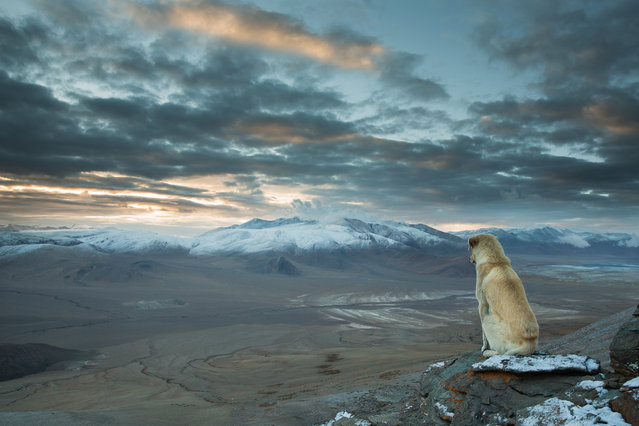
“Himalayan Dog”. This dog just appeared out of nowhere and followed us for an entire week during our trekking trip in the Himalayan outback. He always used to sleep in front of our tent and guarded us in the nights. When I decided to get up at 4 a.m. to climb the next 5000 m peak for sunrise he accompanied me as well. On the top he was sitting for the entire 30 minutes on this place looking straight into the countryside. Photo location: Ladakh, India. (Photo and caption by Sebastian Wahlhuetter/National Geographic Photo Contest)

“Himalayan Dog”. This dog just appeared out of nowhere and followed us for an entire week during our trekking trip in the Himalayan outback. He always used to sleep in front of our tent and guarded us in the nights. When I decided to get up at 4 a.m. to climb the next 5000 m peak for sunrise he accompanied me as well. On the top he was sitting for the entire 30 minutes on this place looking straight into the countryside. Photo location: Ladakh, India. (Photo and caption by Sebastian Wahlhuetter/National Geographic Photo Contest)
Details
01 Apr 2014 10:47:00
“Lofoten Glow”. I was desperately searching a good sunrise spot this particular morning. Normally Storvatnet Lake is completely covered in snow, so you can only imagine my surprise when I saw these crazy ice formations almost being shot out of the frozen lake. I put my crampons on and took a big risk walking out. Photo location: Storvatnet, Lofoten Islands in Northern Norway. (Photo and caption by Stian Klo/National Geographic Photo Contest)

“Lofoten Glow”. I was desperately searching a good sunrise spot this particular morning. Normally Storvatnet Lake is completely covered in snow, so you can only imagine my surprise when I saw these crazy ice formations almost being shot out of the frozen lake. I put my crampons on and took a big risk walking out. I could hear the ice cracking underneath my feet, and when you’re all alone in a fjord/canyon like this – the cracks are echoed and sound really frightening. Was it worth it? I sure think so! Photo location: Storvatnet, Lofoten Islands in Northern Norway. (Photo and caption by Stian Klo/National Geographic Photo Contest)
Details
08 Apr 2014 09:40:00
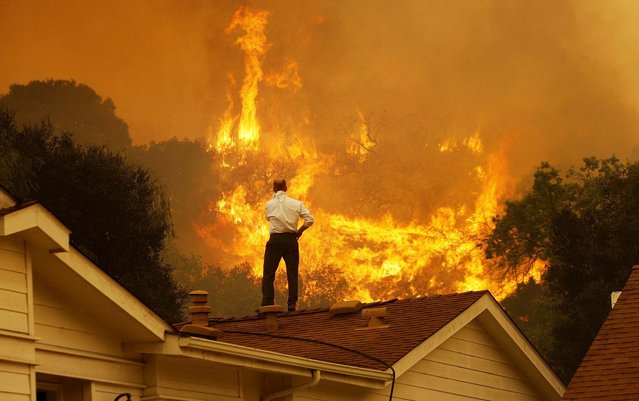
A man watches the approaching flames as the Springs fire continues to grow near Camarillo, California, on May 3, 2013. The wildfire has spread to more than 18,000 acres on day two and is 20 percent contained. (Photo by David McNew/Getty Images)

A man watches the approaching flames as the Springs fire continues to grow near Camarillo, California, on May 3, 2013. The wildfire has spread to more than 18,000 acres on day two and is 20 percent contained. (Photo by David McNew)
Details
05 May 2013 10:10:00
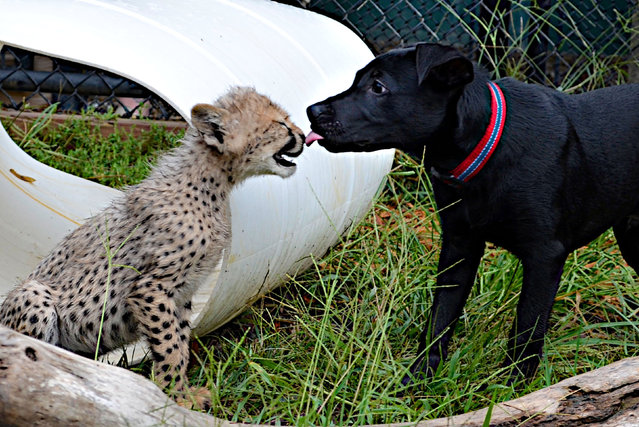
These stunning images could be mistaken for a cheetah ravenously chasing down a dog, but in fact, the pair are best of friends. Savanah, the one-and-a-half-year-old cheetah and Max, who is just a few weeks younger, were put together when Savanah was just 10-weeks-old. (Photo by Caters News Agency)

These stunning images could be mistaken for a cheetah ravenously chasing down a dog, but in fact, the pair are best of friends. Savanah, the one-and-a-half-year-old cheetah and Max, who is just a few weeks younger, were put together when Savanah was just 10-weeks-old. Ever since, their friendship has amazed visitors at Cincinatti Zoo, who are delighted but confused as to why the spotted beast hasnt eaten the dashing hound. So, when it snowed, Savanah and Max just like young children were very excitable and wasted no time playing in the snow. (Photo by Caters News Agency)
Details
21 Dec 2013 13:56:00
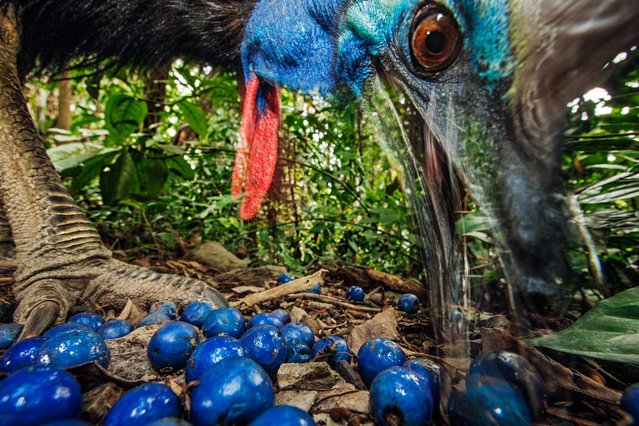
“Cassowaries are large, flightless birds related to emus and (more distantly) to ostriches, rheas, and kiwis”, writes Olivia Judson in the September issue of National Geographic magazine. (Photo by Christian Ziegler/National Geographic)

“Cassowaries are large, flightless birds related to emus and (more distantly) to ostriches, rheas, and kiwis”, writes Olivia Judson in the September issue of National Geographic magazine. How large? People-size: Adult males stand well over five foot five and top 110 pounds. Females are even taller, and can weigh more than 160 pounds. Dangerous when roused, they’re shy and peaceable when left alone. But even birds this big and tough are prey to habitat loss. The dense New Guinea and Australia rain forests where they live have dwindled. Today cassowaries might number 1,500 to 2,000. And because they help shape those same forests – by moving seeds from one place to another – “if they vanish”, Judson writes, “the structure of the forest would gradually change” too. (Photo by Christian Ziegler/National Geographic)

Details
06 Jan 2014 12:21:00