Loading...
Done
Miniature Painting By Lorraine Loots

Postcards for Ants is an ongoing painting project by Cape Town artist Lorraine Loots who has been creating a miniature painting every single day since January 1, 2013. The artist works with paint brushes, pencils, and bare eyes to render superbly detailed paintings scarcely larger than a small coin. After the first year, Loots relaunched the project in a second phase inspired by Cape Town’s designation as World Design Capital 2014.
Details
26 Sep 2014 10:04:00
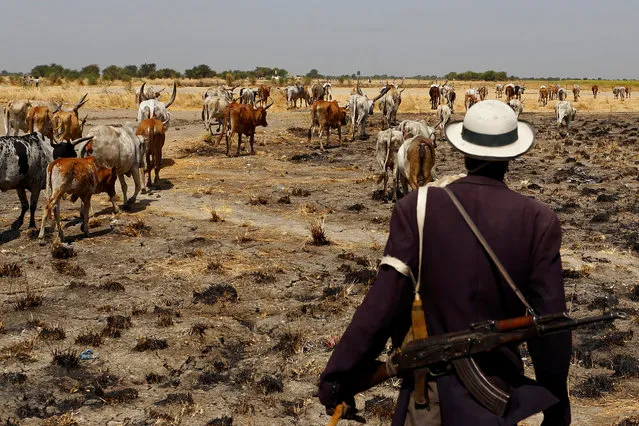
An armed man herds his cattle close to the village of Nimini in northern South Sudan, February 8, 2017. (Photo by Siegfried Modola/Reuters)

An armed man herds his cattle close to the village of Nimini in northern South Sudan, February 8, 2017. In the chaos of South Sudan's civil war, it took three years for Nyagonga Machul to find her lost children. Machul had traveled from her village to the capital when President Salva Kiir, an ethnic Dinka, fired his deputy Riek Machar, a Nuer, in 2013. (Photo by Siegfried Modola/Reuters)
Details
19 Feb 2017 00:04:00
The driver of a Maerlitram (fairy tram), dressed as a Santa Claus, walks past a car which crashed into the tram in Zurich, Switzerland December 7, 2017. (Photo by Angelika Gruber/Reuters)

The driver of a Maerlitram (fairy tram), dressed as a Santa Claus, walks past a car which crashed into the tram in Zurich, Switzerland December 7, 2017. (Photo by Angelika Gruber/Reuters)
Details
13 Dec 2017 07:45:00
A cyclist drives past a flowering rapeseed field not far from the small Bavarian village of Schoengeising, near Munich, during a nice, warm sunny weather day on May 17, 2017. (Photo by Christof Stache/AFP Photo)

A cyclist drives past a flowering rapeseed field not far from the small Bavarian village of Schoengeising, near Munich, during a nice, warm sunny weather day on May 17, 2017. (Photo by Christof Stache/AFP Photo)
Details
27 Jul 2017 06:40:00
A model in Mongolia costumes prepares backstage in Xiangshawan Desert, also called Sounding Sand Desert on July 18, 2013 in Ordos of Inner Mongolia Autonomous Region, China. Xiangshawan is China's famous tourist resort in the desert. It is located along the middle section of Kubuqi Desert on the south tip of Dalate League under Ordos City. Sliding down from the 110-metre-high, 45-degree sand hill, running a course of 200 metres, the sands produce the sound of automobile engines, a natural phenomenon that nobody can explain. (Photo by Feng Li/Getty Images)

A model in Mongolia costumes prepares backstage in Xiangshawan Desert, also called Sounding Sand Desert on July 18, 2013 in Ordos of Inner Mongolia Autonomous Region, China. Xiangshawan is China's famous tourist resort in the desert. It is located along the middle section of Kubuqi Desert on the south tip of Dalate League under Ordos City. Sliding down from the 110-metre-high, 45-degree sand hill, running a course of 200 metres, the sands produce the sound of automobile engines, a natural phenomenon that nobody can explain. (Photo by Feng Li)
Details
26 Aug 2013 08:43:00
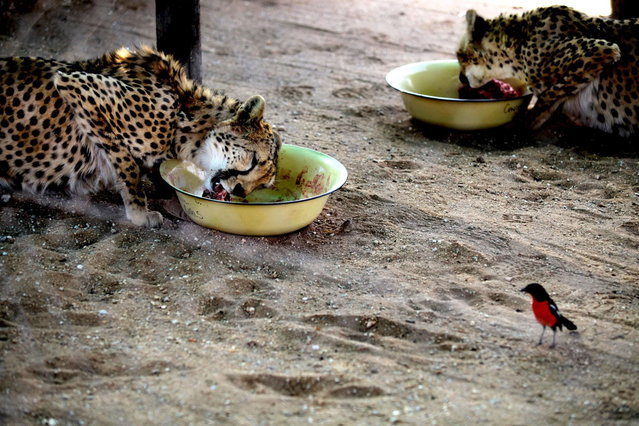
Young cheetahs eat meat at The Cheetah Conservation Fund (CCF) center in Otjiwarongo, Namibia, on August 13, 2013. The CCF started breeding Anatolian livestock dogs to promote cheetah-friendly farming after some 10,000 big cats – the current total worldwide population – were killed or moved off farms in the 1980s.  Up to 1,000 cheetahs were being killed a year, mostly by farmers who saw them as livestock killers. But the use of dogs has slashed losses for sheep and goat farmers and led to less retaliation against the vulnerable cheetah. (Photo by Jennifer Bruce/AFP Photo)

Young cheetahs eat meat at The Cheetah Conservation Fund (CCF) center in Otjiwarongo, Namibia, on August 13, 2013. The CCF started breeding Anatolian livestock dogs to promote cheetah-friendly farming after some 10,000 big cats – the current total worldwide population – were killed or moved off farms in the 1980s. Up to 1,000 cheetahs were being killed a year, mostly by farmers who saw them as livestock killers. But the use of dogs has slashed losses for sheep and goat farmers and led to less retaliation against the vulnerable cheetah. (Photo by Jennifer Bruce/AFP Photo)
Details
29 Aug 2013 10:56:00
A young Nepalese girl dressed as a Kumari or living Goddess, smiles for camera as she waits for Kumari puja at Hanuman Dhoka, Basantapur Durbar Square in Katmandu, Nepal, Tuesday, Sept 17, 2013. More than hundred girls under the age of nine gathered for Kumari puja, a tradition of worshiping young pre-pubescent girls as manifestations of the divine female energy. The ritual holds a strong religious significance in Newar community. It is a community affair held primarily to save small girls from diseases and bad luck in the years to come. (AP Photo/Niranjan Shrestha)

The festival marks the end of the monsoon season and beginning of autumn. More than hundred girls under the age of nine gathered for the tradition of worshiping young pre-pubescent girls as manifestations of the divine female energy. The ritual holds a strong religious significance in Newar community. It is a community affair held primarily to save small girls from diseases and bad luck in the years to come. Photo: A young Nepalese girl dressed as a Kumari or living Goddess, smiles for camera as she waits for Kumari puja at Hanuman Dhoka, Basantapur Durbar Square in Katmandu, Nepal, Tuesday, September 17, 2013. (Photo by Niranjan Shrestha/AP Photo)
Details
18 Sep 2013 09:33:00
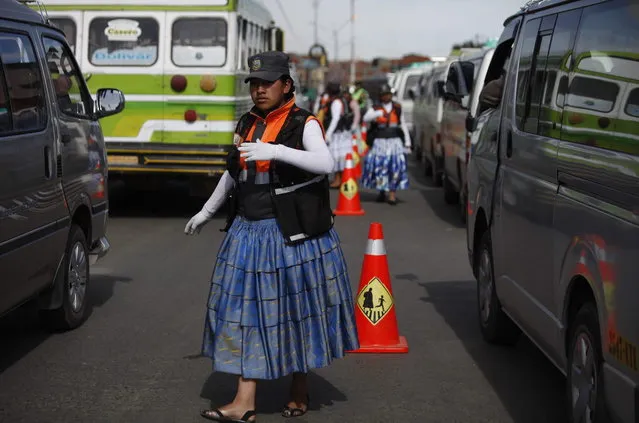
In this December 3, 2013 photo, an Aymara woman cops directs traffic on the streets of El Alto, Bolivia. The women wear the bright petticoats and shawls of indigenous women in the Andes, called cholitas in Bolivian slang, the main difference being that instead of bowler hats they wear khaki green police-style caps. Some don fluorescent traffic vests. (Photo by Juan Karita/AP Photo)

“This city in Bolivia's highlands has hired Aymara women dressed in traditional multilayered Andean skirts and brightly embroidered vests to work as traffic cops and bring order to its road chaos. About 20 of the “traffic cholitas” have been trained to direct cars and buses in El Alto, a teeming, impoverished sister city of La Paz in Bolivia's Andes mountains”. – El Alto via Associated Press. Photo: In this December 3, 2013 photo, an Aymara woman cops directs traffic on the streets of El Alto, Bolivia. The women wear the bright petticoats and shawls of indigenous women in the Andes, called cholitas in Bolivian slang, the main difference being that instead of bowler hats they wear khaki green police-style caps. Some don fluorescent traffic vests. (Photo by Juan Karita/AP Photo)
Details
25 Dec 2013 10:48:00