Loading...
Done
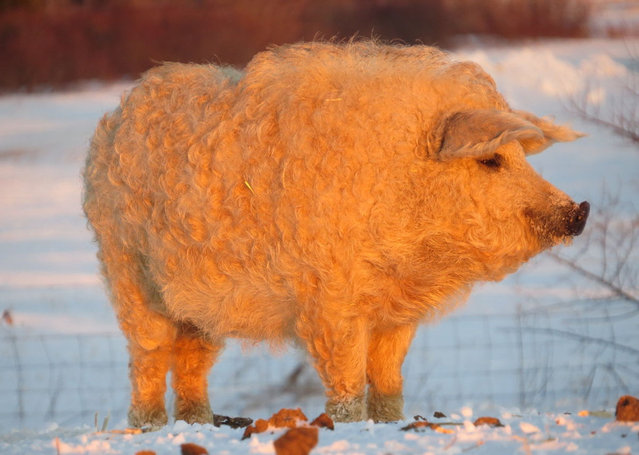
Mangalitsa The Hairy Pig

When you look at the picture of a furry pig that resembles a sheep from a distance, you may think that this may be the result of the work of some crazy scientist that tinkered with the pig’s genome. However, in this case, this is not true. Mangalica is a natural breed of pigs, which were bred in Europe for their lard. This breed of pigs is very unique, since the only other breed of pigs which had a long coat was Loncolnshire Curly Coat, which is now extinct. In the past, these pigs were quite popular, since they were able to produce a lot of lard. However, when the demand for pig lard dwindled, the population of these pigs rapidly decreased, making it a “rare breed”.
Details
01 Dec 2014 13:42:00
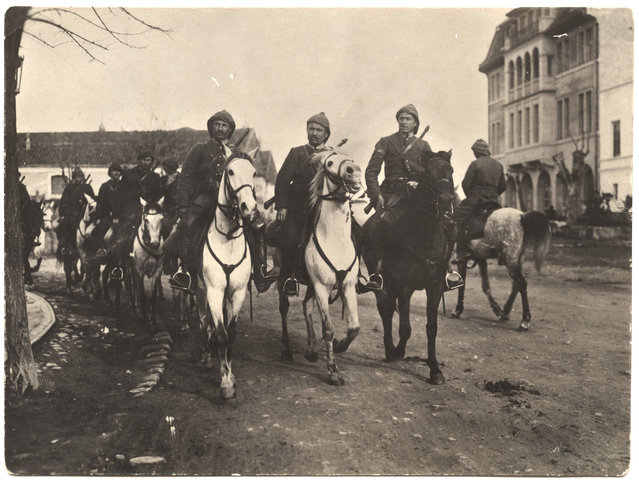
Turkish army, including cavalry, infantry and artillery. (Photo by Dr. P.A. Smithe/National World War I Museum, Kansas City, Mo.)

Dr. P.A. Smithe was sent by the American Red Cross as a doctor and surgeon to work at a hospital in Vienna. He sailed to Europe in December 1915 and returned home in August 1916, according to his daughter, who donated his images to the National World War I Museum. Photo: Turkish army, including cavalry, infantry and artillery. (Photo by Dr. P.A. Smithe/National World War I Museum, Kansas City, Mo.)
Details
29 Jul 2014 11:53:00
A woman argues as Belarus police block a street during an opposition rally in Minsk, Belarus, Saturday, March 25, 2017. (Photo by Sergei Grits/AP Photo)

A woman argues as Belarus police block a street during an opposition rally in Minsk, Belarus, Saturday, March 25, 2017. Over the past two months, protests have broken out across the country of 9.5 million, sometimes attracting thousands – initially they were focused on the labor law but have grown to encompass calls for the resignation of President Alexander Lukashenko, whom critics call Europe's last dictator. (Photo by Sergei Grits/AP Photo)
Details
26 Mar 2017 08:58:00
Stacked stones are pictured during the European Stone Stacking Championships 2018 in Dunbar, Scotland, on April 22, 2018. (Photo by Andy Buchanan/AFP Photo)

Stacked stones are pictured during the European Stone Stacking Championships 2018 in Dunbar, Scotland, on April 22, 2018. The European Stone Stacking Championships are Europe’s largest championships for all Stone Stacking and Rock Balancing artists and practitioners. The overall winner of the European Stone Stacking Championship will receive financial support for flights to the World Stone Balance Championship in Llano, Texas the following year. (Photo by Andy Buchanan/AFP Photo)
Details
25 Apr 2018 00:05:00


WOOTTON, UNITED KINGDOM - APRIL 07: Hot air balloons prepare to depart from Lydden Hill race circuit near Canterbury to take part in mass crossing of the Channel on April 7, 2011 in Wootton, England. 51 balloonists of various nationalities from across Europe took off from Kent making for Calais, France at about 7am. It is the first time a Guinness World Record bid has been made for "the largest group of hot air balloons to make the Channel crossing". (Photo by Oli Scarff/Getty Images)
Details
07 Apr 2011 10:15:00


An arial view of Top Pearsy's Maize Maze in the shape of Harry Potter, on July 11, 2011 in York, England. Farmer Tom Pearcy has cut two portraits of Harry Potter in his crop of maize plants. With some subtle differences the two images create the world's largest spot the difference competition. At over 50m in diameter, and cut out of over 1 million living maize plants, the York Maze is the largest “Maize Maze” in Europe and one of the largest in the world. (Photo by Bethany Clarke/Getty Images)
Details
12 Jul 2011 12:01:00
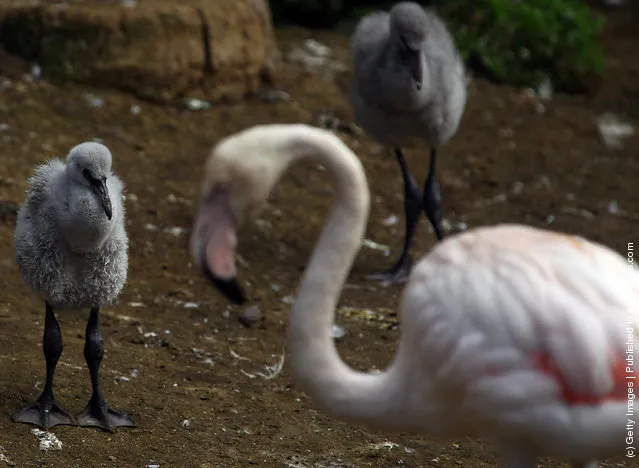
Baby Flamingoes

One of the nine baby flamingos born at Bristol Zoo stands with the adults as they feed together on August 19, 2011 in Bristol, England. Nine flamingo chicks have hatched at Bristol Zoo Gardens in the last three months – the biggest number the Zoo has ever had. The chicks, which are Greater Flamingoes from Africa and southern Europe and range in age from four weeks to three months old, take the Zoo's total flock to 38 birds. (Photo by Matt Cardy/Getty Images)
Details
21 Aug 2011 11:09:00
1941 Chevrolet 1.5 tonnes are left to rot in a field. (Photo by Robert Kahl/Mediadrumworld)

Feast your eyes on Europe’s most spectacular car graveyards as discovered by one auto-obsessed explorer who has dedicated over ten years to finding the best cars left to rot in the European wilderness. The beautiful set of images were taken in Germany, Sweden and Belgium by German Civil Servant Robert Kahl (30) using a Nikon D7100. He describes his photographs as showcasing “the beauty of transience and decayed charm”. Here: 1941 Chevrolet 1.5 tonnes are left to rot in a field. (Photo by Robert Kahl/Mediadrumworld)
Details
01 Mar 2017 00:04:00