Loading...
Done
A sailor of the Marshal Shaposhnikov anti-submarine destroyer takes part in the “Vostok-2022” military exercises at the Peter the Great Gulf of the Sea of Japan outside the city of Vladivostok on September 5, 2022. The Vostok 2022 military exercises, involving several Kremlin-friendly countries including China, takes place from September 1-7 across several training grounds in Russia's Far East and in the waters off it. Over 50,000 soldiers and more than 5,000 units of military equipment, including 140 aircraft and 60 ships, are involved in the drills. (Photo by Kirill Kudryavtsev/AFP Photo)

A sailor of the Marshal Shaposhnikov anti-submarine destroyer takes part in the “Vostok-2022” military exercises at the Peter the Great Gulf of the Sea of Japan outside the city of Vladivostok on September 5, 2022. The Vostok 2022 military exercises, involving several Kremlin-friendly countries including China, takes place from September 1-7 across several training grounds in Russia's Far East and in the waters off it. Over 50,000 soldiers and more than 5,000 units of military equipment, including 140 aircraft and 60 ships, are involved in the drills. (Photo by Kirill Kudryavtsev/AFP Photo)
Details
16 Sep 2022 05:09:00
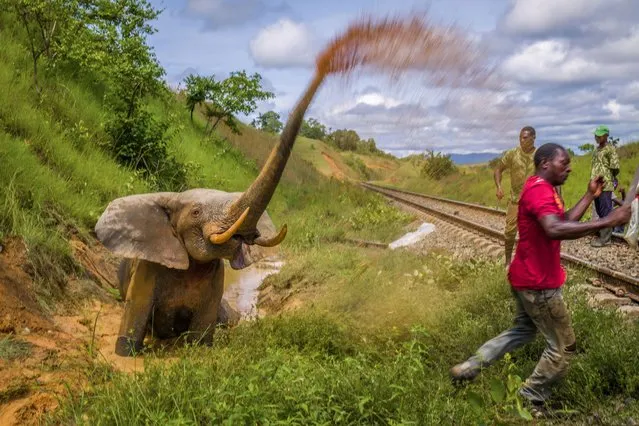
Grand prize winner: environmental photographer of the year 2023; also 1st place in the humanity v nature category; and winner of the 2023 public award. Lopé national park, Gabon, 2021. An angry elephant tries to defend itself after it was hit by a train that crosses paths the animals use within Lopé national park. Park officials decided the elephant was too severely injured to be saved. After it was killed, the park director distributed the meat to local people. As the forest loses its carrying capacity to sustain its megafauna, this kind of human-wildlife conflict is increasing. (Photo by Jasper Doest/Environmental Photography Award)

Grand prize winner: environmental photographer of the year 2023; also 1st place in the humanity v nature category; and winner of the 2023 public award. Lopé national park, Gabon, 2021. An angry elephant tries to defend itself after it was hit by a train that crosses paths the animals use within Lopé national park. Park officials decided the elephant was too severely injured to be saved. After it was killed, the park director distributed the meat to local people. As the forest loses its carrying capacity to sustain its megafauna, this kind of human-wildlife conflict is increasing. (Photo by Jasper Doest/Environmental Photography Award)
Details
09 Jul 2023 03:06:00
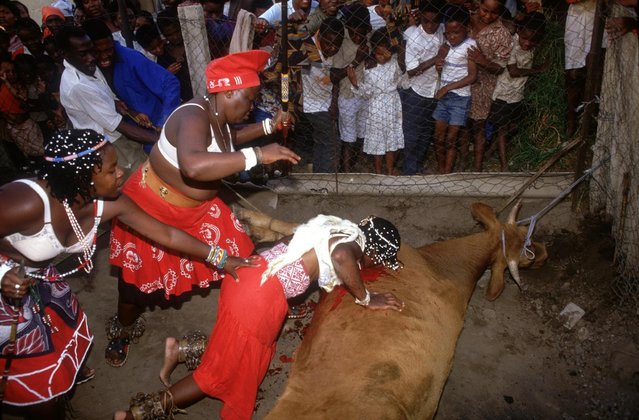
South African Sangomas are wizards and witches who are supposedly chosen by their ancestors to follow a traditional training and go through a rite of passage after which they become Sangomas and can cure and help people. They are so respected and trusted that western medical authorities have actually advised the government of South Africa to develop its cooperation with Sangomas in order to improve hygiene and health among the population. Today is graduation day for Trissa, 25, a Sangoma student in Tembisa, near Pretoria. Thanks to the help of the spirits of her ancestors, she has found a cow that had been hidden. The cow has then been killed by Sangoma Thelma and Trissa is now drinking its blood, thus becoming a Sangoma and changing her name to Nomadlozi. Location: Tembisa, near Pretoria, South Africa. (Photo by Patrick Durand/Sygma via Getty Images)

South African Sangomas are wizards and witches who are supposedly chosen by their ancestors to follow a traditional training and go through a rite of passage after which they become Sangomas and can cure and help people. They are so respected and trusted that western medical authorities have actually advised the government of South Africa to develop its cooperation with Sangomas in order to improve hygiene and health among the population. (Photo by Patrick Durand/Sygma via Getty Images)
Details
24 Feb 2017 00:05:00
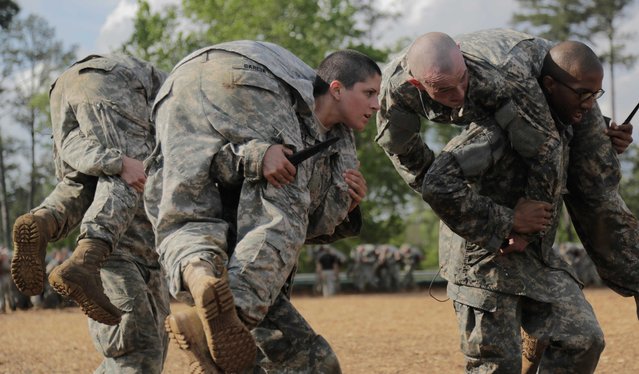
Then U.S. Army First Lieutenant Kirsten Griest (C) and fellow soldiers participate in combatives training during the Ranger Course on Fort Benning, Georgia, in this handout photograph taken on April 20, 2015 and obtained on August 20, 2015. When Griest and another woman completed the daunting U.S. Army Ranger school this week they helped end questions about whether women can serve as combat leaders, as the Pentagon is poised to open new roles, including elite Navy SEALs, to women in coming months. (Photo by Spc. Nikayla Shodeen/Reuters/U.S. Army)

Then U.S. Army First Lieutenant Kirsten Griest (C) and fellow soldiers participate in combatives training during the Ranger Course on Fort Benning, Georgia, in this handout photograph taken on April 20, 2015 and obtained on August 20, 2015. When Griest and another woman completed the daunting U.S. Army Ranger school this week they helped end questions about whether women can serve as combat leaders, as the Pentagon is poised to open new roles, including elite Navy SEALs, to women in coming months. The feat by Griest and First Lieutenant Shaye Haver followed a re-evaluation of the role of women after their frontline involvement in Iraq and Afghanistan and the end of a rule barring them from combat roles in 2013. (Photo by Spc. Nikayla Shodeen/Reuters/U.S. Army)
Details
21 Aug 2015 13:03:00
Taylor's sister, who works in an animal rescue center, found this baby jackdaw who was in need of a little extra love and attention before being released into the wild

Mark Taylor may not have any training as a photographer, but that doesn’t stop him from taking amazing animal photos. From his studio in Southeast England, Taylor has made a big business out of photographing man’s best friends, following in the footsteps of his late mother, Jane Burton. Most of the animals he works with are babies, who are more comfortable in front of the camera than older animals.

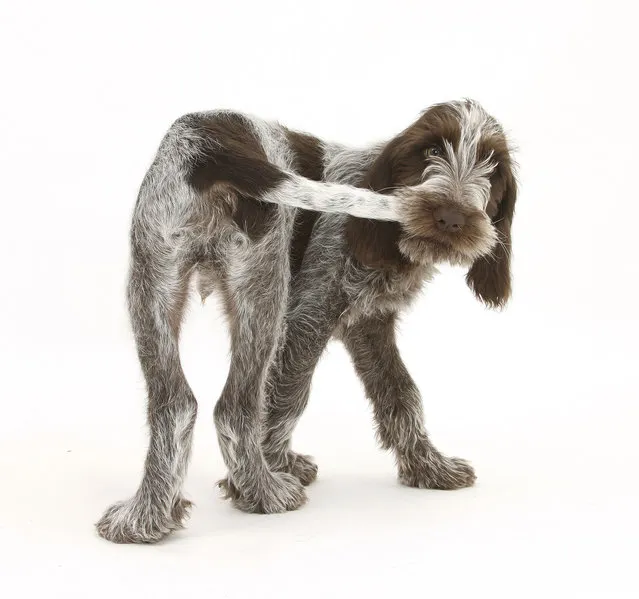
Photo: Taylor often uses animals that belonged to friends of his late mother, including this Italian Spinone puppy chewing his tail. Baby animals make ideal subjects, as the older dogs and cats get, the warier they are of spending time in a studio. And his trick for getting this small subject to pose? Dog treats, of course. (Photo by Mark Taylor/Rex Features)
Details
27 Apr 2012 13:45:00
Female metro passengers hold flowers presented to them by metro workers, prior to International Women's Day in Kiev, Ukraine, 02 March 2016. (Photo by Sergey Dolzhenko/EPA)

Female metro passengers hold flowers presented to them by metro workers, prior to International Women's Day in Kiev, Ukraine, 02 March 2016. The hustle and bustle of the morning commute is broken up by an unexpected surprise. The first passengers to step on the train receive – a warm welcome and a pot of flowers. One woman says, “It's very nice. All the running around and then you're given a flower, it's not often. It's very nice. I'm going to take care of this flower”. International Women's Day first emerged from the activities of labour movements at the turn of the twentieth century, in North America and across Europe, it is celebrated on March 08 in many countries around the world. (Photo by Sergey Dolzhenko/EPA)
Details
03 Mar 2016 11:34:00
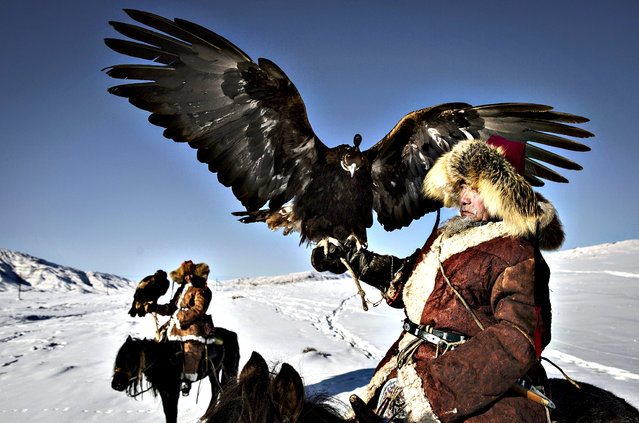
Chinese Kazakh eagle hunters sit on horseback as they travel to a local competition on January 29, 2015 in the mountains of Qinghe County, Xinjiang, northwestern China. The festival, organised by the local hunting community, is part of an effort to promote and grow traditional hunting practices for new generations in the mountainous region of western China that borders Kazakhstan, Russia and Mongolia. (Photo by Kevin Frayer/Getty Images)

Chinese Kazakh eagle hunters sit on horseback as they travel to a local competition on January 29, 2015 in the mountains of Qinghe County, Xinjiang, northwestern China. The festival, organised by the local hunting community, is part of an effort to promote and grow traditional hunting practices for new generations in the mountainous region of western China that borders Kazakhstan, Russia and Mongolia. The training and handling of the large birds of prey follows a strict set of ancient rules that Kazakh eagle hunters are preserving for future generations. (Photo by Kevin Frayer/Getty Images)
Details
07 Feb 2015 14:11:00
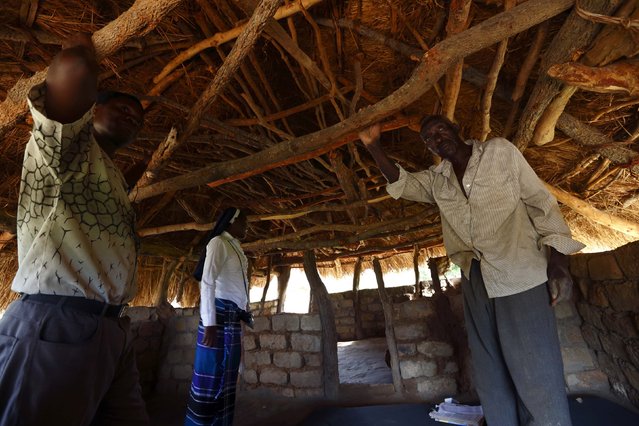
HIV-positive 71-year-old Sylverio Hachiploa (R) talks with caregivers Glandwel Muleya (L) and Sister Abigail Mwaka Mazuba (C) in his thatched hut during a visit by a home-based care team in the village of Nedwmba, south of the Chikuni Mission in the south of Zambia February 23, 2015. (Photo by Darrin Zammit Lupi/Reuters)

HIV-positive 71-year-old Sylverio Hachiploa (R) talks with caregivers Glandwel Muleya (L) and Sister Abigail Mwaka Mazuba (C) in his thatched hut during a visit by a home-based care team in the village of Nedwmba, south of the Chikuni Mission in the south of Zambia February 23, 2015. The caregivers in the Jesuit-run home-based care project at the Chikuni Mission run a capacity-building and empowerment project at the household level, offering training and assistance in crop-growing and animal rearing, as well as offering companionship, pastoral care and monitoring of the antiretroviral treatment compliance of HIV-AIDS patients. (Photo by Darrin Zammit Lupi/Reuters)
Details
25 Feb 2015 09:04:00