Loading...
Done
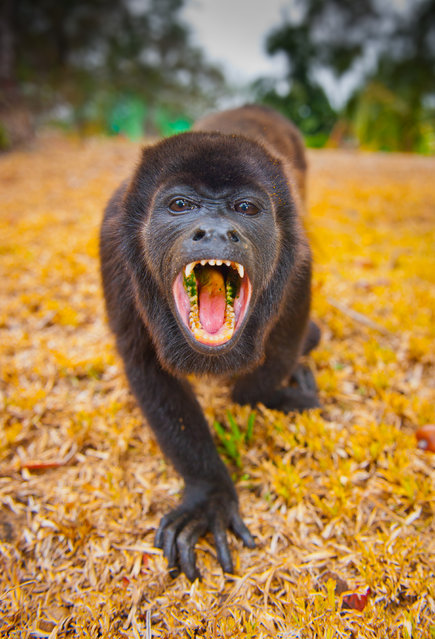
“Attacking Howler Monkey”. Due to a major tropical rainstorm my wife and I were forced to stay overnight in a Howler Monkey Rescue center in Panama. I used the time to explore the area and to take photos of the monkeys. Just after the rain finally stopped, I ran into this monkey that tried to mock attack me. I quickly took a couple of photos before retreating to a (more) safe distance. (Photo and caption by Christian Mueller-Planitz/National Geographic Traveler Photo Contest)

“Attacking Howler Monkey”. Due to a major tropical rainstorm my wife and I were forced to stay overnight in a Howler Monkey Rescue center in Panama. I used the time to explore the area and to take photos of the monkeys. Just after the rain finally stopped, I ran into this monkey that tried to mock attack me. I quickly took a couple of photos before retreating to a (more) safe distance. (Photo and caption by Christian Mueller-Planitz/National Geographic Traveler Photo Contest)

ATTENTION! All pictures are presented in high resolution. To see Hi-Res images – just TWICE click on any picture. In other words, click small picture – opens the BIG picture. Click BIG picture – opens VERY BIG picture.
Details
30 Jun 2013 12:25:00
Brazilian navy soldiers watch a woman as they patrol the area at the Copacabana Beach before carnival festivities in Rio de Janeiro, Brazil February 14, 2017. (Photo by Sergio Moraes/Reuters)

Brazilian navy soldiers watch a woman as they patrol the area at the Copacabana Beach before carnival festivities in Rio de Janeiro, Brazil February 14, 2017. (Photo by Sergio Moraes/Reuters)
Details
15 Feb 2017 10:00:00
Two Chinese farmers got more than they bargained for when they pulled up the root of a fleece flower – and came face-to-face with the doppelganger of Homer Simpson, on May 17, 2013. The large root appears to have two bulging eyes and a prominent nose – giving it an uncanny resemblance to the famous cartoon character. With two offshoot roots shaped like arms, it even looks like it is pondering or confused – just what you would expect from the real Homer. (Photo by ImagineChina)

Two Chinese farmers got more than they bargained for when they pulled up the root of a fleece flower – and came face-to-face with the doppelganger of Homer Simpson, on May 17, 2013. The large root appears to have two bulging eyes and a prominent nose – giving it an uncanny resemblance to the famous cartoon character. With two offshoot roots shaped like arms, it even looks like it is pondering or confused – just what you would expect from the real Homer. (Photo by ImagineChina)
Details
18 May 2013 11:52:00
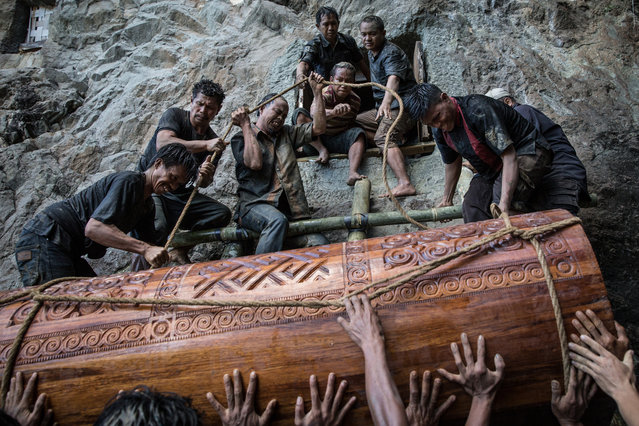
It is said that Torajans are people who “live to die”. For this Indonesian ethnic group, funerals are such extravagant events that they sometimes attract tourists. Families can postpone burials years (and the deceased are considered sick and hosted at home until the funeral) until the family can raise enough money and gather as many relatives as possible. And then it’s a jubilant multiday social event with a parade, dances and animal sacrifices. Agung Parameswara photographed these funerary practices when he traveled to South Sulawesi province, where the Torajans live. But often, their funeral isn’t the last time the dead are seen. In August, crypts are opened, coffins are slid back out and bodies delicately unsheathed. This tender ritual is known as Ma’Nene, which is customarily performed every few years. (Photo by Agung Parameswara/The Washington Post)

It is said that Torajans are people who “live to die”. For this Indonesian ethnic group, funerals are such extravagant events that they sometimes attract tourists. Families can postpone burials years (and the deceased are considered sick and hosted at home until the funeral) until the family can raise enough money and gather as many relatives as possible. And then it’s a jubilant multiday social event with a parade, dances and animal sacrifices. Agung Parameswara photographed these funerary practices when he traveled to South Sulawesi province, where the Torajans live. (Photo by Agung Parameswara/The Washington Post)
Details
06 Oct 2016 09:15:00
A man holds a child after rescuing him from a kindergarten affected by a fire at a commercial building, in Ningde, Fujian province, China, September 16, 2015. According to local media, more than 260 people were evacuated due to the fire, which broke out Wednesday morning. No causalities have been reported and the cause of it is still unknown. (Photo by Reuters/China Daily)

A man holds a child after rescuing him from a kindergarten affected by a fire at a commercial building, in Ningde, Fujian province, China, September 16, 2015. According to local media, more than 260 people were evacuated due to the fire, which broke out Wednesday morning. No causalities have been reported and the cause of it is still unknown. (Photo by Reuters/China Daily)
Details
17 Sep 2015 11:15:00
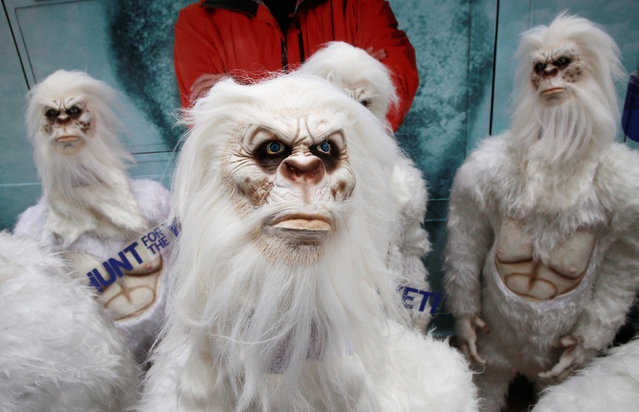
Actors dressed as a “Yeti” attend a promotional event for Travel Channel's “Expedition Unknown: Hunt for the Yeti” in Manhattan, New York City, U.S., October 4, 2016. (Photo by Brendan McDermid/Reuters)

Actors dressed as a “Yeti” attend a promotional event for Travel Channel's “Expedition Unknown: Hunt for the Yeti” in Manhattan, New York City, U.S., October 4, 2016. (Photo by Brendan McDermid/Reuters)
Details
05 Oct 2016 10:07:00
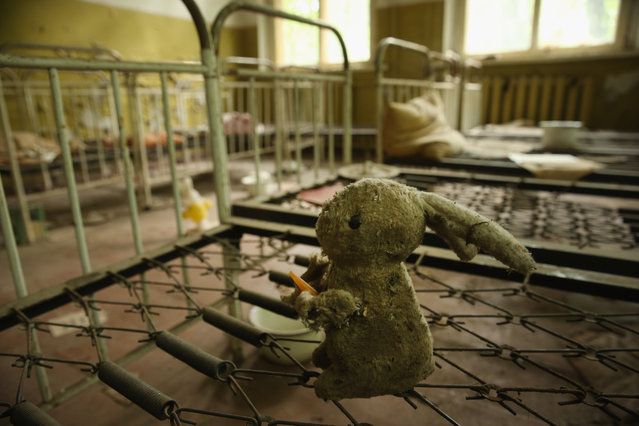
A stuffed rabbit doll sits among children's beds standing in the abandoned kindergarten of Kopachi village located inside the Chernobyl Exclusion Zone on September 29, 2015 near Chornobyl, Ukraine. Kopachi, a village that before 1986 had a population of 1,114, lies only a few kilometers south of the former Chernobyl nuclear power plant, where in 1986 workers inadvertantly caused reactor number four to explode, creating the worst nuclear accident in history. Radiation fallout was so high that authorities bulldozed and buried all of Kopachi's structures except for the kindergarten. (Photo by Sean Gallup/Getty Images)

A stuffed rabbit doll sits among children's beds standing in the abandoned kindergarten of Kopachi village located inside the Chernobyl Exclusion Zone on September 29, 2015 near Chornobyl, Ukraine. Kopachi, a village that before 1986 had a population of 1,114, lies only a few kilometers south of the former Chernobyl nuclear power plant, where in 1986 workers inadvertantly caused reactor number four to explode, creating the worst nuclear accident in history. (Photo by Sean Gallup/Getty Images)
Details
27 Apr 2016 09:28:00
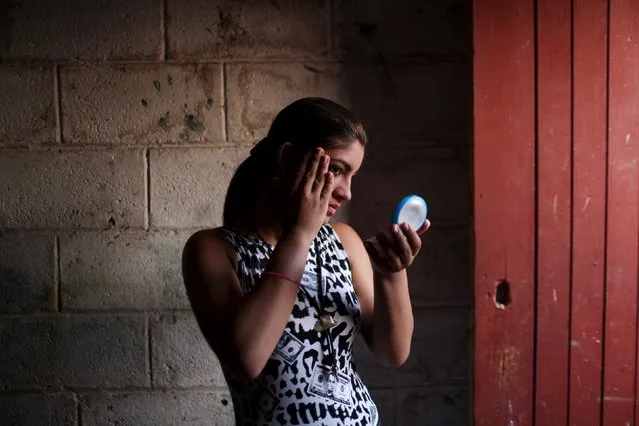
Milena Pino, 15, puts on makeup prior to taking part in a speed competition with horses at the International Livestock Fair Show in Havana March 21, 2015. (Photo by Alexandre Meneghini/Reuters)

Milena Pino, 15, puts on makeup prior to taking part in a speed competition with horses at the International Livestock Fair Show in Havana March 21, 2015. (Photo by Alexandre Meneghini/Reuters)
Details
26 Aug 2015 10:22:00