Loading...
Done
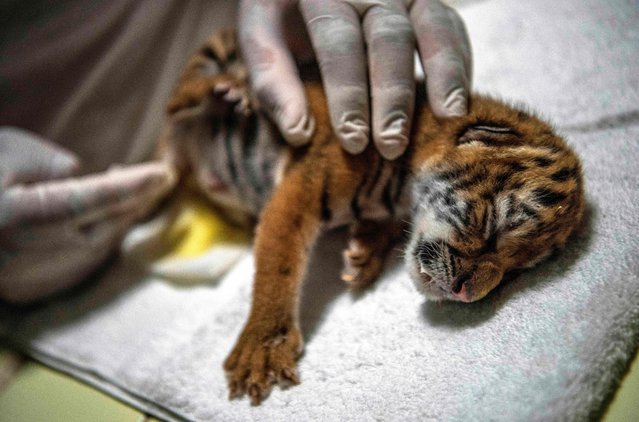
A three-day-old Bengal tiger calf is cared for after being fed at the National Zoo in Masaya on August 30, 2021. A female Bengal tiger calf was born in the National Zoo of Nicaragua, the fourth of this species in risk of extinction born in captivity in the country, and is under special care due to a limited breastfeeding capacity of the mother. (Photo by Inti Ocon/AFP Photo)

A three-day-old Bengal tiger calf is cared for after being fed at the National Zoo in Masaya on August 30, 2021. A female Bengal tiger calf was born in the National Zoo of Nicaragua, the fourth of this species in risk of extinction born in captivity in the country, and is under special care due to a limited breastfeeding capacity of the mother. (Photo by Inti Ocon/AFP Photo)
Details
05 Sep 2021 05:48:00
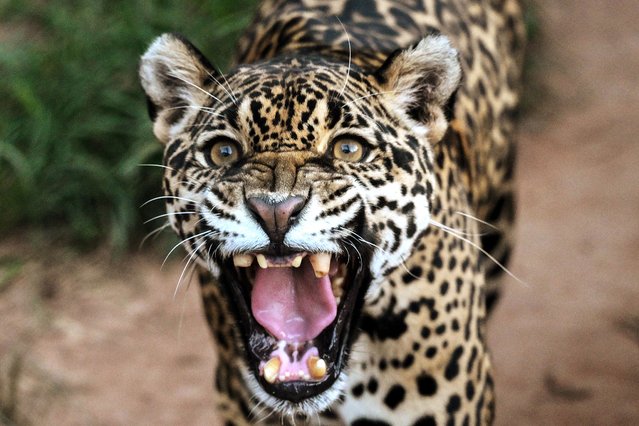
A jaguar (Panthera onca) growls at the Mata Ciliar association, an organization for the conservation of biodiversity, in Jundiai, Sao Paulo state, Brazil on May 29, 2025. Twenty-five pumas and ten jaguars are currently recovering at the Brazilian Center for the Conservation of Neotropical Felines at Mata Ciliar, a site as large as 40 football fields where monkeys, wild dogs, maned wolves, ocelots, and other regional animals are also rehabilitated. (Photo by Nelson Almeida/AFP Photo)

A jaguar (Panthera onca) growls at the Mata Ciliar association, an organization for the conservation of biodiversity, in Jundiai, Sao Paulo state, Brazil on May 29, 2025. Twenty-five pumas and ten jaguars are currently recovering at the Brazilian Center for the Conservation of Neotropical Felines at Mata Ciliar, a site as large as 40 football fields where monkeys, wild dogs, maned wolves, ocelots, and other regional animals are also rehabilitated. (Photo by Nelson Almeida/AFP Photo)
Details
22 Jun 2025 02:21:00
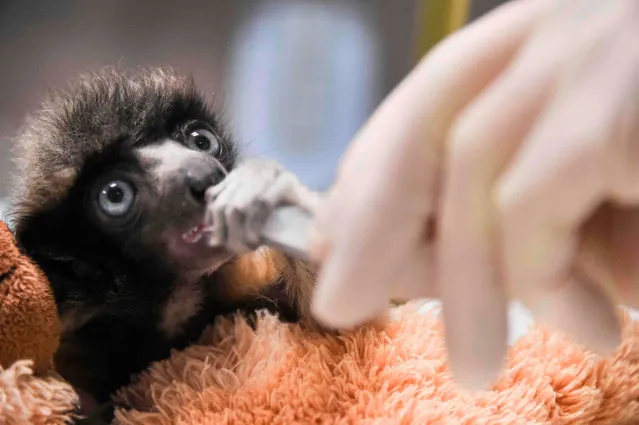
A veterinarian from the zoo of Besancon feeds “Soa”, a female crowned sifaka, in Besancon, eastern France, on February 18, 2019. The crowned sifaka is a critically endangered species from Madagascar. There were only 6 females over 20 individuals living in 7 zoos worldwide end of 2018. (Photo by Sébastien Bozon/AFP Photo)

A veterinarian from the zoo of Besancon feeds “Soa”, a female crowned sifaka, in Besancon, eastern France, on February 18, 2019. The crowned sifaka is a critically endangered species from Madagascar. There were only 6 females over 20 individuals living in 7 zoos worldwide end of 2018. (Photo by Sébastien Bozon/AFP Photo)
Details
24 Feb 2019 00:03:00
Brazil's forward Debinha (up) vies with Jamaica's goalkeeper Sydney Schneider during the France 2019 Women's World Cup Group C football match between Brazil and Jamaica on June 9, 2019, at the Alpes Stadium in Grenoble, central-eastern France. (Photo by Emmanuel Foudrot/Reuters)

Brazil's forward Debinha (up) vies with Jamaica's goalkeeper Sydney Schneider during the France 2019 Women's World Cup Group C football match between Brazil and Jamaica on June 9, 2019, at the Alpes Stadium in Grenoble, central-eastern France. (Photo by Emmanuel Foudrot/Reuters)
Details
11 Jun 2019 00:03:00
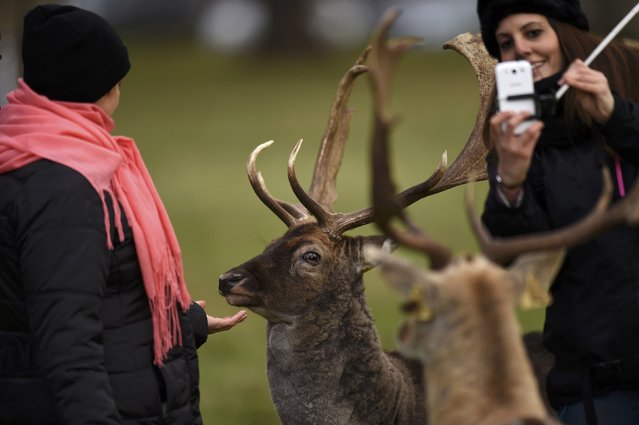
People take pictures of deer in the Phoenix Park in Dublin, Ireland December 5, 2016. (Photo by Clodagh Kilcoyne/Reuters)

People take pictures of deer in the Phoenix Park in Dublin, Ireland December 5, 2016. (Photo by Clodagh Kilcoyne/Reuters)
Details
11 Dec 2016 12:53:00
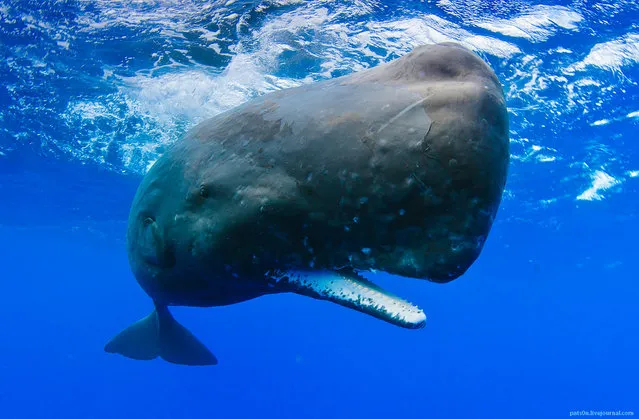
“Sperm whale opening it's huge mouth, Ogasawara Islands, Japan. Sperm whales are the biggest carnivorous animals on the planet. Each teeth in the mouth of adult specimen weights more than 1 kilogram. Interestingly enough that modern marine biologists believe that these teeth despite being fearsome play little role in capturing and eating giant squid – with their main function being mainly ritual aggression between males!”. (Alexander Safonov)

“Sperm whale opening it's huge mouth, Ogasawara Islands, Japan. Sperm whales are the biggest carnivorous animals on the planet. Each teeth in the mouth of adult specimen weights more than 1 kilogram. Interestingly enough that modern marine biologists believe that these teeth despite being fearsome play little role in capturing and eating giant squid – with their main function being mainly ritual aggression between males!”. (Photo by Alexander Safonov)
Details
30 Nov 2012 11:22:00
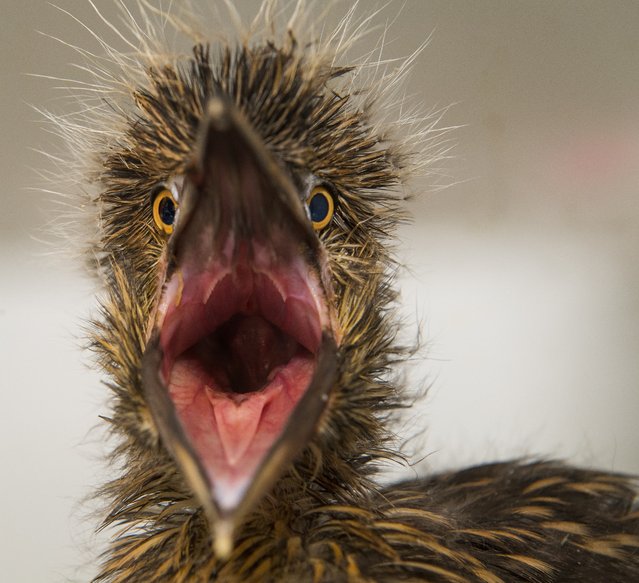
A baby Black-crowned Night Heron squawks in its incubator while being cared for at City Wildlife rescue and rehabilitation center in Washington, DC on May 31, 2017. The heron is one of several that have been brought to CW by the staff at The National Zoo over the past few years. The heron is a native bird and has made an established rookery inside the zoo grounds over a hundred years ago.  Every year at this time, some of the chicks get pushed or fall out of the nest and require human care.  Because the birds are native and not part of the Smithsonian collection, they partnered with CW to rehabilitate the herons for re-release back to the flock inside Zoo. They're reintroduced back to their flock so that they can migrate together in the Fall. The Black-crowned heron usually migrates from the DC area down to southeast North Carolina, some going as far as Jacksonville, FL in winter. The Black-crowned heron is the species of greatest conservation need in the District of Columbia because their numbers are in such rapid decline due to habitat loss. (Photo Linda Davidson/The Washington Post)

A baby Black-crowned Night Heron squawks in its incubator while being cared for at City Wildlife rescue and rehabilitation center in Washington, DC on May 31, 2017. The heron is one of several that have been brought to CW by the staff at The National Zoo over the past few years. (Photo Linda Davidson/The Washington Post)
Details
04 Jun 2017 08:04:00
A partial Solar eclipse is seen just after sunrise over the Queens borough of New York across the East River on November 3, 2013 in New York. (Photo by Stan Honda/AFP Photo)

A partial Solar eclipse is seen just after sunrise over the Queens borough of New York across the East River on November 3, 2013 in New York. (Photo by Stan Honda/AFP Photo)
Details
04 Nov 2013 10:43:00