Loading...
Done
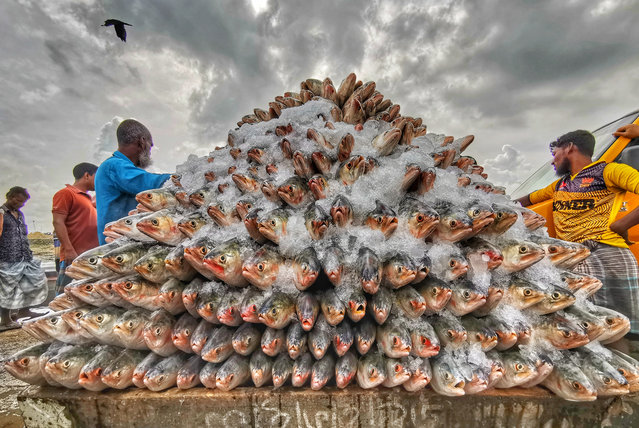
On the phone – Fishes of Hilsa by Azim Khan Ronnie. (Photo by Azim Khan Ronnie/Pink Lady Food Photographer Award 2020)

A selection of winning images from the Pink Lady food photographer of the year awards. Here: On the phone – Fishes of Hilsa by Azim Khan Ronnie. (Photo by Azim Khan Ronnie/Pink Lady Food Photographer Award 2020)
Details
03 May 2020 00:03:00
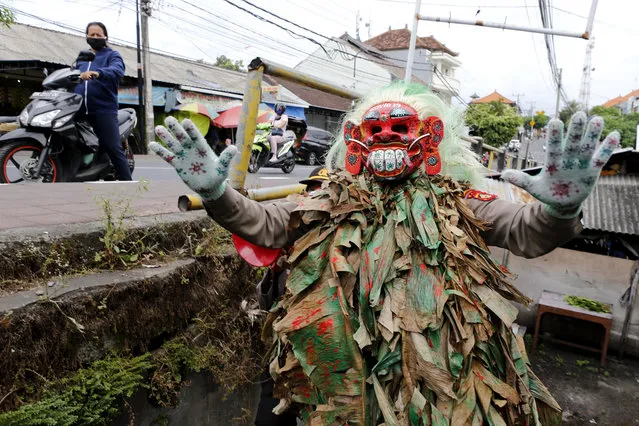
A police officer wearing a Balinese traditional mask, called celuluk, performs as the new coronavirus during a campaign to wear masks as a precaution against the virus outbreak at a market in Bali, Indonesia, Thursday, May 14, 2020. (Photo by Firdia Lisnawati/AP Photo)

A police officer wearing a Balinese traditional mask, called celuluk, performs as the new coronavirus during a campaign to wear masks as a precaution against the virus outbreak at a market in Bali, Indonesia, Thursday, May 14, 2020. (Photo by Firdia Lisnawati/AP Photo)
Details
16 May 2020 00:07:00
In this photograph taken on December 14, 2016, an Indian craftsman works on unfinished cricket bats in a factory in Meerut, some 70 kms north- east of New Delhi. As Indian factory worker Jitender Singh carves out another big- hitting slab of thick willow he insists MCC proposals to limit the size of cricket bats won' t tame Twenty20 marauders. “I don' t think the thickness matters. It' s more about the balance of the bat and the talent of the batsman”, says Singh, who has made bats for many stars, including South Africa's AB de Villiers. The World Cricket committee of the MCC, the guardians of the game, recommended in December 2016 that limitations be placed on the width and depth of bats because it had become too easy to smash fours and sixes. (Photo by Dominique Faget/AFP Photo)

In this photograph taken on December 14, 2016, an Indian craftsman works on unfinished cricket bats in a factory in Meerut, some 70 kms north- east of New Delhi. (Photo by Dominique Faget/AFP Photo)
Details
11 Jan 2017 14:32:00
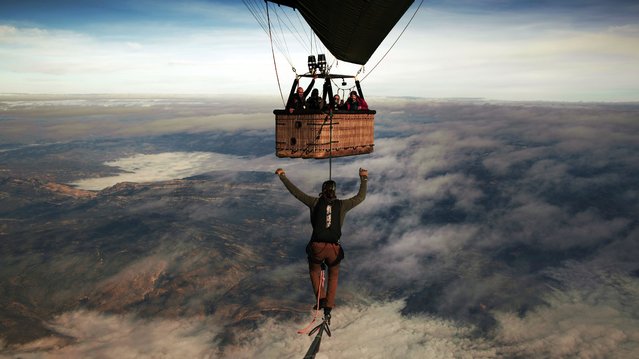
A slackliner, Alexander Schulz, balancing on a line suspended between two hot air balloons above Catalonia, Spain in the last decade of November 2025, at 4700 meters above ground. (Photo by One Inch Dreams/Caters News Agency)

A slackliner, Alexander Schulz, balancing on a line suspended between two hot air balloons above Catalonia, Spain in the last decade of November 2025, at 4700 meters above ground. (Photo by One Inch Dreams/Caters News Agency)
Details
13 Jan 2026 11:46:00
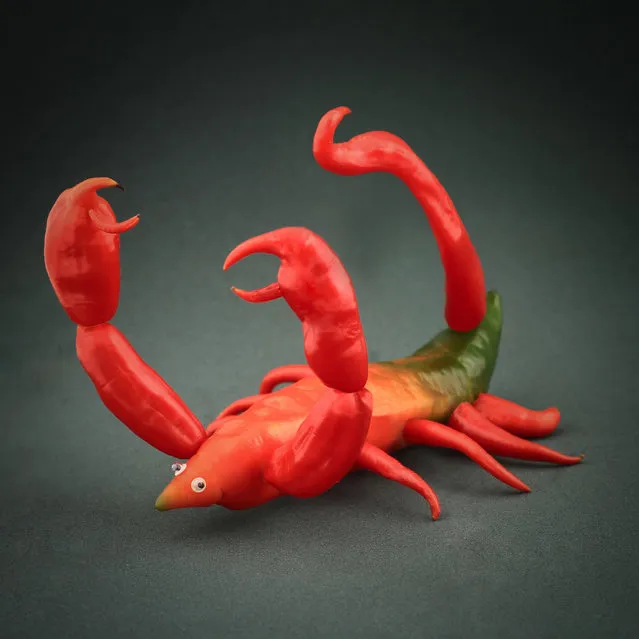
“Red Pepperpion. (Photo by Vanessa Dualib)

“Red Pepperpion. Red Pepperpions are secretive, nocturnal arachilli which can be spotted in kitchens of arid climates all around the world.

Red Pepperpions are equipped with a delicious (and depending on the quantity...deadly!) stinger at the end of its tail. If you happen to get bitten (or if you bite him!) it will produce a burning sensation on your taste nerves.

However, there is no need to worry, since the fact is that his potent stinger is usually only used when hunting or whenever the Pepperpion feels like he might become part of someones meal...

At daylight or when encountering a larger foe, such as a Saucier Chef, they retreat into burrows inside the fridge or hide beneath the oven”. (Photo and comment by Vanessa Dualib)


Details
08 Feb 2013 09:24:00
The Cygnus Wall is in the southern  area of NGC7000 also known as the North America Nebula. It is approximately 1800 light years from Earth, and is in the constellation Cygnus. The Wall is an energized shock front and contains the most concentrated star formations in the nebula. The size of the North America Nebula is about 4 full moons. (Bill Snyder)

Amateur astronomer Bill Snyder has been involved with astrophotography since 2007. Photo: The Cygnus Wall is in the southern area of NGC7000 also known as the North America Nebula. It is approximately 1800 light years from Earth, and is in the constellation Cygnus. The Wall is an energized shock front and contains the most concentrated star formations in the nebula. The size of the North America Nebula is about 4 full moons. (Photo and caption by Bill Snyder)
Details
30 Oct 2013 09:15:00
“Cassowaries are large, flightless birds related to emus and (more distantly) to ostriches, rheas, and kiwis”, writes Olivia Judson in the September issue of National Geographic magazine. (Photo by Christian Ziegler/National Geographic)

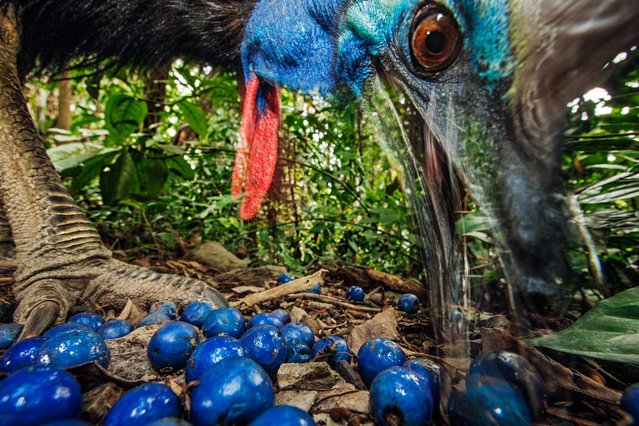
“Cassowaries are large, flightless birds related to emus and (more distantly) to ostriches, rheas, and kiwis”, writes Olivia Judson in the September issue of National Geographic magazine. How large? People-size: Adult males stand well over five foot five and top 110 pounds. Females are even taller, and can weigh more than 160 pounds. Dangerous when roused, they’re shy and peaceable when left alone. But even birds this big and tough are prey to habitat loss. The dense New Guinea and Australia rain forests where they live have dwindled. Today cassowaries might number 1,500 to 2,000. And because they help shape those same forests – by moving seeds from one place to another – “if they vanish”, Judson writes, “the structure of the forest would gradually change” too. (Photo by Christian Ziegler/National Geographic)

Details
06 Jan 2014 12:21:00
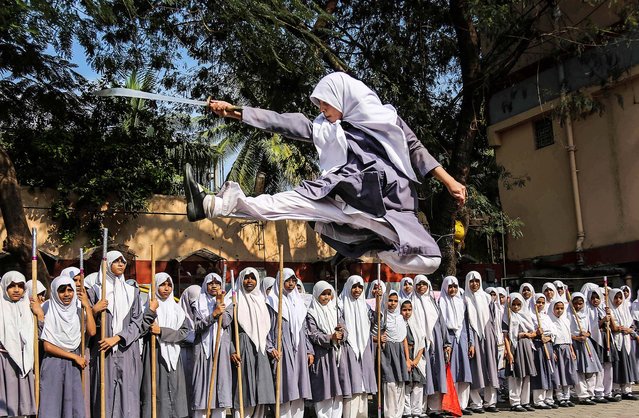
A girl performs martial arts during a function to mark International Women's Day at a school in Hyderabad, India, on March 7, 2014. (Photo by Mahesh Kumar A./Associated Press)

A girl performs martial arts during a function to mark International Women's Day at a school in Hyderabad, India, on March 7, 2014. (Photo by Mahesh Kumar A./Associated Press)
Details
08 Mar 2014 11:18:00