Loading...
Done
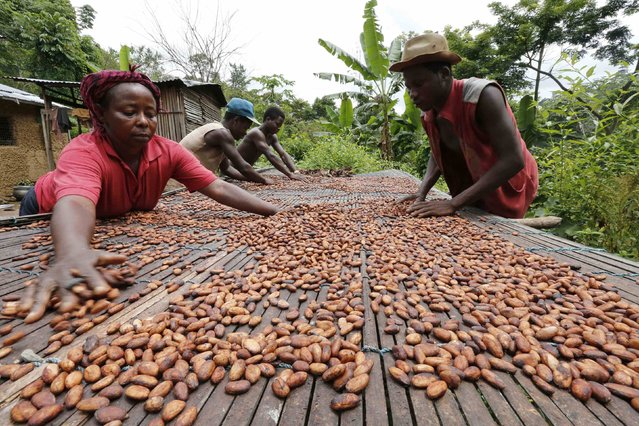
People work with cocoa beans in Enchi June 17, 2014. Picture taken June 17, 2014. Ghana emerged as a success story during the 2000s, when war, political instability and a disastrous liberalization brought Ivory Coast's cocoa sector to its knees. Ghana's output more than tripled from 340,000 tons in the 2001/02 season to a record 1,025,000 tons a decade later. Strict controls cemented its reputation as a producer of top quality beans, establishing a brand that fetches a premium. (Photo by Thierry Gouegnon/Reuters)

People work with cocoa beans in Enchi June 17, 2014. Picture taken June 17, 2014. Ghana emerged as a success story during the 2000s, when war, political instability and a disastrous liberalization brought Ivory Coast's cocoa sector to its knees. Ghana's output more than tripled from 340,000 tons in the 2001/02 season to a record 1,025,000 tons a decade later. Strict controls cemented its reputation as a producer of top quality beans, establishing a brand that fetches a premium. (Photo by Thierry Gouegnon/Reuters)
Details
03 Aug 2014 07:17:00
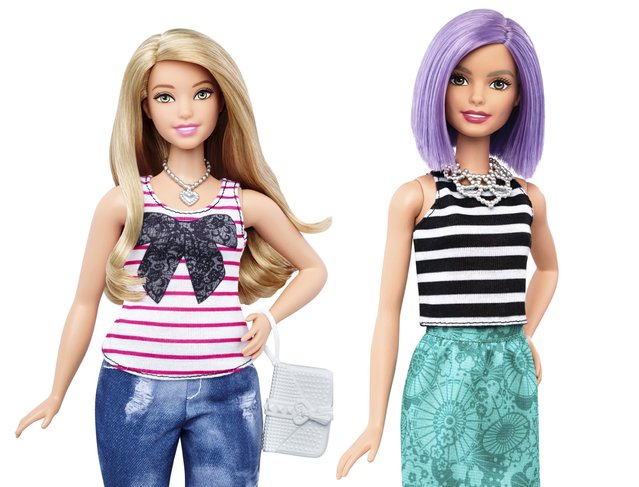
The new curvy Barbie doll body shape (L) is seen next to the traditional Barbie in a combination of photos released by Mattel on January 28, 2016. Barbie, the world's most famous doll, has a new body. In fact, she has three new bodies – petite, tall and curvy. Some 57 years after the impossibly busty and narrow-waisted blue-eyed Barbie doll was first introduced, California-based toy maker Mattel on Thursday released the new models, which it says better reflect a changing world. (Photo by Reuters/Mattel)

The new curvy Barbie doll body shape (L) is seen next to the traditional Barbie in a combination of photos released by Mattel on January 28, 2016. Barbie, the world's most famous doll, has a new body. In fact, she has three new bodies – petite, tall and curvy. Some 57 years after the impossibly busty and narrow-waisted blue-eyed Barbie doll was first introduced, California-based toy maker Mattel on Thursday released the new models, which it says better reflect a changing world. (Photo by Reuters/Mattel)
Details
29 Jan 2016 12:23:00
A crane loads logs at the Novoyeniseisk wood processing plant, with the air temperature at about minus 20 degrees Celsius (minus 4 degrees Fahrenheit), in the town of Lesosibirsk in Krasnoyarsk Region, Siberia, Russia, February 16, 2016. The plant exports timber to Europe, Northern Africa and Asia. The Taiga, also known as the boreal forest, on the coast of the Angara River and Yenisei River is one of the main areas for the industrial cutting of wood thanks to the high quality of the Angara pine. (Photo by Ilya Naymushin/Reuters)

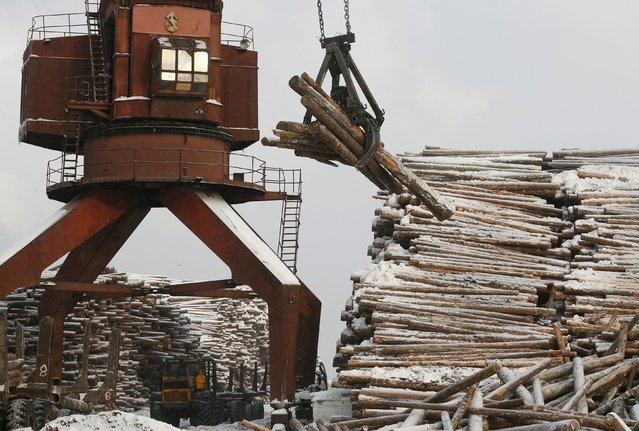
A crane loads logs at the Novoyeniseisk wood processing plant, with the air temperature at about minus 20 degrees Celsius (minus 4 degrees Fahrenheit), in the town of Lesosibirsk in Krasnoyarsk Region, Siberia, Russia, February 16, 2016. The plant exports timber to Europe, Northern Africa and Asia. The Taiga, also known as the boreal forest, on the coast of the Angara River and Yenisei River is one of the main areas for the industrial cutting of wood thanks to the high quality of the Angara pine. Open air work continues all year around regardless to temperatures which can drop to minus 52 degrees Celsius (minus 61.6 degrees Fahrenheit), according to employees. (Photo by Ilya Naymushin/Reuters)
Details
18 Feb 2016 13:10:00
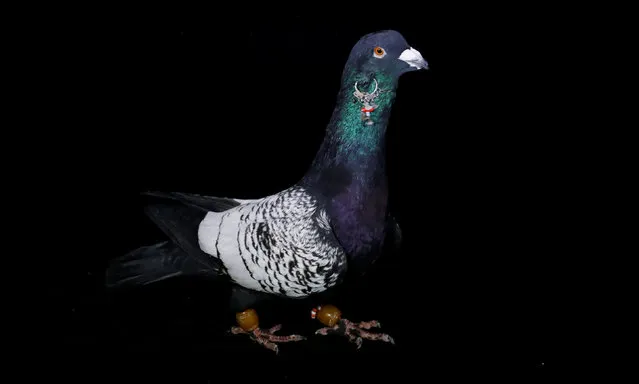
A pigeon, known as Siyah Kinifirli, with an approximate market value of 1000 Turkish Lira ($263), bred by 23-year-old Ismail Ozbek, is pictured in Sanliurfa, Turkey, December 23, 2016. As night-time approaches in Sanliurfa, southeastern Turkey, most of the alleyways of the city's old bazaar are emptying out of buyers and vendors, except for one. The bustle of daytime trading has died down, but on this little street, a stream of men carry cardboard boxes filled with pigeons to a cluster of three teahouses. Here, they sell the birds at Sanliurfa's famed auctions to a dedicated band of pigeon keepers and breeders, a pastime that has been thriving for hundreds of years across the region and over the nearby border into war-torn Syria. In a country where the minimum wage is about 1,400 Liras ($367) a month, enthusiasts regularly easily spend hundreds of dollars for one bird. “I once sold a pair of pigeons for 35,000 Turkish Lira”, says auctioneer Imam Dildas. “This is a passion, a hobby you cannot quit. I've been known to sell the fridge and my wife's gold bracelets to pay for pigeons”. (Photo by Umit Bektas/Reuters)

A pigeon, known as Siyah Kinifirli, with an approximate market value of 1000 Turkish Lira ($263), bred by 23-year-old Ismail Ozbek, is pictured in Sanliurfa, Turkey, December 23, 2016. As night-time approaches in Sanliurfa, southeastern Turkey, most of the alleyways of the city's old bazaar are emptying out of buyers and vendors, except for one. (Photo by Umit Bektas/Reuters)
Details
17 Jan 2017 12:05:00
Dinosaur robots acting as receptionist greet a hotel employee demonstrating how to check-in to the hotel during a press preview for the newly-opening Henn na Hotel Maihama Tokyo Bay in Urayasu, east of Tokyo, Japan March 15, 2017. The reception desk is handled by robots that speak Japanese, English, Chinese and Korean, as well as porter robots that help guests carry luggage to their rooms. Tasks such as window-cleaning and vacuuming are also handled by robots. Japan's second robot-run hotel Henn na Hotel (“strange hotel” in Japanese) opened on March 15, 2017 as the robot-staffed hotel near Tokyo, operating company H.I.S. Co. said. (Photo by Issei Kato/Reuters)

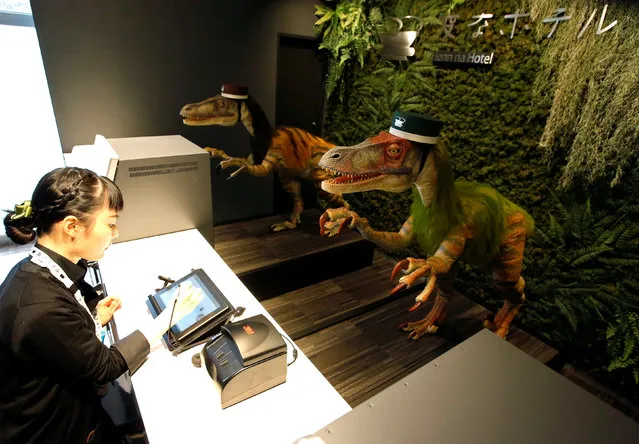
Dinosaur robots acting as receptionist greet a hotel employee demonstrating how to check-in to the hotel during a press preview for the newly-opening Henn na Hotel Maihama Tokyo Bay in Urayasu, east of Tokyo, Japan March 15, 2017. The reception desk is handled by robots that speak Japanese, English, Chinese and Korean, as well as porter robots that help guests carry luggage to their rooms. Tasks such as window-cleaning and vacuuming are also handled by robots. Japan's second robot-run hotel Henn na Hotel (“strange hotel” in Japanese) opened on March 15, 2017 as the robot-staffed hotel near Tokyo, operating company H.I.S. Co. said. (Photo by Issei Kato/Reuters)
Details
16 Mar 2017 09:54:00
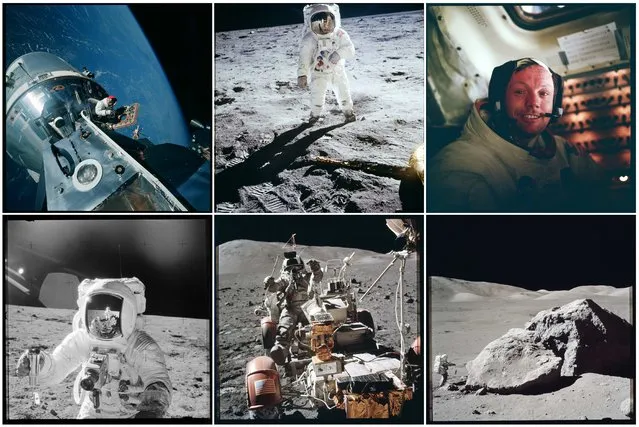
NASA handout photographs from the various Apollo missions are shown in this combination photograph. The photographs are some of more than 12,000 from NASA's archives recently aggregated on the Project Apollo Archive Flickr account. (Photo by Reuters/NASA)

NASA handout photographs from the various Apollo missions are shown in this combination photograph. The photographs are some of more than 12,000 from NASA's archives recently aggregated on the Project Apollo Archive Flickr account. (Top L) David R. Scott, command module pilot, stands in the open hatch of the Command Module during the Apollo 9 mission March 6, 1969. (Top centre) Edwin "Buzz" Aldrin Jr.walks on the surface of the moon during the Apollo 11 mission July 20, 1969. (Top R) Neil Armstrong, Apollo 11 commander, is pictured inside the Lunar Module during the Apollo 11 mission July 20, 1969. (Bottom L) Alan Bean holds a container filled with lunar soil collected during the Apollo 12 mission November 19, 1969. (Bottom centre) Scientist-astronaut Harrison Schmitt rides in the Lunar Roving Vehicle during the Apollo 17 mission December 13, 1972. (Bottom R) Harrison Schmitt stands next to a huge, split boulder during the Apollo 17 mission December 13, 1972. (Photo by Reuters/NASA)
Details
13 Oct 2015 08:02:00
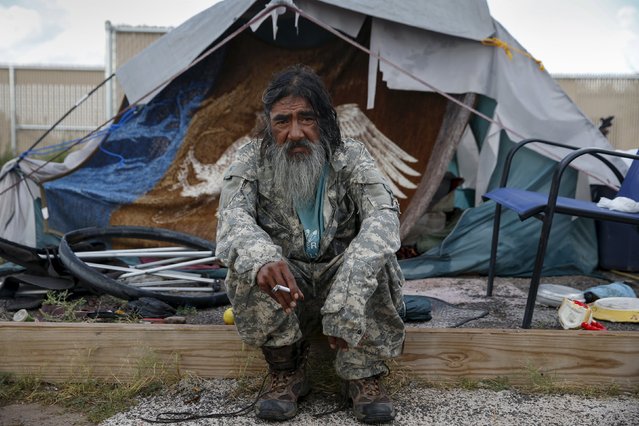
Daniel J. Wabsey, a 58-year-old war veteran, sits outside his tent at Camp Hope in Las Cruces, New Mexico October 6, 2015. “I've been traveling for 35 or 38 years. Getting inside would take a while to get used to. I just want to be able to eat, sleep and be safe. We all get along and understand in Camp Hope. We've all been there. With common sense you can survive out here”, Wabsey said. Camp Hope describe themselves as an “alternative transitional living project for the homeless”. Around 50 people live at the camp. (Photo by Shannon Stapleton/Reuters)

Daniel J. Wabsey, a 58-year-old war veteran, sits outside his tent at Camp Hope in Las Cruces, New Mexico October 6, 2015. “I've been traveling for 35 or 38 years. Getting inside would take a while to get used to. I just want to be able to eat, sleep and be safe. We all get along and understand in Camp Hope. We've all been there. With common sense you can survive out here”, Wabsey said. Camp Hope describe themselves as an “alternative transitional living project for the homeless”. Around 50 people live at the camp. (Photo by Shannon Stapleton/Reuters)
Details
19 Dec 2015 08:05:00
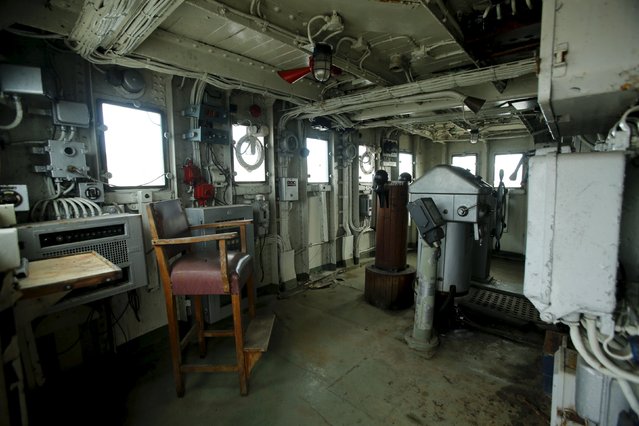
The interior of the ship's bridge on the yacht Galeb is seen in the port city of Rijeka, December 16, 2015. Rijeka announced plans to convert the yacht Galeb used by Yugoslavia's communist leader Josip Broz Tito into a floating museum moored in the city's harbour. Now in disrepair, the 117-metre ship was an iconic symbol of luxury and used by Tito from the 1950s until his death in 1980 to entertain world leaders and celebrities, including  the likes of Khruschev, Gaddafi, Indira Gandhi, Elizabeth Taylor and Richard Burton. (Photo by Antonio Bronic/Reuters)

The interior of the ship's bridge on the yacht Galeb is seen in the port city of Rijeka, December 16, 2015. Rijeka announced plans to convert the yacht Galeb used by Yugoslavia's communist leader Josip Broz Tito into a floating museum moored in the city's harbour. Now in disrepair, the 117-metre ship was an iconic symbol of luxury and used by Tito from the 1950s until his death in 1980 to entertain world leaders and celebrities, including the likes of Khruschev, Gaddafi, Indira Gandhi, Elizabeth Taylor and Richard Burton. (Photo by Antonio Bronic/Reuters)
Details
20 Dec 2015 08:03:00