Loading...
Done
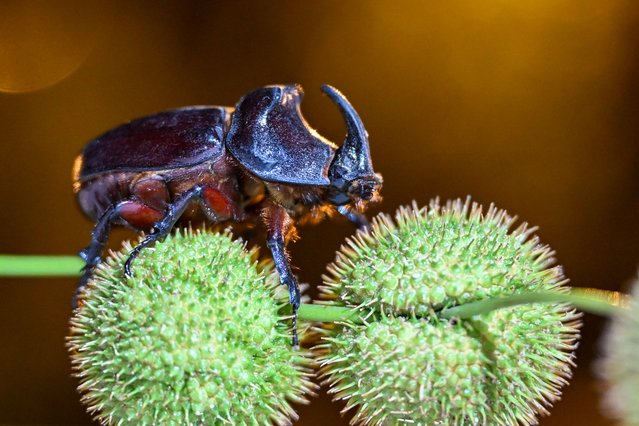
A “Rhino Beetle” (Oryctes nasicornis) is seen in Edremit, Van, Turkiye on August 2, 2024. Named “Rhino Beetle” due to the horn on its head, this beetle is commonly found in moist areas across Europe and Turkiye. (Photo by Ozkan Bilgin/Anadolu via Getty Images)

A “Rhino Beetle” (Oryctes nasicornis) is seen in Edremit, Van, Turkiye on August 2, 2024. Named “Rhino Beetle” due to the horn on its head, this beetle is commonly found in moist areas across Europe and Turkiye. (Photo by Ozkan Bilgin/Anadolu via Getty Images)
Details
24 Aug 2024 04:43:00
Igor Perne (L), 53, an electronic engineer and a member of the International Virtual Aviation Organisation (IVAO), and fellow virtual pilot Franc Lavric gesture for the camera before taking off on a virtual flight in a flight simulator in Nova Vas, Slovenia November 13, 2014. In 2011, Perne, a lifelong flying enthusiast, bought parts of a written-off Cyprus Airways airliner and then spent two and a half years turning the entire nose of the scrapped aircraft into an elaborate flight simulator. (Photo by Srdjan Zivulovic/Reuters)

Igor Perne (L), 53, an electronic engineer and a member of the International Virtual Aviation Organisation (IVAO), and fellow virtual pilot Franc Lavric gesture for the camera before taking off on a virtual flight in a flight simulator in Nova Vas, Slovenia November 13, 2014. In 2011, Perne, a lifelong flying enthusiast, bought parts of a written-off Cyprus Airways airliner and then spent two and a half years turning the entire nose of the scrapped aircraft into an elaborate flight simulator. (Photo by Srdjan Zivulovic/Reuters)
Details
16 Nov 2014 12:07:00
Visitors crowd an artificial wave swimming pool at a tourist resort to escape the summer heat in Daying county of Suining, Sichuan province, China, July 11, 2015. (Photo by Reuters/Stringer)

Visitors crowd an artificial wave swimming pool at a tourist resort to escape the summer heat in Daying county of Suining, Sichuan province, China, July 11, 2015. (Photo by Reuters/Stringer)
Details
12 Jul 2015 14:06:00
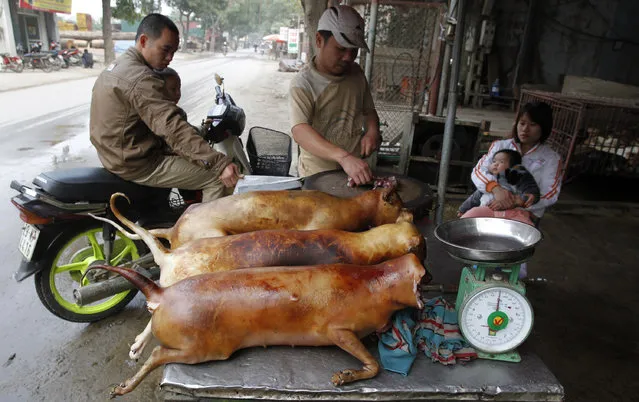
A vendor (C) cuts slaughtered dogs for sale at his roadside stall in Duong Noi village, outside Hanoi December 16, 2011. While animal rights activists have condemned eating dog meat as cruel treatment of the animals, it is still an accepted popular delicacy for some Vietnamese, as well in some other Asian countries. (Photo by Reuters/Kham)

A vendor (C) cuts slaughtered dogs for sale at his roadside stall in Duong Noi village, outside Hanoi December 16, 2011. While animal rights activists have condemned eating dog meat as cruel treatment of the animals, it is still an accepted popular delicacy for some Vietnamese, as well in some other Asian countries. Duong Noi is well-known as a dog-meat village, where hundreds of dogs are killed each day for sale as popular traditional food. Dog-eating as a custom is rooted in Vietnam and was developed as a result of poverty. One kilogram of dog meat costs about 130,000 dongs ($6.2). (Photo by Reuters/Kham)
Details
16 Jul 2013 11:40:00
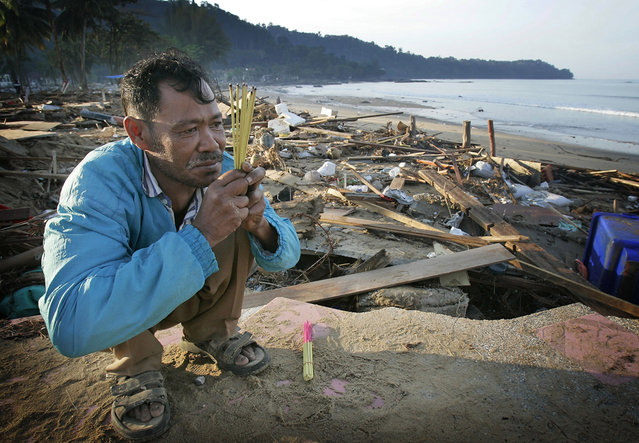
In this December 29, 2004 file photo, Kusol Wetchakul offers prayers for the soul of his sister, at dawn along the beach near Khao Lak, Thailand.  Wetchakul's sister was swept out to sea and believed drowned as she sold goods to tourists on the popular tourist beach just north of Phuket. (Photo by David Longstreath/AP Photo)

In this December 29, 2004 file photo, Kusol Wetchakul offers prayers for the soul of his sister, at dawn along the beach near Khao Lak, Thailand. Wetchakul's sister was swept out to sea and believed drowned as she sold goods to tourists on the popular tourist beach just north of Phuket. Friday marks the 10th anniversary of one of the deadliest natural disasters in world history: a tsunami, triggered by a massive earthquake off the Indonesian coast, leaving more than 230,000 people dead in 14 countries and causing about $10 billion in damage. (Photo by David Longstreath/AP Photo)
Details
26 Dec 2014 15:16:00
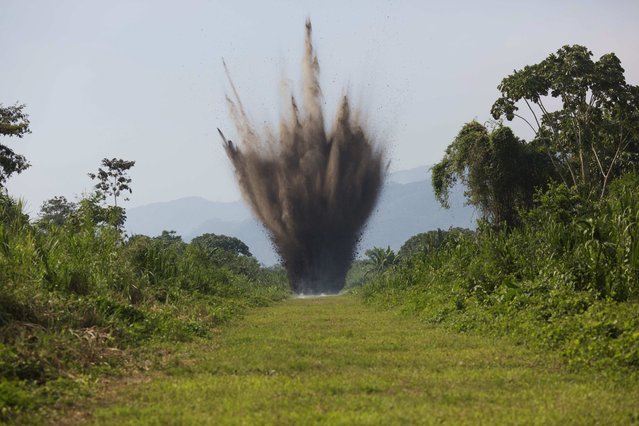
In this September 19, 2014 photo, explosives are detonate by Peruvian counternarcotics forces on a part of a clandestine grassy airstrip in the Apurimac, Ene and Mantaro River Valleys, or VRAEM, the world's No. 1 coca-growing region, in Ayacucho, Peru. The dynamiting of craters by Peruvian security forces into clandestine airstrips cuts into profits but hardly discourages cocaine traffickers who net tens of thousands of dollars with each flight flown from these airstrips. (Photo by Rodrigo Abd/AP Photo)

In this September 19, 2014 photo, explosives are detonate by Peruvian counternarcotics forces on a part of a clandestine grassy airstrip in the Apurimac, Ene and Mantaro River Valleys, or VRAEM, the world's No. 1 coca-growing region, in Ayacucho, Peru. The dynamiting of craters by Peruvian security forces into clandestine airstrips cuts into profits but hardly discourages cocaine traffickers who net tens of thousands of dollars with each flight flown from these airstrips. (Photo by Rodrigo Abd/AP Photo)
Details
23 Sep 2014 12:56:00
Couples take part in the “Love and Challenge Marathon” in Hanoi, Vietnam, 16 August 2015. Fifty couples, who are going to get married, participated in the event which is held the fifth time. This year, the winners of the marathon received a honeymoon trip to Malaysia. (Photo by Luong Thai Linh/EPA)

Couples take part in the “Love and Challenge Marathon” in Hanoi, Vietnam, 16 August 2015. Fifty couples, who are going to get married, participated in the event which is held the fifth time. This year, the winners of the marathon received a honeymoon trip to Malaysia. (Photo by Luong Thai Linh/EPA)
Details
17 Aug 2015 12:14:00
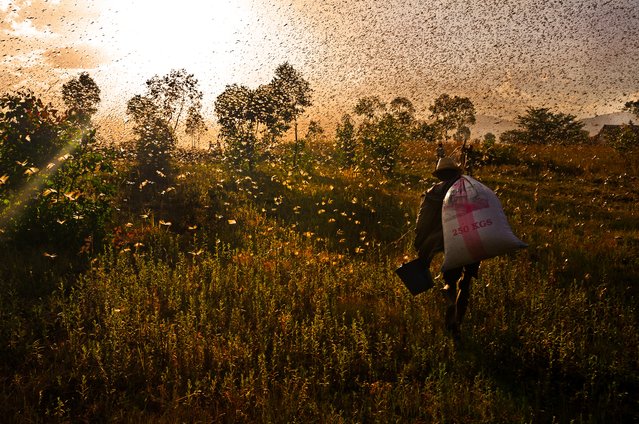
“Locusts & Men”. Oppression, interaction, collaboration. In the life cycle of nature nothing is lost, but the coexistence of different species is sometimes difficult. In Madagascar periodically returns the archaic antagonism between man and the migratory locust, in a circle of life where the two species are looking for space and food for their survival. Photo location: Madagascar, 2013. (Photo and caption by Michele Martinelli/National Geographic Photo Contest)

“Locusts & Men”. Oppression, interaction, collaboration. In the life cycle of nature nothing is lost, but the coexistence of different species is sometimes difficult. In Madagascar periodically returns the archaic antagonism between man and the migratory locust, in a circle of life where the two species are looking for space and food for their survival. At the end of the day a man walks home carrying on his shoulders the heavy bag which contains the locusts captured during the day. The insects provide nutritious meals for the man and his family. Photo location: Madagascar, 2013. (Photo and caption by Michele Martinelli/National Geographic Photo Contest)

ATTENTION! All pictures are presented in high resolution. To see Hi-Res images – just TWICE click on any picture. In other words, click small picture – opens the BIG picture. Click BIG picture – opens VERY BIG picture.
Details
03 Dec 2013 10:59:00