Loading...
Done
A commuter exits a closed off station after a subway train derailment, Tuesday, June 27, 2017, in the Harlem neighborhood of New York. A subway train derailed near a station in Harlem on Tuesday, frightening passengers and resulting in a power outage as people were evacuated from trains along the subway line. The Fire Department of New York said a handful of people were treated for minor injuries at around 10 a.m. It said there was smoke but no fire. Delays were reported throughout the subway system. (Photo by Mary Altaffer/AP Photo)

A commuter exits a closed off station after a subway train derailment, Tuesday, June 27, 2017, in the Harlem neighborhood of New York. A subway train derailed near a station in Harlem on Tuesday, frightening passengers and resulting in a power outage as people were evacuated from trains along the subway line. The Fire Department of New York said a handful of people were treated for minor injuries at around 10 a.m. It said there was smoke but no fire. Delays were reported throughout the subway system. (Photo by Mary Altaffer/AP Photo)
Details
18 Jul 2017 08:48:00
Women dressed in folk costumes take part in a traditional wedding ceremony in the village of Galicnik, west of Macedonia's capital Skopje, July 12, 2014. The Galicnik Wedding, a three-day traditional Macedonian wedding celebration held each “Petrovden” or St. Peter's Day, involves traditional customs, costumes, and rituals and dances that have been passed down over the centuries. (Photo by Ognen Teofilovski/Reuters)

Women dressed in folk costumes take part in a traditional wedding ceremony in the village of Galicnik, west of Macedonia's capital Skopje, July 12, 2014. The Galicnik Wedding, a three-day traditional Macedonian wedding celebration held each “Petrovden” or St. Peter's Day, involves traditional customs, costumes, and rituals and dances that have been passed down over the centuries. (Photo by Ognen Teofilovski/Reuters)
Details
19 Jul 2014 10:11:00
Republic of Korea Air Force's (ROKAF) aerobatic unit “Black Eagles” maneuver their T-50B aircraft as they perform an air show at Clark Air Base on March 03, 2024 in Pampanga, Philippines. The Republic of Korea Air Force's (ROKAF) aerobatic unit “Black Eagles” is in the Philippines to conduct a series of air shows to mark the 75th anniversary of diplomatic relations between the Philippines and South Korea. (Photo by Ezra Acayan/Getty Images)

Republic of Korea Air Force's (ROKAF) aerobatic unit “Black Eagles” maneuver their T-50B aircraft as they perform an air show at Clark Air Base on March 03, 2024 in Pampanga, Philippines. The Republic of Korea Air Force's (ROKAF) aerobatic unit “Black Eagles” is in the Philippines to conduct a series of air shows to mark the 75th anniversary of diplomatic relations between the Philippines and South Korea. (Photo by Ezra Acayan/Getty Images)
Details
08 Apr 2024 03:41:00
The shadow of a partial eclipse is cast on to the cheek of a student on the roof of the Jana Dlugosza Academy in Czestochowa, Poland March 20, 2015. (Photo by Grzegorz Skowronek/Reuters/Agencja Gazeta)

The shadow of a partial eclipse is cast on to the cheek of a student on the roof of the Jana Dlugosza Academy in Czestochowa, Poland March 20, 2015. (Photo by Grzegorz Skowronek/Reuters/Agencja Gazeta)
Details
21 Mar 2015 12:12:00
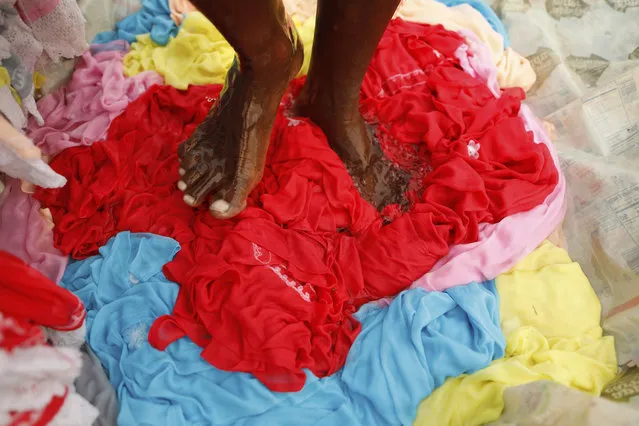
A dhobi, or a washerman washes cloths on the banks of the River Gomti in Lucknow, India, Saturday, September 12, 2020. Dhobis are traditional laundry workers who wash clothes by hand and dry them in the sun, an occupation which has been in existence for generations. Most cities in India have a Dhobi Ghat, or washermen's area, where the city's pile of clothes is laundered. This practice is still popular in India, despite of modern technology. Around 1,000 families work in Lucknow's Dhobi Ghat. However, in light of the novel coronavirus, their wages have decreased drastically. With each family earning around US$100-200 per month. (Photo by Rajesh Kumar Singh/AP Photo)

A dhobi, or a washerman washes cloths on the banks of the River Gomti in Lucknow, India, Saturday, September 12, 2020. Dhobis are traditional laundry workers who wash clothes by hand and dry them in the sun, an occupation which has been in existence for generations. Most cities in India have a Dhobi Ghat, or washermen's area, where the city's pile of clothes is laundered. This practice is still popular in India, despite of modern technology. Around 1,000 families work in Lucknow's Dhobi Ghat. However, in light of the novel coronavirus, their wages have decreased drastically. With each family earning around US$100-200 per month. (Photo by Rajesh Kumar Singh/AP Photo)
Details
25 Sep 2020 00:03:00
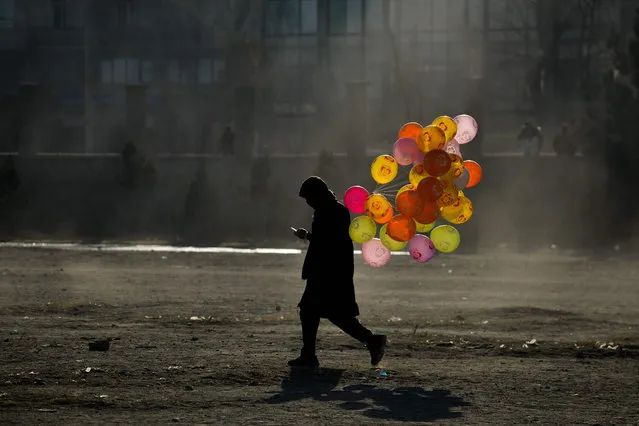
An Afghan hawker selling balloons walks along a path in a ground in Chaman-e-Hozori area in Kabul on December 10, 2021. (Photo by Ahmad Sahel Arman/AFP Photo)

An Afghan hawker selling balloons walks along a path in a ground in Chaman-e-Hozori area in Kabul on December 10, 2021. (Photo by Ahmad Sahel Arman/AFP Photo)
Details
25 Dec 2021 08:29:00
Participants hold red scarves as they celebrate the “Chupinazo” marking the start at noon sharp of the San Fermin Festival at Castle square in Pamplona, northern Spain on July 6, 2013. Ten of thousands of people packed Pamplona's streets for a drunken kick-off to Spain's best-known fiesta: the nine-day San Fermin bull-running festival. (Photo by Pedro Armestre/AFP Photo)

Participants hold red scarves as they celebrate the “Chupinazo” marking the start at noon sharp of the San Fermin Festival at Castle square in Pamplona, northern Spain on July 6, 2013. Ten of thousands of people packed Pamplona's streets for a drunken kick-off to Spain's best-known fiesta: the nine-day San Fermin bull-running festival. (Photo by Pedro Armestre/AFP Photo)
Details
11 Jul 2013 09:30:00
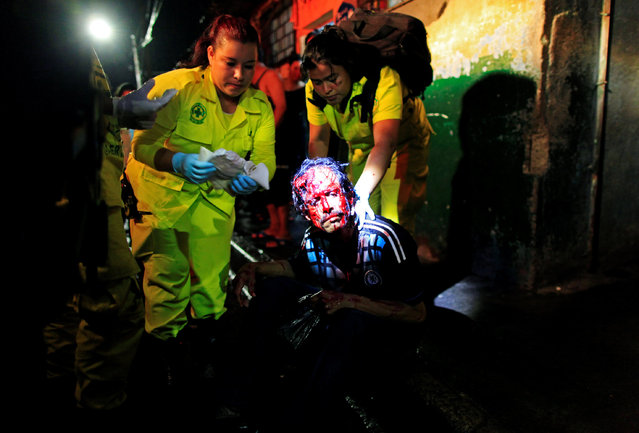
Comandos de Salvamento rescuers Maria Martinez (L) and Ana Chichilla attend to a wounded homeless man in San Salvador, El Salvador July 16, 2016. The man was attacked with a machete by suspected gang members. (Photo by Jose Cabezas/Reuters)

Comandos de Salvamento rescuers Maria Martinez (L) and Ana Chichilla attend to a wounded homeless man in San Salvador, El Salvador July 16, 2016. The man was attacked with a machete by suspected gang members. In 2015, El Salvador registered a record 103 homicides per 100,000 habitants, making it one of the most dangerous countries in the world outside a war zone. But for many young people who have few chances to distance themselves from rivalries between so-called maras in their schools and neighbourhoods, a civil-society organisation called the Comandos de Salvamento, or Rescue Corps, has been a refuge. (Photo by Jose Cabezas/Reuters)
Details
16 Nov 2016 11:10:00