Loading...
Done
Residents of the Korean port of Inchon surrender to American troops

Residents of the Korean port of Inchon surrender to American troops. (Photo by Bert Hardy/Getty Images). 1950
Details
07 May 2011 10:24:00


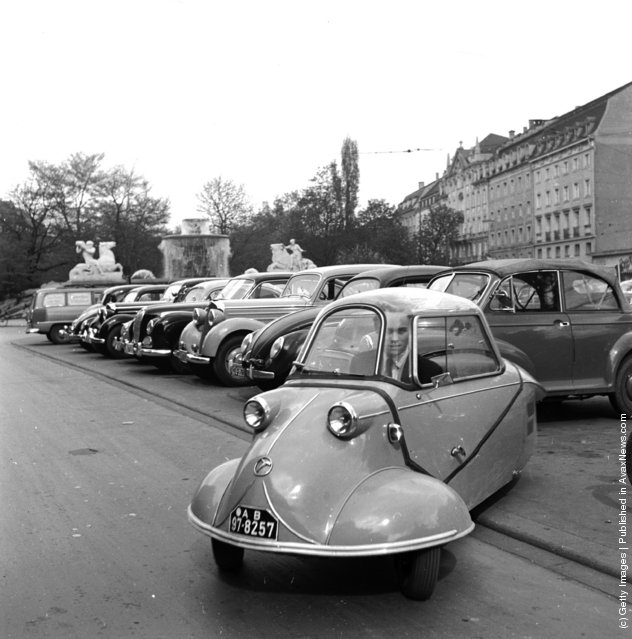
A three wheeled “cabin” scooter manufactured by German aircraft engineers Messerschmitt & Co at factories in Regensburg. (Photo by Hans Enzwieser/BIPs/Getty Images). 1955
Details
22 Jul 2013 19:49:00


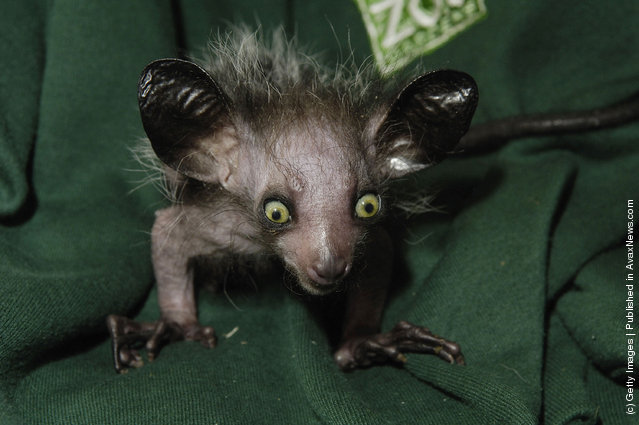
“The aye-aye (Daubentonia madagascariensis) is a lemur, a strepsirrhine primate native to Madagascar that combines rodent-like teeth and a special thin middle finger to fill the same ecological niche as a woodpecker. It is the world's largest nocturnal primate, and is characterized by its unusual method of finding food; it taps on trees to find grubs, then gnaws holes in the wood and inserts its narrow middle finger to pull the grubs out. The only other animal species known to find food in this way is the striped possum. From an ecological point of view the aye-aye fills the niche of a woodpecker as it is capable of penetrating wood to extract the invertebrates within”. – Wikipedia

Photo: In this handout image from Bristol Zoo is seen the first captive bred aye-aye in the UK named “Kintana” (meaning star in Malagasy) April 15, 2005 at Bristol Zoo Gardens, England. The zoo announced today only the second baby aye-aye to be hand-reared in the world (the first was in Jersey Zoo) and has now made his first public appearance since his birth on 11 February 2005. (Photo by Rob Cousins/Bristol Zoo via Getty Images)
Details
13 Apr 2011 13:33:00
A Ballet Paraisópolis student wearing a face mask rehearses amidst the coronavirus (COVID-19) pandemic on August 13, 2020 in Sao Paulo, Brazil. The Ballet Paraisópolis is a project that teaches dance to children and young people in the Paraisópolis community in order to encourage them to seek better life opportunities. Founded in 2012 by ballerina, teacher and choreographer, Monica Tarragó, Ballet Paraisópolis has a total of 200 students and another 2,000 on the waiting list. (Photo by Alexandre Schneider/Getty Images)

A Ballet Paraisópolis student wearing a face mask rehearses amidst the coronavirus (COVID-19) pandemic on August 13, 2020 in Sao Paulo, Brazil. The Ballet Paraisópolis is a project that teaches dance to children and young people in the Paraisópolis community in order to encourage them to seek better life opportunities. Founded in 2012 by ballerina, teacher and choreographer, Monica Tarragó, Ballet Paraisópolis has a total of 200 students and another 2,000 on the waiting list. (Photo by Alexandre Schneider/Getty Images)
Details
02 Sep 2020 00:01:00
The towers of Russky Bridge are seen over the fog covered Vladivostok, Russia on May 26, 2020. The so-called “fog season” on the Pacific coast and in the south of Russia's Primorye Territory lasts from April till September. (Photo by Yuri Smityuk/TASS)

The towers of Russky Bridge are seen over the fog covered Vladivostok, Russia on May 26, 2020. The so-called “fog season” on the Pacific coast and in the south of Russia's Primorye Territory lasts from April till September. (Photo by Yuri Smityuk/TASS)
Details
03 Sep 2020 00:03:00
Revellers partied the night away in Leeds, UK on September 5, 2020. Leeds has been added to Public Health England's coronavirus "watchlist" and could be hit with lockdown measures after a rise in coronavirus cases in the city. (Photo by NB Press LTD/The Sun)

Revellers partied the night away in Leeds, UK on September 5, 2020. Leeds has been added to Public Health England's coronavirus "watchlist" and could be hit with lockdown measures after a rise in coronavirus cases in the city. (Photo by NB Press LTD/The Sun)
Details
06 Sep 2020 00:07:00
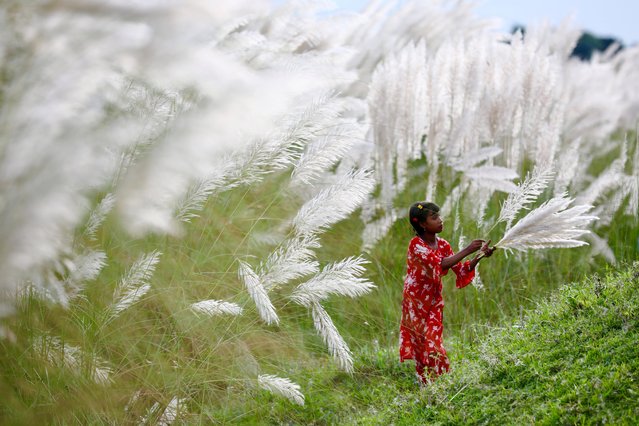
A girl picks catkins at a field amid the COVID-19 pandemic in Sarighat, on the outskirts of Dhaka, Bangladesh, October 2, 2020. (Photo by Mohammad Ponir Hossain/Reuters)

A girl picks catkins at a field amid the COVID-19 pandemic in Sarighat, on the outskirts of Dhaka, Bangladesh, October 2, 2020. (Photo by Mohammad Ponir Hossain/Reuters)
Details
16 Oct 2020 00:05:00
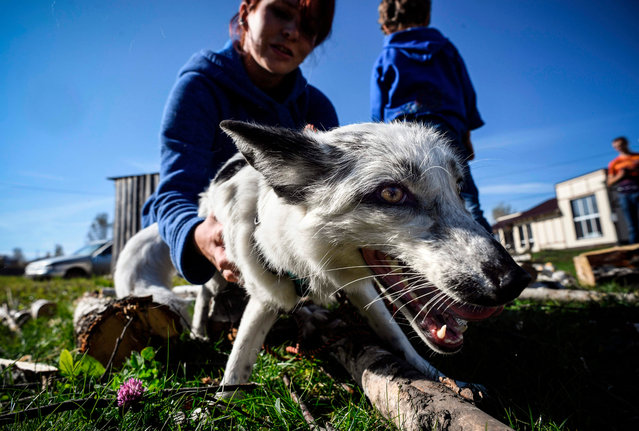
Tatyana Abramova, 33, plays with her home fox Plombir at her countryside house outside Siberian city of Novosibirsk on September 12, 2020. The official start of the Soviet experiment to better understand the domestication of animals by humans began in 1959, and was initiated by geneticists Dmitri Beliaiev and Lioudmila Trout on a farm in Akademgorodok, the scientific center of excellence in Siberia. Their primary objective was to domesticate foxes, to understand how the ancestor of wolves, another canine, evolved into a loyal and loving dog. And understand what this domestication tells us about the genetic evolution of species. (Photo by Alexander Nemenov/AFP Photo)


Tatyana Abramova, 33, plays with her home fox Plombir at her countryside house outside Siberian city of Novosibirsk on September 12, 2020. The official start of the Soviet experiment to better understand the domestication of animals by humans began in 1959, and was initiated by geneticists Dmitri Beliaiev and Lioudmila Trout on a farm in Akademgorodok, the scientific center of excellence in Siberia. Their primary objective was to domesticate foxes, to understand how the ancestor of wolves, another canine, evolved into a loyal and loving dog. And understand what this domestication tells us about the genetic evolution of species. (Photo by Alexander Nemenov/AFP Photo)
Details
25 Oct 2020 00:05:00