Loading...
Done
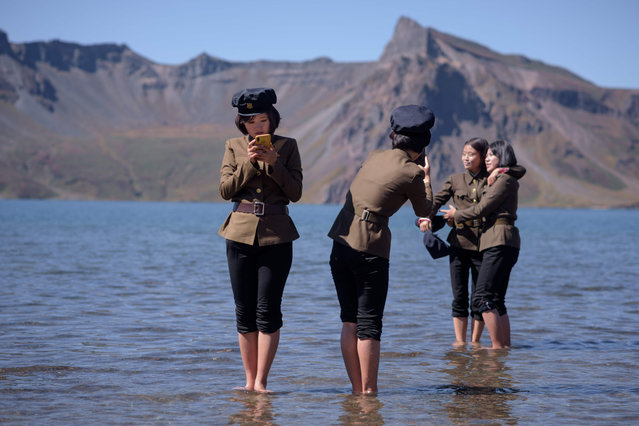
In a photo taken on September 11, 2019, North Korean students pose for photos in Chonji lake, or “Heaven lake”, as they visit the crater of Mount Paektu, near Samjiyon. Mount Paektu has long been considered the spiritual birthplace of the Korean nation and is a place of pilgrimage for tens of thousands of North Koreans every year, who are trained from birth to revere their leaders. Every year 100,000 North Koreans or more are taken on study tours to the camp, the mountain, and nearby revolutionary sites where relics of operations are preserved. Dressing in khaki uniforms said to resemble guerrillas' outfits and carrying red flags, they march to the summit of the volcano. (Photo by Ed Jones/AFP Photo)

In a photo taken on September 11, 2019, North Korean students pose for photos in Chonji lake, or “Heaven lake”, as they visit the crater of Mount Paektu, near Samjiyon. Mount Paektu has long been considered the spiritual birthplace of the Korean nation and is a place of pilgrimage for tens of thousands of North Koreans every year, who are trained from birth to revere their leaders. (Photo by Ed Jones/AFP Photo)
Details
09 Oct 2019 00:03:00
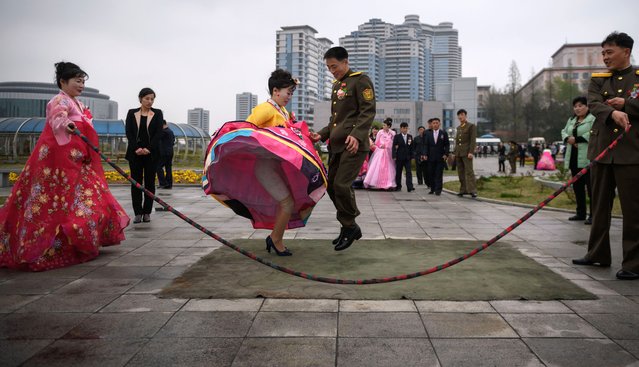
A bride and groom jump over a skipping rope as they pose during a wedding photo shoot at a park in Pyongyang on April 18, 2019. (Photo by Ed Jones/AFP Photo)

A bride and groom jump over a skipping rope as they pose during a wedding photo shoot at a park in Pyongyang on April 18, 2019. (Photo by Ed Jones/AFP Photo)
Details
19 Oct 2019 00:05:00
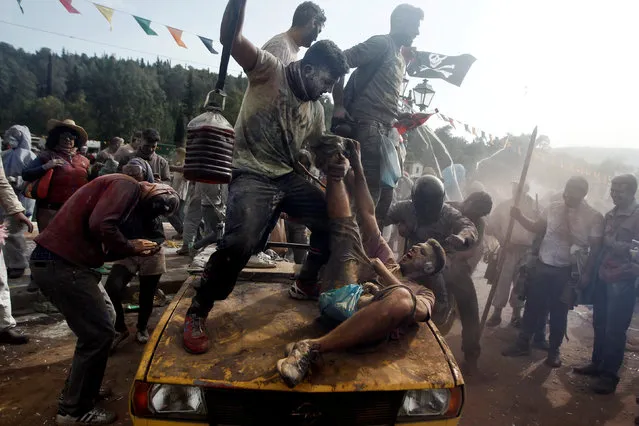
Revellers celebrate “Ash Monday” by participating in a colourful “flour war”, a traditional festivity marking the end of the carnival season and the start of the 40-day Lent period until the Orthodox Easter,in the port town of Galaxidi, Greece, February 27, 2017. (Photo by Alkis Konstantinidis/Reuters)

Revellers celebrate “Ash Monday” by participating in a colourful “flour war”, a traditional festivity marking the end of the carnival season and the start of the 40-day Lent period until the Orthodox Easter,in the port town of Galaxidi, Greece, February 27, 2017. (Photo by Alkis Konstantinidis/Reuters)
Details
01 Mar 2017 00:00:00
An injured man is carried atop an Iraqi special forces armored vehicle during fighting against Islamic State militants in western Mosul, Iraq, Tuesday, March 14, 2017. (Photo by Felipe Dana/AP Photo)

An injured man is carried atop an Iraqi special forces armored vehicle during fighting against Islamic State militants in western Mosul, Iraq, Tuesday, March 14, 2017. (Photo by Felipe Dana/AP Photo)
Details
15 Mar 2017 09:37:00
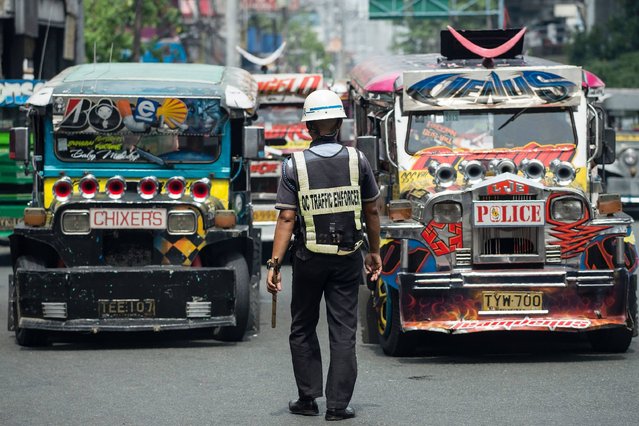
Jeepneys are seen as an enforcer manages traffic at a busy street in Manila on May 30, 2017. Jeepneys, once hailed as the “King of the Road” and a cultural symbol in the Phillipines to rival New York's yellow taxis, may soon disappear from Manila's gridlocked streets, as authorities move to phase out the Philippines' iconic World War II-era minibuses, citing pollution and safety concerns. (Photo by Noel Celis/AFP Photo)

Jeepneys are seen as an enforcer manages traffic at a busy street in Manila on May 30, 2017. Jeepneys, once hailed as the “King of the Road” and a cultural symbol in the Phillipines to rival New York's yellow taxis, may soon disappear from Manila's gridlocked streets, as authorities move to phase out the Philippines' iconic World War II-era minibuses, citing pollution and safety concerns. (Photo by Noel Celis/AFP Photo)
Details
31 May 2017 07:14:00
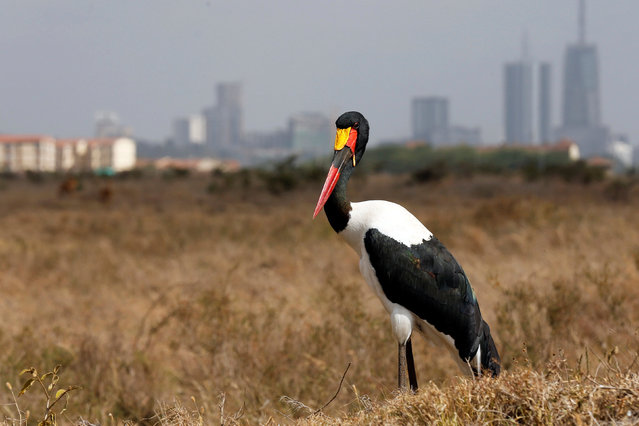
A saddle-billed stork stands in the grassland at the Nairobi National Park near Nairobi, Kenya January 23, 2017. (Photo by Thomas Mukoya/Reuters)

A saddle-billed stork stands in the grassland at the Nairobi National Park near Nairobi, Kenya January 23, 2017. (Photo by Thomas Mukoya/Reuters)
Details
29 Jan 2017 11:32:00
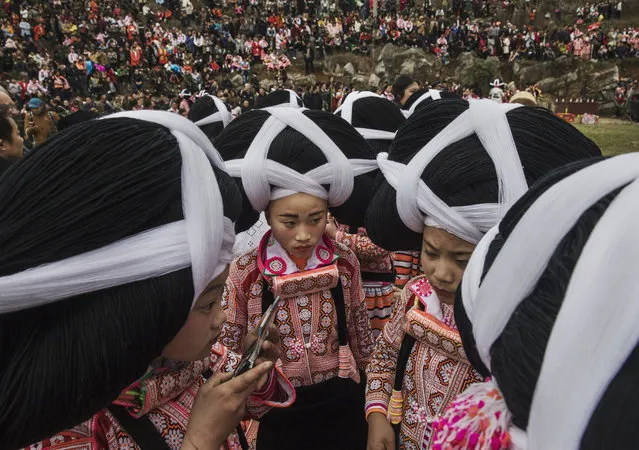
Girls of the Long Horn Miao ethnic minority group wear headdresses as they prepare gather for Tiaohua or Flower Festival as part of the Lunar New Year on February 6, 2017 in Longga village, Guizhou province, southern China. The Long Horn Miao are recognized for their declining practice of wrapping a blend of linen, wool, and the hair of their ancestors around animal horns or a wooden clip to make headdresses. Many young women say they now wear the headdresses only for special occasions and festivals, as the ornaments, which are attached by the horns to their real hair, have proved impractical for modern daily life in a fast changing world. China officially recognizes 56 different ethnic minorities, and statistics show over 7 million Chinese identifying themselves as Miao. But the small Long Horn Miao community counts only around 5000 people living in 12 villages, whose age-old traditions, language, and culture are fading. It is increasingly difficult in a modernizing China, as young people are drawn from remote rural villages to opportunities in bigger cities amongst wide-scale urbanization. Farming and labour remain the mainstays of life for the Long Horn Miao, leaving the area relatively poor in comparison with many parts of China. The government has invested significant amounts into local infrastructure and the tourism industry to try to bolster the local economy. (Photo by Kevin Frayer/Getty Images)

Girls of the Long Horn Miao ethnic minority group wear headdresses as they prepare gather for Tiaohua or Flower Festival as part of the Lunar New Year on February 6, 2017 in Longga village, Guizhou province, southern China. (Photo by Kevin Frayer/Getty Images)
Details
13 Feb 2017 00:01:00
Rumor, a German shepherd and winner of Best In Show at the 141st Westminster Kennel Club Dog Show, is fed steak at Sardi's in New York, U.S., February 15, 2017. (Photo by Shannon Stapleton/Reuters)

Rumor, a German shepherd and winner of Best In Show at the 141st Westminster Kennel Club Dog Show, is fed steak at Sardi's in New York, U.S., February 15, 2017. (Photo by Shannon Stapleton/Reuters)
Details
17 Feb 2017 00:05:00