Loading...
Done
Migrants rush as they try to get on a train heading to the border with Serbia at the train station of Gevgelija, on the Macedonian-Greek border, on August 9, 2015. Non-EU Serbia's frontier with Hungary, which is in the bloc's passport-free Schengen zone, has become a major crossing point for the huge numbers of migrants entering the EU. (Photo by Dimitar Dilkoff/AFP Photo)

Migrants rush as they try to get on a train heading to the border with Serbia at the train station of Gevgelija, on the Macedonian-Greek border, on August 9, 2015. Non-EU Serbia's frontier with Hungary, which is in the bloc's passport-free Schengen zone, has become a major crossing point for the huge numbers of migrants entering the EU. (Photo by Dimitar Dilkoff/AFP Photo)
Details
11 Aug 2015 13:56:00
Ukrainian refugee circus student Mariia Lysytska stretching in a training room in Budapest, Hungary, Monday, February 13, 2023. More than 100 Ukrainian refugee circus students, between the ages of 5 and 20, found a home with the Capital Circus of Budapest after escaping the embattled cities of Kharkiv and Kyiv amid Russian bombings. (Photo by Denes Erdos/AP Photo)

Ukrainian refugee circus student Mariia Lysytska stretching in a training room in Budapest, Hungary, Monday, February 13, 2023. More than 100 Ukrainian refugee circus students, between the ages of 5 and 20, found a home with the Capital Circus of Budapest after escaping the embattled cities of Kharkiv and Kyiv amid Russian bombings. (Photo by Denes Erdos/AP Photo)
Details
12 Mar 2023 06:11:00
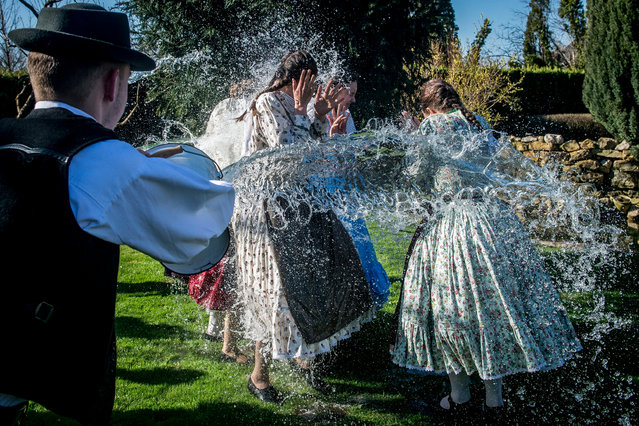
Members of the Mayossa Folk Dance Group pour water on young women in Kiskunmajsa, some 140 kms southeast of Budapest, Hungary, Monday, April 2, 2018. According to a several hundred years old tradition of Hungarian villages young men pour water on young women who in exchange present their sprinklers with beautifully colored eggs on Easter Monday. (Photo by Sandor Ujvari/MTI via AP Photo)

Members of the Mayossa Folk Dance Group pour water on young women in Kiskunmajsa, some 140 kms southeast of Budapest, Hungary, Monday, April 2, 2018. According to a several hundred years old tradition of Hungarian villages young men pour water on young women who in exchange present their sprinklers with beautifully colored eggs on Easter Monday. (Photo by Sandor Ujvari/MTI via AP Photo)
Details
03 Apr 2018 08:21:00
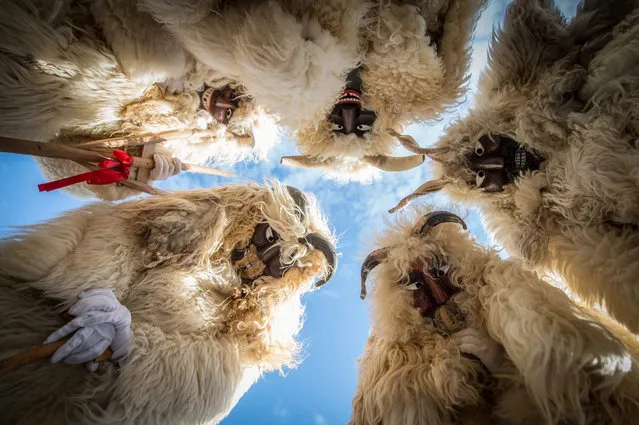
Participants wearing costumes and masks take part in the first day of the traditional carnival parade in Mohacs, Hungary, 23 February 2017. The carnival parade of so-called busos, dressed in costumes with frightening wooden masks and using various noisy wooden rattlers, is traditionally held on the seventh weekend before Easter to drive away winter. (Photo by Sandor Ujvari/EPA)

Participants wearing costumes and masks take part in the first day of the traditional carnival parade in Mohacs, Hungary, 23 February 2017. The carnival parade of so-called busos, dressed in costumes with frightening wooden masks and using various noisy wooden rattlers, is traditionally held on the seventh weekend before Easter to drive away winter. (Photo by Sandor Ujvari/EPA)
Details
25 Feb 2017 10:35:00
Centre of the Heart Nebula by Ivan Eder (Hungary). Situated 7500 light years away in the ‘W’-shaped constellation of Cassiopeia, the Heart Nebula is a vast region of glowing gas, energized by a cluster of young stars at its centre. The image depicts the central region, where dust clouds are being eroded and moulded into rugged shapes by the searing cosmic radiation. (Photo by Ivan Eder)

The competition, which is run by the Royal Observatory Greenwich in association with BBC Sky at Night Magazine, is now in its sixth year and has received over 2,500 entries. Photo: Centre of the Heart Nebula by Ivan Eder (Hungary). Situated 7500 light years away in the “W”-shaped constellation of Cassiopeia, the Heart Nebula is a vast region of glowing gas, energized by a cluster of young stars at its centre. The image depicts the central region, where dust clouds are being eroded and moulded into rugged shapes by the searing cosmic radiation. (Photo by Ivan Eder)
Details
03 Jul 2014 11:59:00
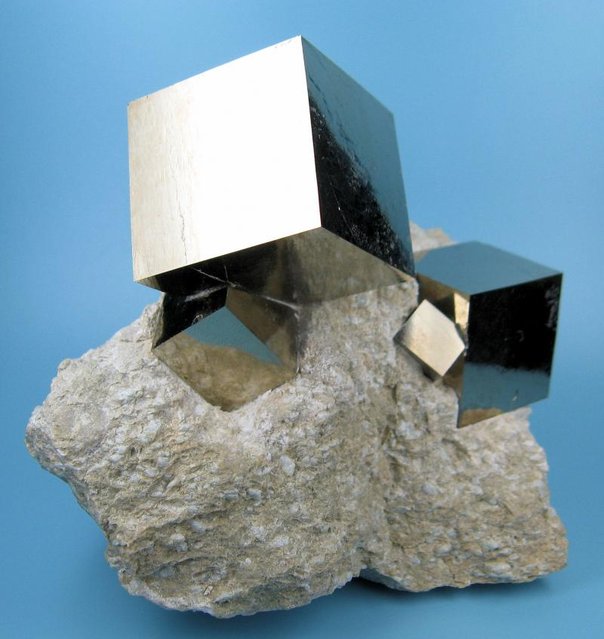
Pyrite Cubic Crystals

The mineral pyrite, or iron pyrite, also known as fool's gold, is an iron sulfide with the formula FeS2. This mineral's metallic luster and pale brass-yellow hue give it a superficial resemblance to gold, hence the well-known nickname of fool's gold. The color has also led to the nicknames brass, brazzle, and Brazil, primarily used to refer to pyrite found in coal.
In crystallography, the cubic (or isometric) crystal system is a crystal system where the unit cell is in the shape of a cube. This is one of the most common and simplest shapes found in crystals and minerals.
Details
23 Nov 2013 13:31:00
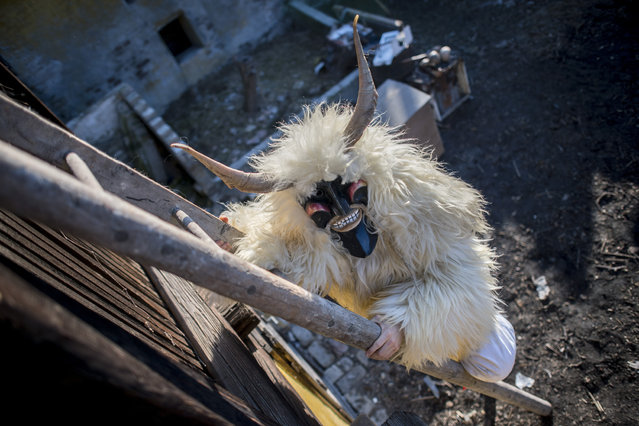
A man wears a busho mask and a costume made of sheep pelt while climbing up a ladder outside a barn in Mohacs, Hungary, 20 February 2020, on the first day of carnival. The traditional Busho carnival, which marks the end of winter, dates back to the 16th century. According to local legend, members of an ethnic South Slavic group living in Mohacs at the time dressed up in similar costumes and wore wooden masks to scare away Ottoman invaders, who mistook them for demons. (Photo by Tamas Soki/EPA/EFE)

A man wears a busho mask and a costume made of sheep pelt while climbing up a ladder outside a barn in Mohacs, Hungary, 20 February 2020, on the first day of carnival. The traditional Busho carnival, which marks the end of winter, dates back to the 16th century. According to local legend, members of an ethnic South Slavic group living in Mohacs at the time dressed up in similar costumes and wore wooden masks to scare away Ottoman invaders, who mistook them for demons. (Photo by Tamas Soki/EPA/EFE)
Details
23 Feb 2020 00:07:00
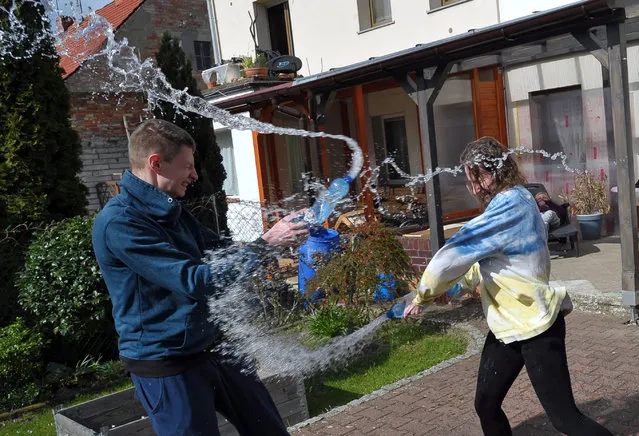
A Polish girl and a boy throw water over each other on Wet Monday in Szczecin, northwestern Poland, 13 April 2020. Wet Monday is a Catholic celebration held on Easter Monday mostly in Poland, but also in the Czech Republic, Slovakia, Hungary and some parts of western Ukraine. Due to the lockdown it is forbidden to celebrate this holiday in public. (Photo by Marcin Bielecki/EPA/EFE)

A Polish girl and a boy throw water over each other on Wet Monday in Szczecin, northwestern Poland, 13 April 2020. Wet Monday is a Catholic celebration held on Easter Monday mostly in Poland, but also in the Czech Republic, Slovakia, Hungary and some parts of western Ukraine. Due to the lockdown it is forbidden to celebrate this holiday in public. (Photo by Marcin Bielecki/EPA/EFE)
Details
15 Apr 2020 00:07:00