Loading...
Done
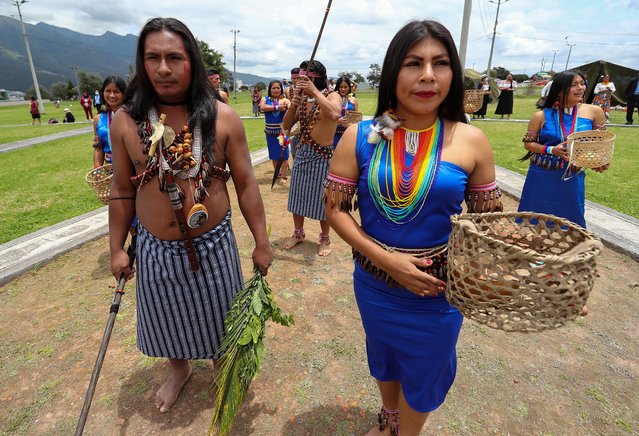
Ecuadorian indigenous people celebrate the festival of the moon or Kulla Raymi, in Quito, Ecuador, 21 September 2021. A circle on the ground made up of fruits and inside the Andean symbol of the chacana, multinational geometric flags and a cross that symbolizes the four cardinal points, were the setting in which the festival of the moon, the Kulla, was commemorated this Tuesday. Raymi, on a hill in Quito. It is one of the four most significant festivities of the Andean agroecological calendar, which commemorates the beginning of life and exalts women as the maximum representation of fertility. (Photo by Jose Jacome/EPA/EFE)

Ecuadorian indigenous people celebrate the festival of the moon or Kulla Raymi, in Quito, Ecuador, 21 September 2021. A circle on the ground made up of fruits and inside the Andean symbol of the chacana, multinational geometric flags and a cross that symbolizes the four cardinal points, were the setting in which the festival of the moon, the Kulla, was commemorated this Tuesday. Raymi, on a hill in Quito. It is one of the four most significant festivities of the Andean agroecological calendar, which commemorates the beginning of life and exalts women as the maximum representation of fertility. (Photo by Jose Jacome/EPA/EFE)
Details
22 Sep 2021 09:01:00
Daily Life in Hong Kong. (Photo by Jerry Lee)

“Untitled”. Hong Kong, Wan Chai area, on March 7, 2013. (Photo by Jerry Lee)
Details
03 Jun 2013 10:43:00
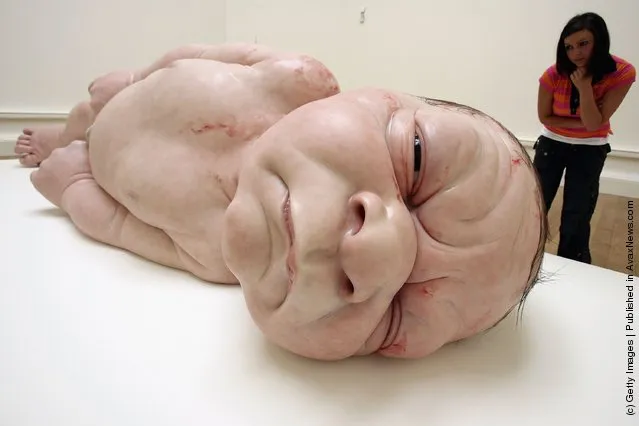
A girl by Ron Mueck

A visitors to the National Galleries of Scotland view the work “A girl” of sculptor Ron Mueck on August 4, 2006 Edinburgh in Scotland. (Photo by Jeff J Mitchell/Getty Images)
Details
03 Oct 2011 09:54:00
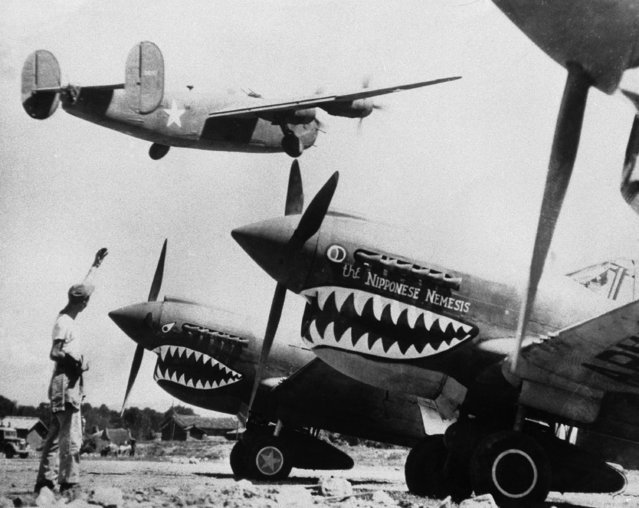
A U.S. Army B-24 Liberator Bomber is hailed by a ground crewman as it takes off over a line of shark- nosed fighter planes at an advanced base in China on a mission on October 10, 1943, to bomb Japanese installations. (Photo by AP Photo)

A U.S. Army B-24 Liberator Bomber is hailed by a ground crewman as it takes off over a line of shark- nosed fighter planes at an advanced base in China on a mission on October 10, 1943, to bomb Japanese installations. (Photo by AP Photo)
Details
13 Oct 2015 08:05:00
Some Iraqi candidates for Miss Iraq beauty contest pose in front of the Ishtar Gate at the ancient archaeological site of Babylon, outside the modern city of Hilla, south of the capital Baghdad on December 17, 2015. The beauty contest,  which is the first one in more than 40 years, aims to boost tourism in the city and will take place on December 19, 2015. (Photo by Ahmad Al-Rubaye/AFP Photo)

Some Iraqi candidates for Miss Iraq beauty contest pose in front of the Ishtar Gate at the ancient archaeological site of Babylon, outside the modern city of Hilla, south of the capital Baghdad on December 17, 2015. The beauty contest, which is the first one in more than 40 years, aims to boost tourism in the city and will take place on December 19, 2015. (Photo by Ahmad Al-Rubaye/AFP Photo)
Details
19 Dec 2015 10:25:00
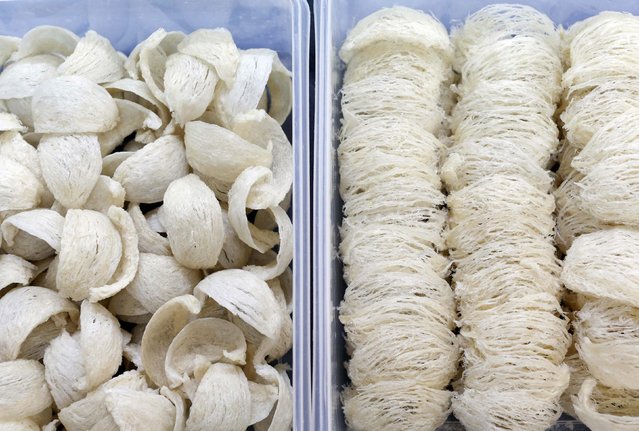
Two styles of cleaned bird's nest, Yan Zhan (L) and Su Zhan (R) await repacking at a processing plant in Kuala Lumpur, February 17, 2015. Prized in China for is alleged health benefits for hundreds of years, nests made from swiftlets' saliva are being mixed into coffee and cereal as the Southeast Asian producers of the delicacy seek to broaden its appeal, and their profit margins. (Photo by Olivia Harris/Reuters)

Two styles of cleaned bird's nest, Yan Zhan (L) and Su Zhan (R) await repacking at a processing plant in Kuala Lumpur, February 17, 2015. Prized in China for is alleged health benefits for hundreds of years, nests made from swiftlets' saliva are being mixed into coffee and cereal as the Southeast Asian producers of the delicacy seek to broaden its appeal, and their profit margins. The nests are among the world's most expensive foods, selling for up to $2,500 a kg and the swiftlets that weave them are indigenous to Indonesia, Malaysia, Thailand and Vietnam. (Photo by Olivia Harris/Reuters)
Details
24 Feb 2015 13:57:00
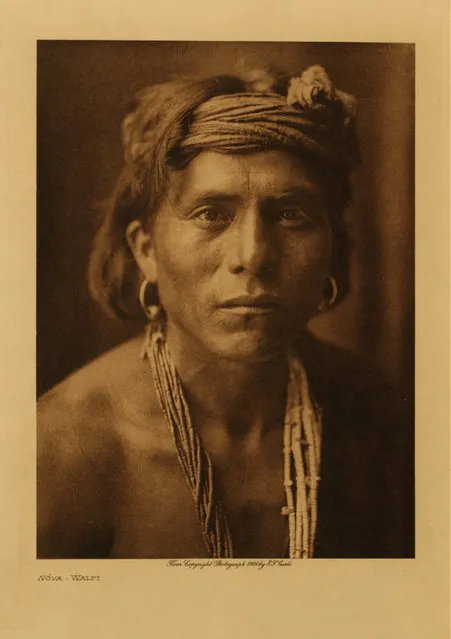
Nova, a Walpi, in 1906. (Photo by Edward S. Curtis)

At the beginning of the 20th century, Edward S. Curtis set out to document what he saw as a disappearing race: the Native American. From 1907 to 1930, Curtis took more than 2,000 photos of 80 tribes stretching from the Great Plains to the Pacific Northwest and Alaska. He then published and sold these photos, along with narrative text, in 20 volumes of work known as “The North American Indian”. It is one of the most significant collections of its kind, “probably the most important photographic document of its age and its topic,” said Jeffrey Garrett, associate university librarian for Special Libraries at Northwestern University. (Photo by Edward S. Curtis)
Details
07 Sep 2014 12:57:00
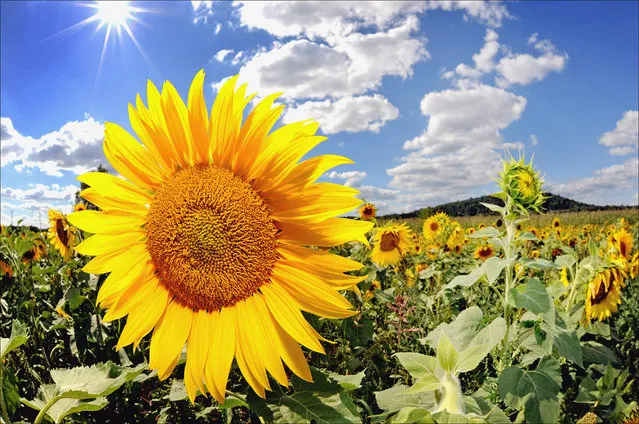
In this Wednesday, September 17, 2014 photo, the sun shines over a field of sunflowers in Walkill, N.Y. (Photo by John DeSanto/AP Photo/Times Herlad-Record)

In this Wednesday, September 17, 2014 photo, the sun shines over a field of sunflowers in Walkill, N.Y. (Photo by John DeSanto/AP Photo/Times Herlad-Record)
Details
22 Oct 2014 13:40:00