Kim Tae-yeon holds a national flag while waiting for a parade to celebrate the country's National Foundation Day in Seoul, South Korea, Thursday, October 3, 2024. (Photo by Ahn Young-joon/AP Photo)
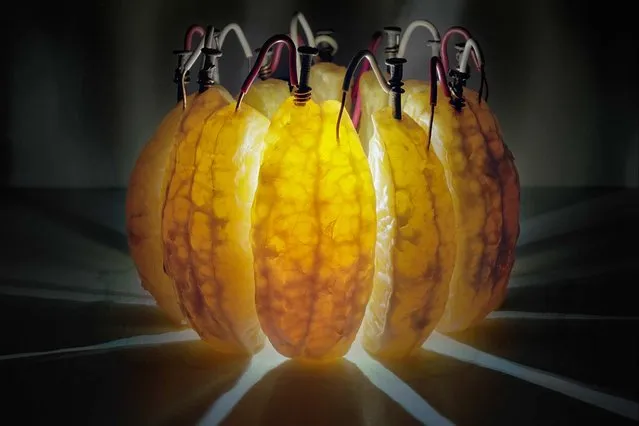
Wedges of an orange generate enough current and electrical juice – 3.5 volts – to power an LED. The fruit’s citric acid helps electrons flow from galvanized nails to copper wire in this 14-hour exposure. This image was published in September’s Visions of Earth, a trio of photos that appear in each issue of National Geographic. (Photo by Caleb Charland/National Geographic)
A man checks his mobile phone near overturned shipping containers after explosions hit the Binhai new district, Tianjin, August 13, 2015. A huge explosion hit an industrial area in the northeastern Chinese city of Tianjin late on Wednesday evening, triggering a blast wave felt several kilometres away and injuring at least 50 people, domestic media reported. (Photo by Reuters/Stringer)
Richard Coleby of Polaris falls over his quad into muddy waters during day one of the HydroGarden Weston Beach Race on October 14, 2017 in Weston-Super-Mare, England. (Photo by Michael Steele/Getty Images)
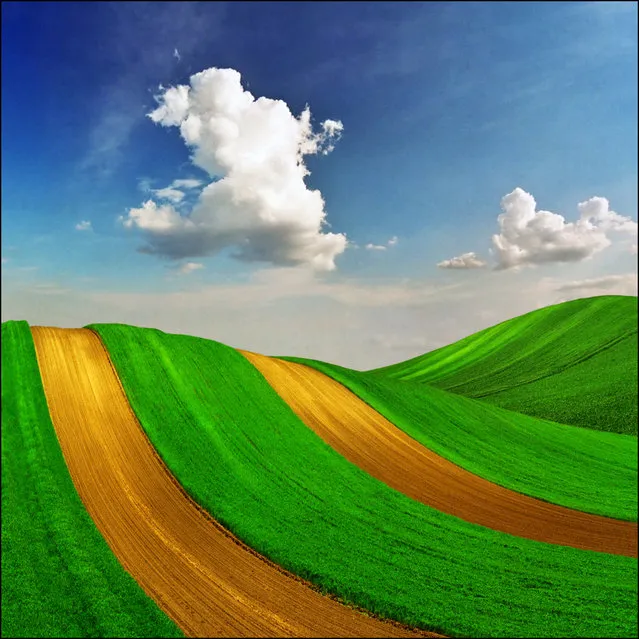
“I am not a photo reporter, so I don’t feel obligated to honour every detail. What I’m trying to achieve is to emphasize the whole potential of a shot, creating a sight that I'd like if existed.. And since it’s impossible in real life, I do it in virtual :) My work is maybe more similar to ‘photo-painting’ than photography”. – Katarina Stefanović
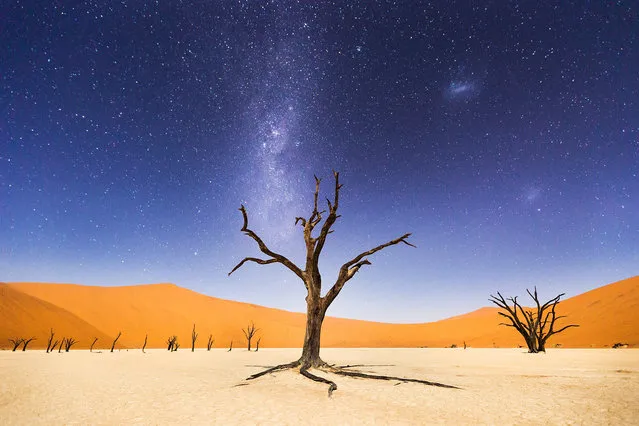
Merit: A Night at Deadvlei. The night before returning to Windhoek, we spent several hours at Deadveli. The moon was bright enough to illuminate the sand dunes in the distance, but the skies were still dark enough to clearly see the milky way and magellanic clouds. Deadveli means “dead marsh. The camelthorn trees are believed to be about 900 years old, but have not decomposed because the environment is so dry. (Photo and caption by Beth McCarley/National Geographic Traveler Photo Contest)