Loading...
Done


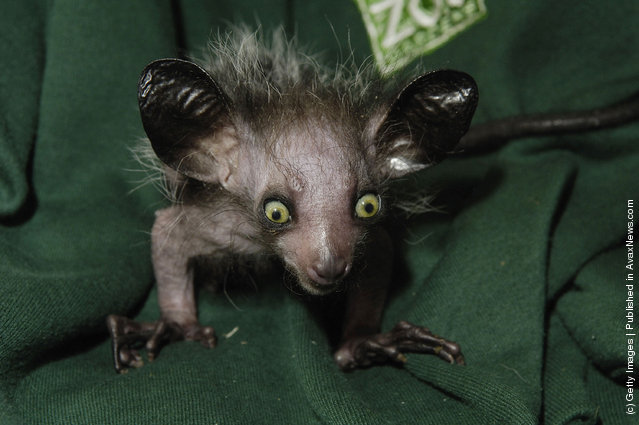
“The aye-aye (Daubentonia madagascariensis) is a lemur, a strepsirrhine primate native to Madagascar that combines rodent-like teeth and a special thin middle finger to fill the same ecological niche as a woodpecker. It is the world's largest nocturnal primate, and is characterized by its unusual method of finding food; it taps on trees to find grubs, then gnaws holes in the wood and inserts its narrow middle finger to pull the grubs out. The only other animal species known to find food in this way is the striped possum. From an ecological point of view the aye-aye fills the niche of a woodpecker as it is capable of penetrating wood to extract the invertebrates within”. – Wikipedia

Photo: In this handout image from Bristol Zoo is seen the first captive bred aye-aye in the UK named “Kintana” (meaning star in Malagasy) April 15, 2005 at Bristol Zoo Gardens, England. The zoo announced today only the second baby aye-aye to be hand-reared in the world (the first was in Jersey Zoo) and has now made his first public appearance since his birth on 11 February 2005. (Photo by Rob Cousins/Bristol Zoo via Getty Images)
Details
13 Apr 2011 13:33:00
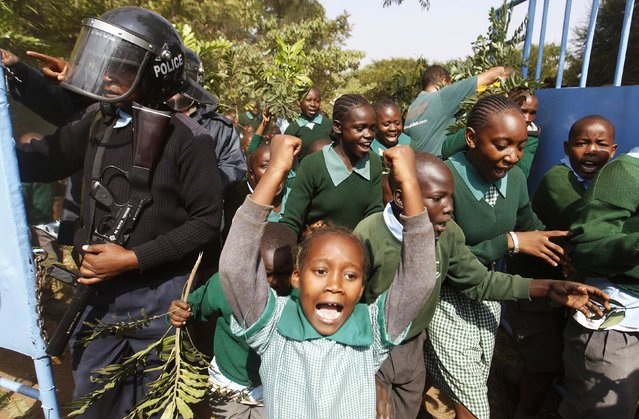
Students from Langata primary school run past riot police as they protest against a perimeter wall illegally erected by a private developer around their school playground in Kenya's capital Nairobi January 19, 2015. (Photo by Thomas Mukoya/Reuters)

Students from Langata primary school run past riot police as they protest against a perimeter wall illegally erected by a private developer around their school playground in Kenya's capital Nairobi January 19, 2015. Riot police used teargas to disperse students at a school in Nairobi as the children protested against the potential loss of their playground. The playground was fenced off in December, during the school holidays, by a prominent developer who also claims ownership of the land. The title to the contested site is said to be in the name of Airport View Housing Limited, according to local media, with plans to use the space to build a parking lot for a hotel. (Photo by Thomas Mukoya/Reuters)
Details
20 Jan 2015 13:04:00
The spinning vortex of Saturn's north polar storm resembles a deep red rose of giant proportions surrounded by green foliage in this false-color image from NASA's Cassini spacecraft. (Photo by NASA/JPL-Caltech/SSI)

NASA's Cassini spacecraft has provided scientists the first close-up, visible-light views of a behemoth hurricane swirling around Saturn's north pole. In high-resolution pictures and video, scientists see the hurricane's eye is about 1,250 miles (2,000 kilometers) wide, 20 times larger than the average hurricane eye on Earth. Thin, bright clouds at the outer edge of the hurricane are traveling 330 mph(150 meters per second). The hurricane swirls inside a large, mysterious, six-sided weather pattern known as the hexagon. Photo: The spinning vortex of Saturn's north polar storm resembles a deep red rose of giant proportions surrounded by green foliage in this false-color image from NASA's Cassini spacecraft. (Photo by NASA/JPL-Caltech/SSI)
Details
31 May 2015 09:11:00
The Dark Side of Sochi Olympics by Vasily Slonov

“Exactly one year before the long awaited Sochi Olympics, Vladimir Putin went to Sochi personally to see how the construction is going. After receiving a report saying the ski jumps that were supposed to be ready in 2011, are not completed still, while their price has sky-rocketed from 1.2 billion to 8 billion roubles, he commented, “Good for you. Good job”, and then fired the vice president of the Olympic committee. Russian artist Vasily Slonov painted his view of the upcoming games, giving a new interpretation to the adored Russian mascot Cheburashka, and combining officially endorsed stereotypes of Russia with grimmer and less accepted ones”. – Ruskie.info. (Photo by Vasily Slonov)
Details
07 Jun 2013 10:24:00
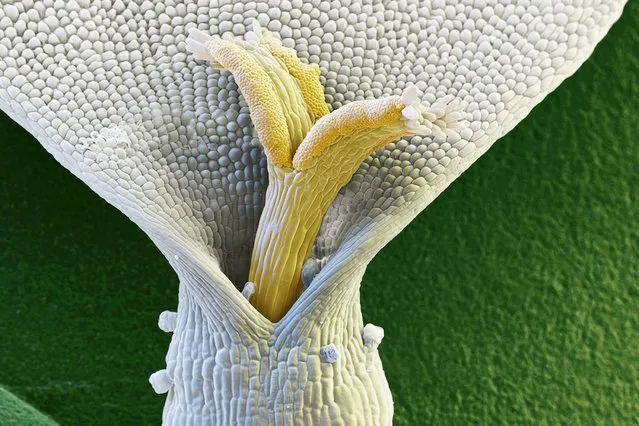
The floret of a Chamomile flower up close and personal. (Photo by Oliver Meckes/Barcroft Media)

These images have been created using a colour scanning electron microscope (SEM) by the award-winning Eye of Science, comprised of snapper Oliver Meckes and biologist Nicole Ottawa. For a decade the pair, based in Reutlingen in the south of Germany, worked with an old SEM they saved from the scrapheap, but for the last five years they have used a £250,000 FEI Quanta Series Field Emission SEM. Oliver said: “Flowers are beautiful in 'normal' view, but when you look closer, some parts get very bizarre and unexpected structures appear – flowers within flowers, worlds within worlds”. Photo: The floret of a Chamomile flower up close and personal. (Photo by Oliver Meckes/Barcroft Media)
Details
26 May 2014 13:51:00
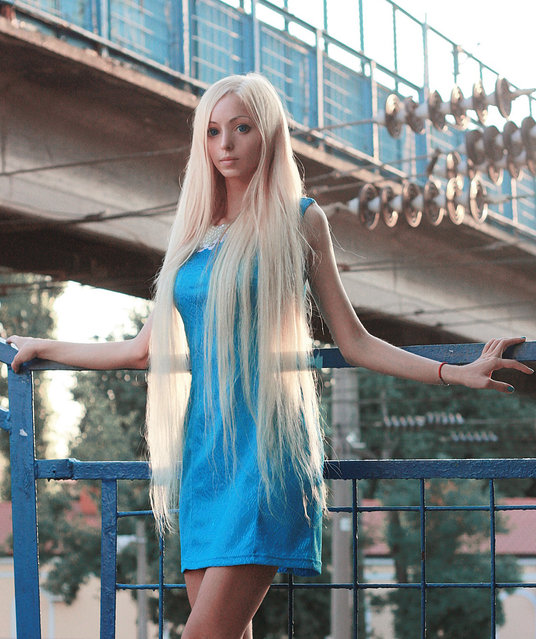
Real life doll Alina Kovalevskaya poses for a photograph on May 29, 2014 in Odessa, Ukraine. Alina Kovalevskaya is a walking, talking, breathing living doll on the lookout for her real-life Ken. (Photo by Aleksey Solodunov/Barcroft Media)

Real life doll Alina Kovalevskaya poses for a photograph on May 29, 2014 in Odessa, Ukraine. Alina Kovalevskaya is a walking, talking, breathing living doll on the lookout for her real-life Ken. The 21-year-old is from Odessa, Ukraine – the same city as real-life Barbie Valeria Lukyanova, who has made headlines around the world for her unique look and controversial opinions. The pair were friends, but their relationship has since soured. Alina has made a splash online, with her YouTube videos showing off her doll-like charms attracting hundreds of thousands of views. (Photo by Aleksey Solodunov/Barcroft Media)
Details
13 Jul 2014 11:14:00
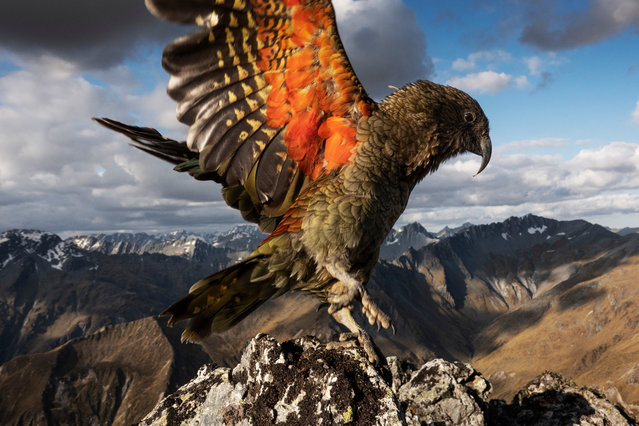
The endangered kea is the world’s only alpine parrot, and one of the most intelligent birds. They show no fear of humans and are thieves and pranksters. The parrot is seen in the Whakaari conservation area, near Glen Orchy in the Otago region of New Zealand, a place where historic huts and mining relics are surrounded by stunning mountains covered in tussock. (Photo by Murdo MacLeod/The Guardian)

The endangered kea is the world’s only alpine parrot, and one of the most intelligent birds. They show no fear of humans and are thieves and pranksters. The parrot is seen in the Whakaari conservation area, near Glen Orchy in the Otago region of New Zealand, a place where historic huts and mining relics are surrounded by stunning mountains covered in tussock. (Photo by Murdo MacLeod/The Guardian)
Details
15 Jun 2020 00:05:00


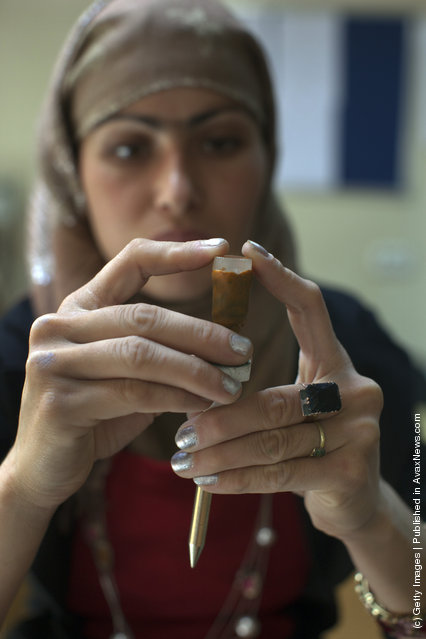
Student, Shoukria positions a stone for cutting at the Turquoise Mountain Gem cutting class on May 18, 2011, in Kabul, Afghanistan. The mineral resources of Afghanistan are relatively unexplored even with Afghanistan's mineral wealth of coal, copper, gold and iron ore, with precious and semiprecious stones, including high-quality emerald, lapis lazuli, red garnet and ruby. Given the country's remote and rugged terrain, on-going instability plus an inadequate infrastructure and transportation means that mining is still difficult. While many are trying to bring positive changes, Afghanistan's mining industry uses unregulated, primitive methods and outdated equipment. (Photo by Paula Bronstein/Getty Images)
Details
22 May 2011 09:11:00