Loading...
Done
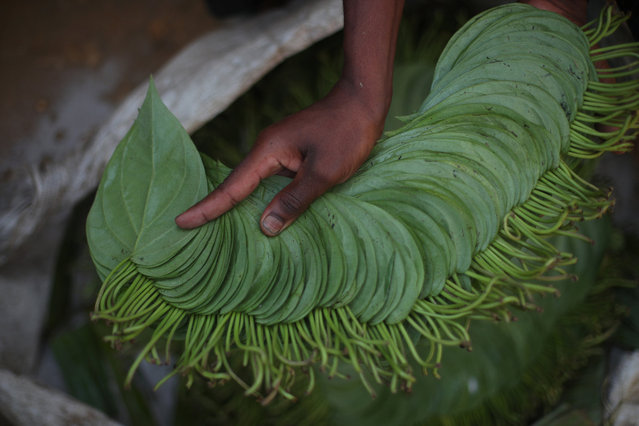
Faruk, 17, a Rohingya refugee trader holds betel leaves which are on sale at a stall in Palong Khali refugee camp near Cox's Bazar, Bangladesh, November 3, 2017. He left his village in Myanmar when the military opened fire towards the Rohingya. “I buy this betel leaf from Palong Khali market, in one bundle there are 160 pieces, I buy it for 80 taka and I sell it for 100 taka. Bangladeshi's and I sell for the same rate in the camp. Outside in the local market it is 80 taka per bundle. My problem is that I don't have money so I can't buy anything to eat, I can't buy fish to eat”, he said. (Photo by Hannah McKay/Reuters)

Faruk, 17, a Rohingya refugee trader holds betel leaves which are on sale at a stall in Palong Khali refugee camp near Cox's Bazar, Bangladesh, November 3, 2017. He left his village in Myanmar when the military opened fire towards the Rohingya. “I buy this betel leaf from Palong Khali market, in one bundle there are 160 pieces, I buy it for 80 taka and I sell it for 100 taka (1 Bangladeshi Taka = 0.012 US Dollar). Bangladeshi's and I sell for the same rate in the camp. Outside in the local market it is 80 taka per bundle. My problem is that I don't have money so I can't buy anything to eat, I can't buy fish to eat”, he said. (Photo by Hannah McKay/Reuters)
Details
27 Nov 2017 08:54:00
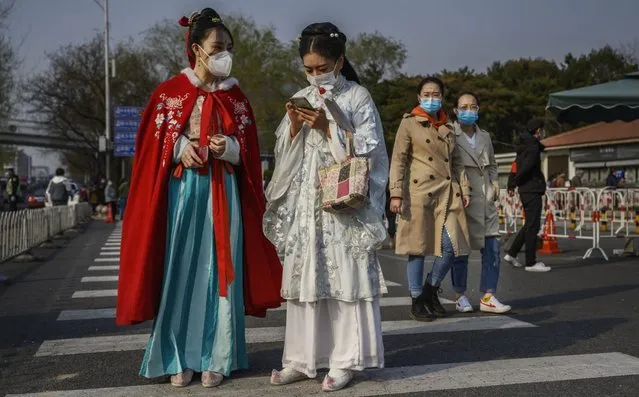
Chinese women wear protective masks as they are dressed in traditional clothing from the Qing Dynasty era outside a park on March 29, 2020 in Beijing, China. A limited section of the iconic tourist site was re-opened to the public this week allowing a smaller number of visitors to reserve tickets online in advance and to enter after passing health screening. With the pandemic hitting hard across the world, China recorded its first day with no new domestic cases of the coronavirus last week, since the government imposed sweeping measures to keep the disease from spreading. For two months, millions of people across China have been restricted in how they move from their homes, while other cities have been locked down in ways that appeared severe at the time but are now being replicated in other countries trying to contain the virus. Officials believe the worst appears to be over in China, though there are concerns of another wave of infections as the government attempts to reboot the worlds second largest economy. In Beijing, it is mandatory to wear masks outdoors, retail stores operate on reduced hours, restaurants employ social distancing among patrons, and tourist attractions at risk of drawing large crowds remain closed. Monitoring and enforcement of virus-related measures and the quarantine of anyone arriving to Beijing is carried out by neighborhood committees and a network of Communist Party volunteers who wear red arm bands. A primary concern for Chinese authorities remains the arrival of flights from Europe and elsewhere, given the exposure of passengers in regions now regarded as hotbeds for transmission. Since January, China has recorded more than 81,000 cases of COVID-19 and at least 3200 deaths, mostly in and around the city of Wuhan, in central Hubei province, where the outbreak first started. (Photo by Kevin Frayer/Getty Images)

Chinese women wear protective masks as they are dressed in traditional clothing from the Qing Dynasty era outside a park on March 29, 2020 in Beijing, China. A limited section of the iconic tourist site was re-opened to the public this week allowing a smaller number of visitors to reserve tickets online in advance and to enter after passing health screening. (Photo by Kevin Frayer/Getty Images)
Details
01 Apr 2020 00:05:00
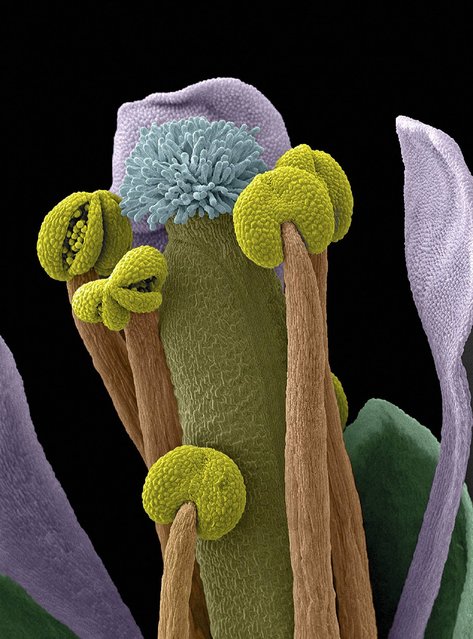
Scanning electron micrograph (SEM) of an Arabidopsis thaliana flower, also commonly known as thale cress. Some of the anthers are open, revealing pollen grains ready for dispersal. Arabidopsis was the first plant to have its entire genome sequenced and is widely used as a model organism in molecular and plant biology. Horizontal width of image is 1200 microns. Magnification 100x. (Photo by Stefan Eberhard/Wellcome Images)

Beautiful, strange and occasionally alarming pictures from the shortlist for this year’s Wellcome image awards – which celebrate the very best in science photography and imaging – from an x-ray of a bat to a micrograph of a kidney stone. The exhibition opens on 12 March at three science centres and the Museum of Science and Industry in Manchester. Photo: Scanning electron micrograph (SEM) of an Arabidopsis thaliana flower, also commonly known as thale cress. Some of the anthers are open, revealing pollen grains ready for dispersal. Arabidopsis was the first plant to have its entire genome sequenced and is widely used as a model organism in molecular and plant biology. Horizontal width of image is 1200 microns. Magnification 100x. (Photo by Stefan Eberhard/Wellcome Images)
Details
11 Mar 2014 05:58:00
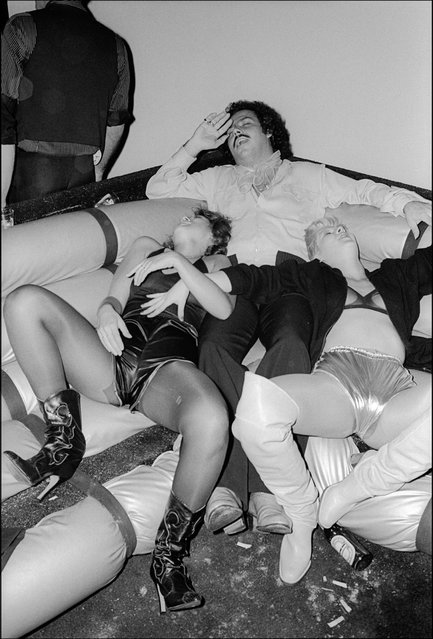
At Studio 54, an unidentified trio of two woman and one man recline on a banquette, miming unconsciousness, New York, New York, September 29, 1977. (Photo by Allan Tannenbaum/Getty Images)

At Studio 54, an unidentified trio of two woman and one man recline on a banquette, miming unconsciousness, New York, New York, September 29, 1977. (Photo by Allan Tannenbaum/Getty Images)
Details
23 Aug 2017 08:35:00
Papier-mache sculptures, also known as “ninots”, burn during the “Nit de la Crema” (Fire Night) of the Fallas Festival in Valencia, eastern Spain, 19 March 2024. Fallas is a fortnight-long fiesta in which installations of parodic papier-mache, cardboard, and wooden sculptures are traditionally burnt every year on the last day of the event in the so-called “Crema” to end the festivities. (Photo by Biel Alino/EPA/EFE)

Papier-mache sculptures, also known as “ninots”, burn during the “Nit de la Crema” (Fire Night) of the Fallas Festival in Valencia, eastern Spain, 19 March 2024. Fallas is a fortnight-long fiesta in which installations of parodic papier-mache, cardboard, and wooden sculptures are traditionally burnt every year on the last day of the event in the so-called “Crema” to end the festivities. (Photo by Biel Alino/EPA/EFE)
Details
29 Apr 2024 05:27:00
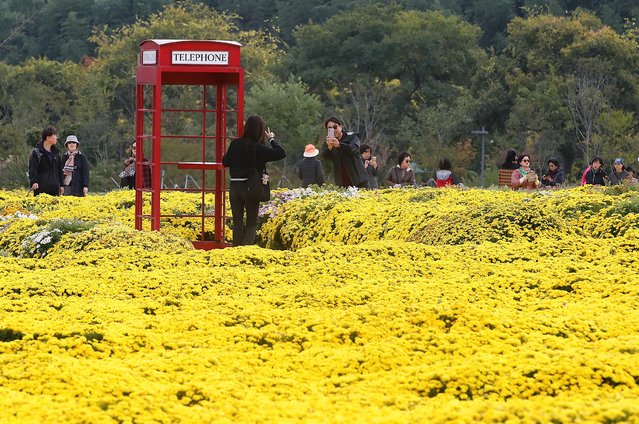
On October 31st, 2025, when the weather was in full autumn, citizens visiting the Taehwagang National Garden Chrysanthemum Garden in Nam-gu, Ulsan, are making memories among the chrysanthemums turning yellow. (Photo by Kim Dong-hwan)

On October 31st, 2025, when the weather was in full autumn, citizens visiting the Taehwagang National Garden Chrysanthemum Garden in Nam-gu, Ulsan, are making memories among the chrysanthemums turning yellow. (Photo by Kim Dong-hwan)
Details
19 Nov 2025 05:04:00
“Basunga”. Basunga (3 weeks-old newborn with albinism) is happily sleeping with his cousin. For now, he does not yet realize the difficulties he will face to integrate into the Congolese society as a PWA. The success of his integration will greatly depends of how he accepts himself and his skin condition a and how educated he will be. Photo location: Kinshasa, Congo RDC. (Photo and caption by Patricia Willocq/National Geographic Photo Contest)

“Basunga”. Basunga (3 weeks-old newborn with albinism) is happily sleeping with his cousin. For now, he does not yet realize the difficulties he will face to integrate into the Congolese society as a PWA. The success of his integration will greatly depends of how he accepts himself and his skin condition a and how educated he will be. Photo location: Kinshasa, Congo RDC. (Photo and caption by Patricia Willocq/National Geographic Photo Contest)
Details
09 Dec 2013 06:38:00
A person stands on a car while looking at Auroras, caused by a coronal mass ejection on the Sun, that illuminate the skies in the southwestern Siberian Omsk region, Russia on November 6, 2023. (Photo by Alexey Malgavko/Reuters)

A person stands on a car while looking at Auroras, caused by a coronal mass ejection on the Sun, that illuminate the skies in the southwestern Siberian Omsk region, Russia on November 6, 2023. (Photo by Alexey Malgavko/Reuters)
Details
20 Nov 2023 04:55:00